
The car keys jingle. Your puppy — who was happily chewing a toy two seconds ago — freezes, then bolts behind the couch. Getting them near the car takes ten minutes; getting them in takes twenty. And the whole ride is panting, drooling, and trembling.
If your puppy is scared of car rides, here’s the reframe that changes everything: it’s fear, not stubbornness. Your puppy isn’t being difficult — they’re overwhelmed by noise, motion, and associations they can’t explain. And fear can be fixed. In this guide, you’ll learn the 6-step confidence plan trainers use to desensitize puppies to car rides, the mistakes that set you back, and how to tell fear apart from motion sickness.
Here’s why this matters more than convenience: a puppy who fears the car misses out on socialization, training classes, vet care without trauma, and half the adventures of dog ownership. Fixing car fear isn’t about road trips — it’s about unlocking your puppy’s whole world. And the younger you start, the faster it works.
Why Puppies Fear Cars (It’s Not What You Think)
Cars are objectively terrifying from a puppy’s perspective. The engine roars to life with no warning. The ground moves. The world blurs past the windows. Strange vibrations hum through their paws. And here’s the kicker: for many puppies, the car has only ever gone one place — the vet. Of course they’re scared; the car is a loud shaking box that delivers them to the scary place.
Four root causes, and most fearful puppies have a mix:
- Motion sickness — real nausea, especially in puppies under 6 months whose balance systems are still developing. Rule this out first (more below).
- Noise sensitivity — often it’s not the car, it’s the engine. The sudden roar is the trigger.
- Bad associations — vet-only rides teach “car = bad news.”
- Sheer newness — everything about cars is novel, and novelty plus no control equals fear. This is the same mechanism behind puppy fear periods, where familiar things suddenly seem scary.
Understanding the cause matters because each one has a different fix. Nausea needs a vet conversation; noise needs desensitization; associations need rewriting. The plan below handles all of them.
The 6-Step Confidence Plan
The golden rule of the whole plan: never push past the puppy’s comfort threshold. Every step should feel boringly easy before you move to the next. Rushing is the #1 reason desensitization fails — a single terrifying experience can undo a week of progress. Slow is fast here.
Step 1: The Parked Car Becomes a Treat Dispenser
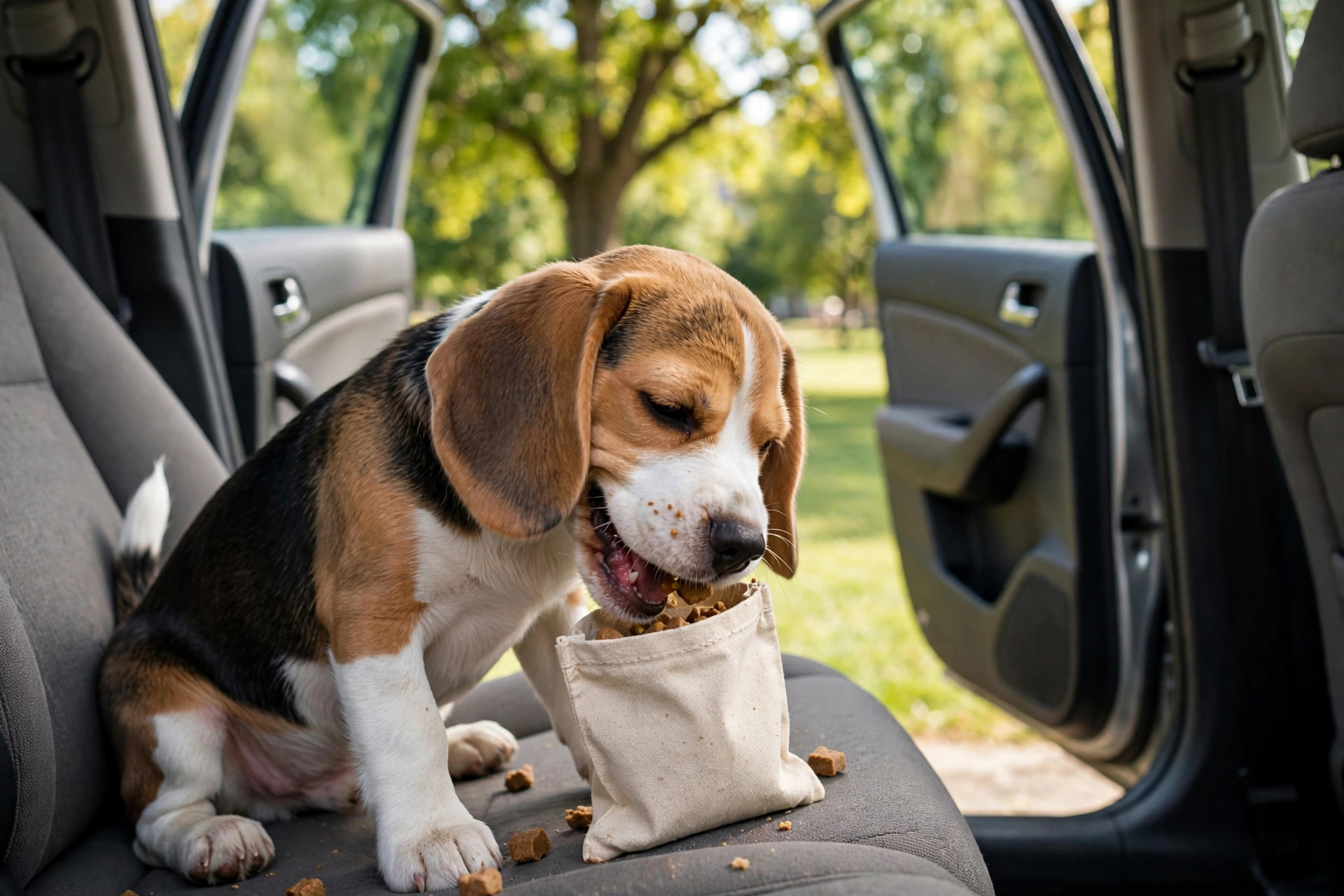
For the first few days, the car doesn’t move. It doesn’t even turn on. It just sits in the driveway being the most wonderful place on earth. Feed meals in the car (doors open). Play favorite games in the back seat. Scatter high-value treats — cheese, chicken, the good stuff — for the puppy to discover inside. Let the puppy explore at their own pace, in and out freely, with zero pressure.
The goal: the puppy starts dragging you toward the car. That shift — from avoidance to enthusiasm — is the foundation everything else builds on. Don’t skip it, don’t rush it. Most puppies need 3–5 sessions here.
Pro tip for this stage: use only-in-the-car treats — something the puppy never gets anywhere else. Novelty supercharges the association. If chicken appears exclusively inside the parked car, the car becomes the only place in the universe where chicken exists. That’s powerful motivation, and it costs you nothing extra.
Step 2: Desensitize the Engine Noise
Here’s the step most guides skip, and it’s often the whole ballgame. Start the engine while the puppy is at a distance — far enough that they notice but don’t panic — and feed treats. Over sessions, decrease the distance: across the yard, then near the car, then beside the car with doors open, then inside with doors open, then doors closed. Each stage gets treats until the engine sound predicts good things.
Watch the body language like a hawk: ears forward and eating happily means you’re at the right level; freezing, lip-licking, or refusing treats means you jumped too far — go back a stage. This is the same gradual-exposure principle behind good puppy socialization: new experiences one at a time, always at a winnable level.
Step 3: First Trips — Driveway, Then Around the Block
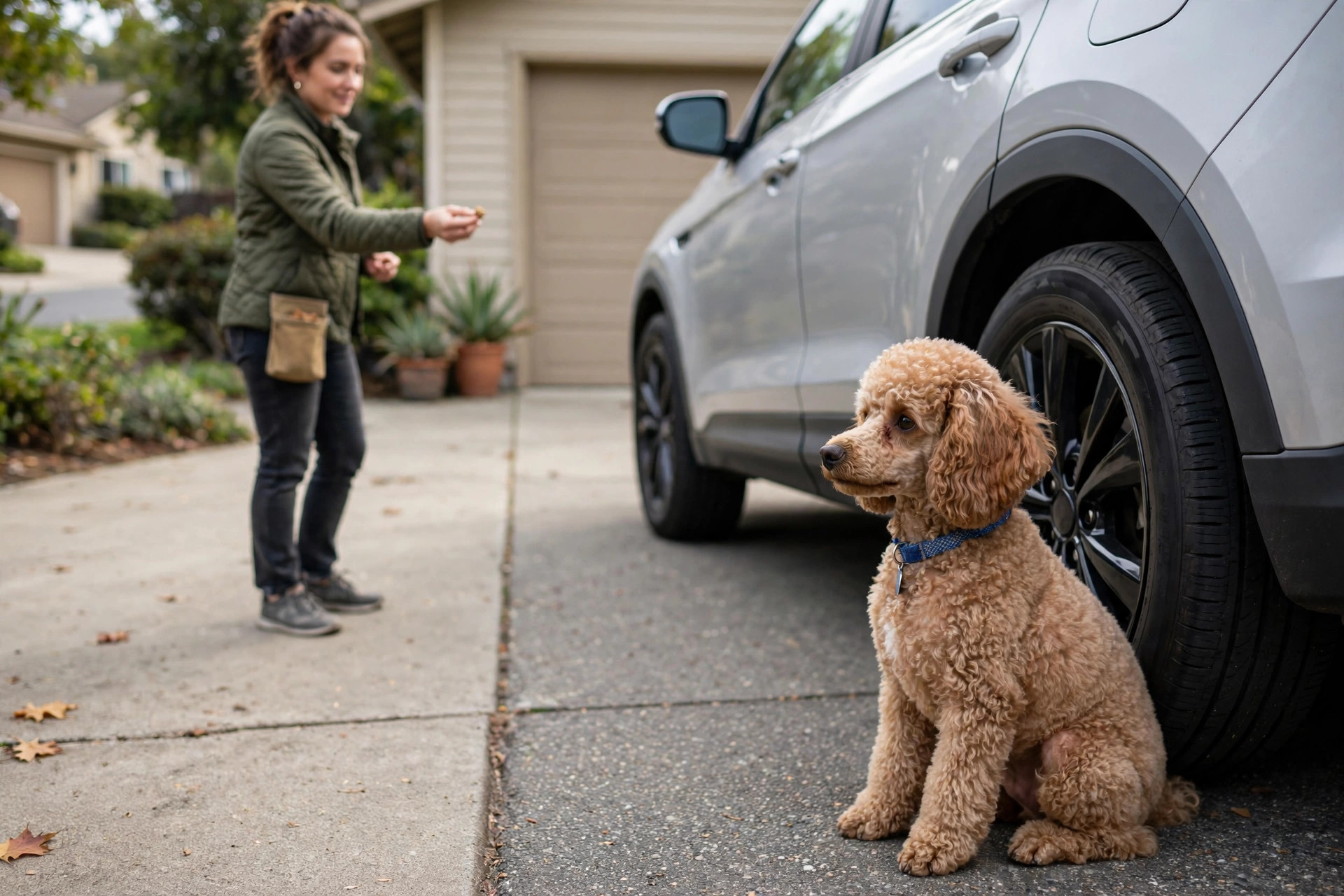
The first “trip” is barely a trip: engine on, roll to the end of the driveway, treats, engine off, done. Celebrate like it’s a championship. Next session: around the block. Then two blocks. Lengthen gradually over days, always ending while the puppy is still comfortable. If the puppy panics at any point, you’ve gone too far too fast — drop back to the last comfortable distance for a few sessions.
Keep early trips under 5 minutes. The goal isn’t distance; it’s a history of uneventful rides. Ten boring 3-minute trips beat one terrifying 30-minute trip every time.
Step 4: Fun Destinations Only (For a While)
This is the association-rewriter. For the next few weeks, the car goes only to wonderful places: the park, a friend’s house, the pet store for a treat, a favorite walking trail. No vet, no groomer, no boarding. You’re systematically replacing “car = scary place” with “car = adventure machine.”
Once the puppy loves car rides, you can reintroduce the vet — but even then, mix in fun trips regularly. The ratio matters: if 9 out of 10 rides are fun, the 1 vet trip doesn’t poison the pattern. This same confidence-building approach works for other fears too — see our guide on helping a puppy scared of other dogs.
Step 5: Set Up Comfort and Safety
The physical setup matters more than people think. A puppy sliding around the back seat is a puppy who can’t relax. Options: a secured crate (many puppies find the den-like enclosure calming — see our crate training guide), a crash-tested harness with a seatbelt attachment, or a back-seat hammock. Add a familiar blanket that smells like home.
Pre-ride routine helps too: a good walk before the trip burns off nervous energy, and a settle cue gives the puppy a job (“lie down and relax”) instead of panicking. Calming aids (Adaptil, snug-fitting anxiety wraps) are reasonable bonuses — not solutions, but they can take the edge off while training does the real work.
Temperature and airflow matter more than you’d expect: a stuffy, hot car amplifies anxiety fast. Crack windows for fresh air (not enough for the puppy to stick their head out — that’s dangerous), keep the car cool, and avoid strong air fresheners. A calm sensory environment gives the training the best chance to work.
Step 6: Keep the Rhythm — Consistency Is the Secret
Here’s the retention reality most articles skip: 2–3 car trips per week minimum, even after the puppy seems fine. Long gaps let the fear creep back — confidence is maintained, not permanently installed. This doesn’t mean long trips; a quick drive for ice cream (pup cup!) counts. The point is keeping the “car = good” association fresh.
Think of it like any training: the behavior you stop rehearsing fades. A monthly fun ride keeps the whole system working for years.
5 Mistakes That Set You Back
- 1. Rushing the rungs. Skipping from “parked car” to “30-minute drive” in one day. Every rushed step risks a fear spike that undoes a week of work.
- 2. Punishing fear. Yelling at, scolding, or forcing a trembling puppy. Fear isn’t disobedience — punishing it teaches the puppy that the car and you are scary.
- 3. The first trip is too long. A 45-minute maiden voyage to grandma’s. Start with minutes, not miles.
- 4. Vet-only rides. If every car trip ends at the vet, the car becomes the vet’s waiting room on wheels. Mix in fun destinations from the start.
- 5. Skipping consistency. Three great weeks, then no car trips for two months, then surprise — the fear is back. Maintenance matters.
Motion Sickness vs. Fear — Rule This Out First
Before assuming fear, check for nausea. Signs pointing to motion sickness: drooling that starts only once the car moves (not when it’s parked with the engine on), vomiting, lip-smacking, and a puppy who’s fine near the car but miserable once it rolls. Puppies under 6 months are especially prone — their vestibular (balance) systems are still maturing, and most outgrow it.
If it looks like sickness: talk to your vet before the next long trip. There are safe anti-nausea options for puppies, and a vet can confirm whether it’s motion sickness, anxiety, or both (they often travel together). Don’t try to desensitize through genuine nausea — that’s like exposure therapy for seasickness. Fix the stomach first, then train the brain.
Frequently Asked Questions
How long until my puppy is comfortable with car rides?
Most puppies show real progress in 2–4 weeks of consistent work (2–3 short sessions per week). Severe fear or motion sickness can take 2–3 months. There’s no deadline — only the standard: is the puppy relaxed?
Is anxiety medication okay for car fear?
For severe cases, yes — talk to your vet. Medication isn’t cheating; it’s a tool that lowers panic enough for training to work. It’s usually temporary, paired with the desensitization plan.
Crate or seatbelt harness — which is better?
Both are safe when used correctly. Crates suit puppies who find enclosed spaces calming; harnesses suit puppies who want to see out. Never let a puppy ride loose — it’s dangerous for everyone in a sudden stop.
My puppy vomits in the car. Sickness or fear?
Vomiting once the car is moving points to motion sickness; drooling/panting/trembling while parked points to fear. Many puppies have both. Vet first for the nausea, then desensitize the fear.
My puppy is only scared of the engine, not the car. Normal?
Completely — and it’s actually good news, because noise desensitization (Step 2) is the most straightforward part of the plan. You’re closer than you think.
Does this work the same for adult dogs?
The principles are identical, but adult fears are more entrenched — expect the timeline to roughly double. The plan still works; it just needs more patience.
The Bottom Line
A puppy scared of car rides isn’t giving you a hard time — they’re having a hard time. And the fix isn’t force, it’s architecture: treat dispenser first, engine noise second, short trips third, fun destinations always.
Build it patiently, and one day you’ll jingle the keys and watch your puppy sprint for the car door — because the car finally means what it should: adventure with their favorite person.
Related Reads
- Puppy Fear Periods: What Every Owner Should Know
- Why Is My Puppy Scared of Other Dogs? (6 Steps to Confidence)
- How to Teach a Puppy to Settle on a Mat (7-Step Calm Method)

