
Picture this: you’re enjoying a peaceful walk when a stranger appears down the sidewalk — and your sweet little puppy suddenly turns into a tiny alarm system. Barking, lunging, hackles up. Passersby give you that look, and you feel your face go red.
Here’s the reassuring truth: barking at strangers is one of the most common puppy behaviors in the world, and it almost never means your puppy is “aggressive” or “bad.” It means your puppy is unsure — and unsure puppies bark. It’s their way of saying, “I’m not comfortable, please keep your distance.”
The good news? This is one of the most fixable behaviors in puppyhood. In this guide, you’ll learn exactly why your puppy barks at strangers, a proven 7-step method to build calm confidence, the 5 mistakes that make barking worse (most owners accidentally do #1), and how to handle the trickiest real-world situations.
Why Do Puppies Bark at Strangers?
Barking is communication, not defiance. When your puppy barks at a stranger, they’re responding to one (or more) of these very normal triggers:
- Fear and uncertainty. This is the #1 reason. Puppies go through developmental fear periods (roughly 8–11 weeks and again around 6–14 months) when unfamiliar people, objects, and sounds feel genuinely scary. A puppy who never met a person in a hat, with a beard, or using a cane may bark simply because the silhouette is new.
- Territorial instinct. Even young puppies can feel protective of “their” home, yard, or car. Barking at the mail carrier or a guest at the door is often a puppy guarding their space — an instinct that was useful for thousands of years.
- Overexcitement. Some puppies bark because they’re thrilled, not scared. The wiggly body, wagging tail, and play-bows give it away: “A NEW FRIEND! I MUST SAY HI RIGHT NOW!”
- Under-socialization. Puppies who met few different people during their critical socialization window (3–16 weeks) are more likely to treat every unfamiliar human as suspicious. This is why proper early socialization matters so much — though it’s never too late to start.
- Learned behavior. Here’s an uncomfortable truth: barking often works. The stranger walks away, the scary person leaves the house, the mail carrier departs. Your puppy’s brain files that under “barking = problem solved” and repeats it with enthusiasm.
- Breed tendencies. Some breeds are simply more vocal and watchful — terriers, herding breeds, and guardian breeds were literally bred to notice and announce. That’s genetics, not a training failure.
Notice what these have in common: none of them mean your puppy is broken. They’re all variations of a young dog trying to cope with a big, confusing human world.
Is It Normal? When Should You Worry?
For most puppies, stranger-directed barking is completely normal and peaks between 4 and 10 months. It typically improves a lot with consistent training and maturity — many puppies grow significantly calmer by 12–18 months as their brain finishes developing.
That said, pay closer attention if you see these red flags:
- Barking that escalates to snapping, lunging with intent to bite, or biting
- A puppy who can’t recover — stays agitated for many minutes after the stranger is gone
- Fear so intense the puppy freezes, trembles uncontrollably, or tries to flee in panic
- Barking paired with a hard stare, stiff body, and raised hackles that doesn’t soften with distance
If any of those sound familiar, skip the DIY route and consult a certified professional dog trainer or veterinary behaviorist. There’s no shame in it — some cases genuinely need expert eyes. For everyone else, the 7-step method below is exactly what trainers use.
The 7-Step Calm-Down Method
The core principle is simple: change how your puppy feels about strangers, and the barking takes care of itself. You can’t punish fear away — but you can teach your puppy that strangers predict wonderful things, and that calm behavior earns rewards. Work through these steps in order, and don’t rush: most puppies show real improvement within 2–4 weeks.
Step 1: Manage First, Train Second
Before training a single thing, stop rehearsing the problem. Every time your puppy practices frantic barking, the habit gets stronger. Management buys you a clean slate:
- Control the distance. Barking has a trigger radius — find the distance where your puppy notices strangers but can still think (no barking, takes treats). That’s your training zone.
- Block the view at home. If your puppy barks at passersby through the window, close the curtains or use frosted window film for a few weeks. Out of sight really does mean out of mind.
- Skip the dog park rush hour. Crowded, chaotic environments flood a reactive puppy. Choose quieter walking times and routes while you train.
- Use a secure leash setup. A well-fitted harness (never a choke or prong collar — pain makes fear worse) and a standard 6-foot leash. No retractable leashes; they teach pulling and give you zero control.
Goal: fewer barking episodes per day, starting immediately. Management isn’t cheating — it’s what every professional trainer does first.
Step 2: Teach “Look at Me” (Your Emergency Brake)
You need a way to redirect your puppy’s attention before the barking starts. “Look at me” is that tool, and it’s delightfully simple to teach indoors first:
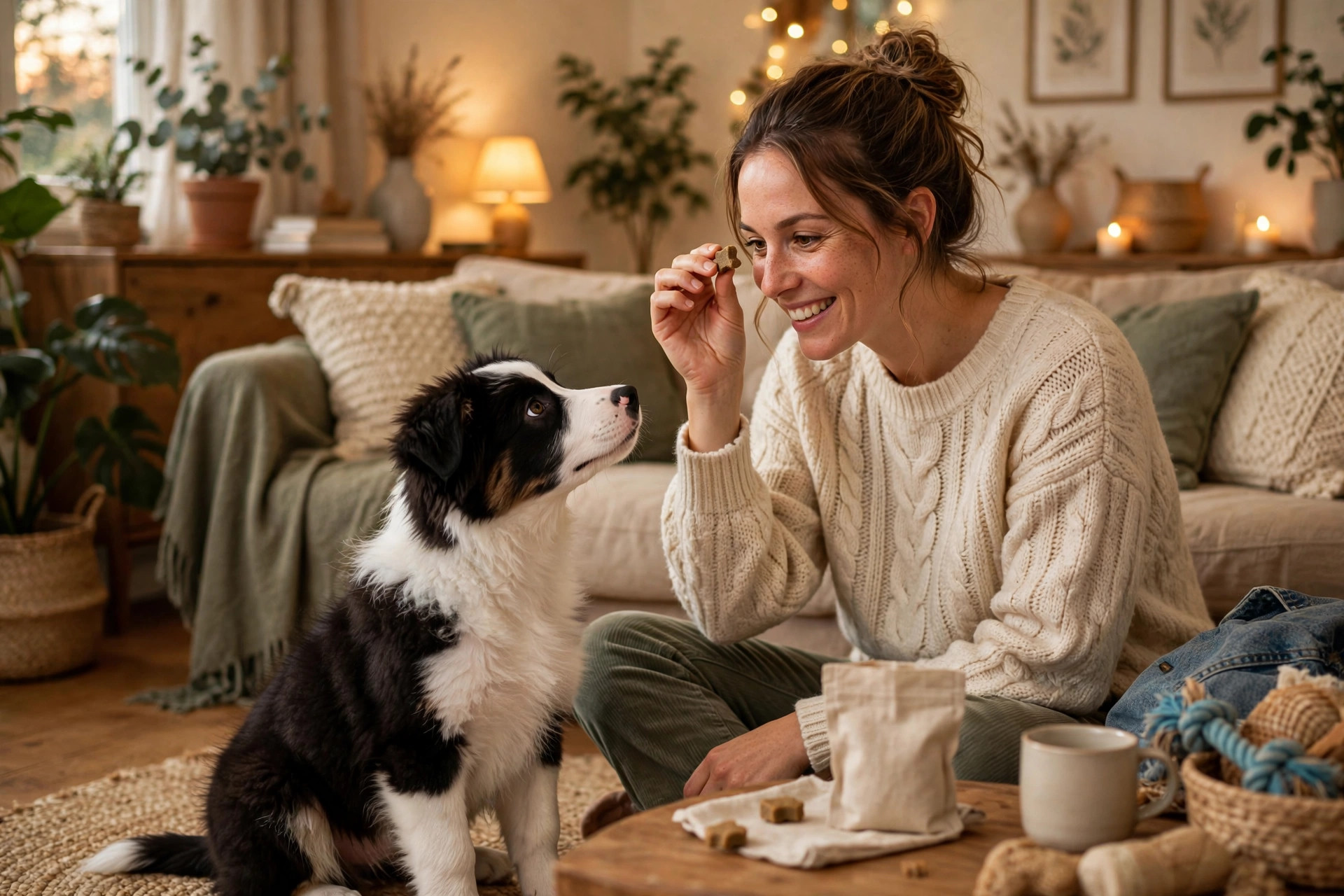
- Hold a treat near your eyes. The moment your puppy glances at your face: “Yes!” and treat.
- Repeat 10–15 times. Then try just the words “look at me” — reward any eye contact.
- Practice in every room, then the backyard, then on quiet streets. Build the habit where it’s easy before you need it where it’s hard.
Goal: your puppy whips their head toward you on cue, even with mild distractions around. This becomes your redirect when a stranger appears at a distance.
Step 3: The “Stranger = Treats” Game (Counter-Conditioning)
This is the heart of the whole method. You’re going to rewire your puppy’s emotional response so that the sight of a stranger predicts amazing treats — not a scary confrontation.
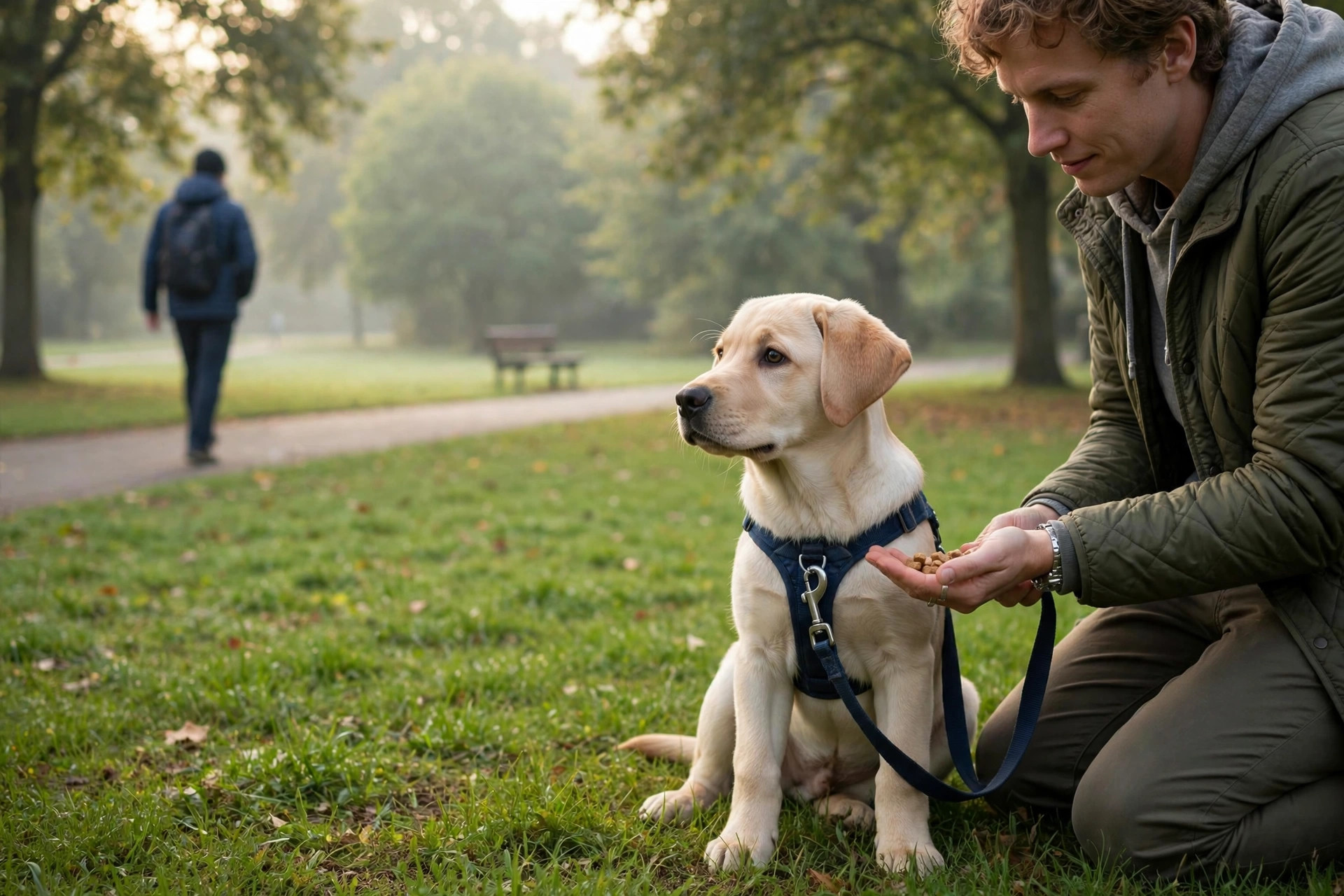
- Find your puppy’s training zone (Step 1): a stranger is visible but your puppy is still under threshold — noticing, not barking.
- The instant your puppy spots the stranger, start feeding tiny high-value treats (chicken, cheese — the good stuff), one after another.
- When the stranger disappears from view, treats stop. Stranger appears → treat shower. Stranger gone → treats gone.
- Keep sessions short: 5 minutes, a few times a day. End while your puppy is still happy.
After a week or two of this, something magical happens: your puppy sees a stranger and looks at you expectantly instead of barking. That’s the new association clicking into place: strangers predict chicken. This same principle works wonders for puppies who are scared of other dogs too — fear of unfamiliar people and fear of unfamiliar dogs often travel together.
Goal: your puppy’s first reaction to a distant stranger becomes “where’s my treat?” instead of “WOOF WOOF WOOF.”
Step 4: Reward Calm Choices (Teach an Off Switch)
While counter-conditioning changes feelings, you also want to reward the behavior you like. Anytime your puppy notices a stranger and chooses calm — a glance then looking away, a soft body, a sigh, sitting down — mark it: “Yes!” and treat.
You’re building a reinforcement history for calmness. Puppies repeat what pays. If barking historically paid (stranger left) and now calmness pays better (chicken appears), the economics of your puppy’s brain shift decisively toward calm.
Goal: a growing menu of calm behaviors your puppy offers voluntarily around strangers.
Step 5: Practice With Helper Strangers
Once your puppy is solid at a distance, it’s time for controlled closer encounters. Recruit friends your puppy doesn’t know well:

- Have your helper appear at a distance, toss treats toward your puppy (not hand-feed — reaching hands scare nervous puppies), then leave.
- Over sessions, decrease the distance gradually. If barking returns, you moved too fast — add distance back. That’s not failure, it’s information.
- Helpers should ignore the puppy completely: no eye contact, no reaching, no “it’s okay, he doesn’t bite!” Let the puppy choose to approach. Choice builds confidence; forced greetings destroy it.
- Never lure your puppy toward a scary stranger with treats. That creates conflict: “I want the chicken but I’m terrified.” Let distance shrink on your puppy’s terms.
Goal: your puppy remains relaxed with a helper stranger at conversational distance.
Step 6: Teach “Quiet” as a Trained Cue
For barking that still slips through — especially alert barking at home — a trained “quiet” cue gives you an off switch:
- Wait for a bark (or engineer one with a doorbell sound). The moment there’s a pause — even half a second — say “quiet,” then “Yes!” and treat.
- Gradually require longer pauses before the reward. Your puppy learns: silence after barking is what earns the treat, not the barking itself.
- Important: never yell “quiet!” over barking. To your puppy, you’re just barking along with them. Calm, low voice — always.
Think of “quiet” as a complement to the emotional work, not a replacement. For the full deep-dive on nuisance barking of all kinds, see our guide on training a puppy not to bark excessively.
Goal: one calm “quiet” cue ends a barking episode within seconds.
Step 7: Proof It in the Real World
Training-zone success doesn’t automatically transfer to real life. Proof gradually:

- New locations: quiet park → busier park → pet store entrance → café patio. Each new place is a fresh test — bring treats and keep distances generous at first.
- New stranger types: people with hats, beards, uniforms, umbrellas, kids on scooters. Variety is the whole point — generalize the calm.
- Shorter distances over time. Let your puppy’s comfort set the pace. Two steps forward, one step back is still progress.
- Keep rewarding. Don’t retire the treats too early. Intermittent rewards maintain behavior for months while the new habit cements.
Goal: a puppy who notices strangers, stays relaxed, and looks to you — in the real world, not just the training zone.
5 Mistakes That Make Barking Worse
Most owners do at least one of these without realizing. Fixing them alone often cuts barking in half:
- 1. Yelling at the barking. The #1 mistake. Your puppy hears loud noise joining their loud noise and thinks you’re barking with them. The “threat” must be serious — even the human is alarm-barking!
- 2. Punishing fear. Leash jerks, spray bottles, or scolding a scared puppy doesn’t teach courage — it teaches that strangers predict pain and scary people. Fear + pain = more barking, or worse, a bite with no warning.
- 3. Flooding. Dragging your puppy into crowds “to get used to it” overwhelms them. Desensitization works at low intensity with gradual increases. Flooding often sensitizes instead — making fear worse.
- 4. Forcing greetings. “Go say hi!” while pushing your puppy toward a stranger (or letting strangers loom over and grab at them) teaches your puppy that people are inescapable. Let the puppy choose; choice is confidence.
- 5. Inconsistency. If barking sometimes works (the guest leaves, you retreat from the walk), it will persist. Everyone in the household needs the same plan: distance, treats for calm, no yelling.
Troubleshooting: When Progress Stalls
“My puppy barks at SOME strangers but not others.” Totally normal — puppies categorize by appearance. Men with beards, people in uniforms, kids: each is a separate category to desensitize. Work through them one at a time.
“He’s fine on walks but loses it at the front door.” Door barking is territorial + barrier frustration. Practice doorbell = treat party (ring the bell yourself, treat, repeat until the sound is boring), and manage with a baby gate so your puppy greets guests from a calm distance.
“She was improving, then suddenly got worse.” Welcome to the extinction burst — behavior often spikes right before it fades, like a toddler’s last big tantrum. Don’t change course; ride it out for a few days. Also check for a fear period or a scary incident that may have set things back.
“My puppy only barks at men / kids / people in hats.” That’s a socialization gap for that specific category. Recruit helpers matching the category and run Step 5 with them specifically.
“Nothing works — he barks at everyone, everywhere.” Revisit Step 1: you’re probably training too close to triggers. Double your distance for a week. And honestly assess: is your puppy getting enough sleep? An overtired puppy (under 18–20 hours of sleep a day) has zero impulse control.
Frequently Asked Questions
Will my puppy grow out of barking at strangers?
Often, partially — maturity helps a lot between 12–18 months. But barking that’s rehearsed daily becomes a habit, not just a phase. Training now means you get a calm adult instead of hoping for one.
Should I let strangers give my puppy treats?
Not at first. Have helpers toss treats toward your puppy rather than hand-feeding — reaching hands frighten nervous puppies. Hand-feeding comes later, only when your puppy happily approaches on their own.
Is it okay if my puppy barks once or twice and then stops?
Absolutely — that’s actually the goal for many owners. One or two alert barks (“hey, someone’s here!”) followed by settling is perfectly reasonable dog behavior. We’re fixing the nonstop frenzy, not eliminating communication.
My puppy barks at strangers on TV. Is that a problem?
It’s common and harmless — your puppy genuinely doesn’t understand screens yet. You can use it as free training: TV stranger appears → treats rain. Just keep the volume moderate.
Do bark collars work for stranger barking?
They suppress the symptom while often worsening the cause. A citronella or shock collar on a fear-barking puppy adds pain to fear — the barking may pause, but anxiety grows, and some dogs escalate to biting without the warning barks. Positive methods are both kinder and more effective long-term.
How long until I see results?
Most owners notice improvement within 2–4 weeks of consistent practice (short daily sessions). Full reliability around novel strangers typically takes 2–3 months. Puppies in an active fear period may need extra patience — keep sessions easy and short during those weeks.
The Bottom Line
Your puppy isn’t barking at strangers to ruin your walks or embarrass you. They’re barking because the human world is big, strange, and sometimes scary — and barking is the only tool they have. Your job isn’t to silence them; it’s to teach them the world is safe: manage the environment, pair strangers with wonderful things, reward every calm choice, and never punish fear.
Do that consistently, and the frantic alarm-barker gradually becomes the confident puppy who notices a stranger, glances at you, and carries on with their day. That’s not just a quieter dog — that’s a happier one.
Related Reads
- Why Is My Puppy Scared of Other Dogs? (6 Steps to Confidence)
- How to Socialize a Puppy Properly
- How to Train a Puppy Not to Bark Excessively

 and a 7-step trainer method to build calm confidence.)