
Many new rescue parents are surprised by how shut down their dog seems at first — hiding behind furniture, refusing food, avoiding eye contact. That behavior is completely normal, and the 3-3-3 rule rescue dog adopters talk about gives you a reassuring roadmap for it.
Here’s what every new rescue parent should know on day one: that behavior is completely normal, and there is a roadmap for it. The 3-3-3 rule is a simple guideline that rescue organizations use to explain what the first three days, three weeks, and three months with an adopted dog usually look like. It’s not a rigid schedule — every dog is different — but rescue organizations call it the single most reassuring framework for new rescue parents. It tells you what’s normal, what’s temporary, and when to ask for help.

A newly adopted rescue dog decompressing in her new home — hiding and hesitation are completely normal in the first few days.
Why This Happens: Your Rescue Dog’s Brain Is Overloaded
Think about what your rescue dog has been through. Shelters are loud, chaotic places full of unfamiliar smells, strange dogs, and constantly changing routines. Many rescues came from hoarding situations, the streets, or homes that didn’t work out. Then, suddenly, they’re in your living room — new sounds, new people, new rules, new everything.
When an animal experiences that much change at once, the stress response kicks in hard. Cortisol (the stress hormone) floods the system, and it can take weeks for those levels to fully return to normal. That’s why a dog who was “so sweet at the shelter” might shut down, hide, refuse food, or have accidents in your house. She’s not being difficult. She’s decompressing.
The 3-3-3 rule works because it mirrors this biological reality: roughly three days for initial decompression, three weeks to start learning the routine, and three months to truly feel at home. Understanding this timeline changes how you handle the early days — with patience instead of panic.
The 3-3-3 Rule Timeline

A small, quiet safe zone with an open crate gives your new rescue a place to decompress during the first 3 days.
Phase 1: The First 3 Days — Decompression
What to expect: Your dog may refuse to eat, hide in a corner or crate, pant or drool, avoid eye contact, or have accidents indoors. Some dogs do the opposite — they seem overly clingy or manic. Both are stress responses. Don’t read too much into either.
Step 1: Set Up a Small, Quiet Safe Zone
Pick one low-traffic room or a corner with her crate (door open), a soft bed, water, and a few toys — ideally before she arrives. This becomes her decompression den. For example, keeping a new rescue’s whole world to one quiet room — a laundry room with the door propped open works well — for the first 48 hours is exactly right. A new rescue doesn’t need the whole house on day one; a whole house is overwhelming.
Step 2: Keep the First 72 Hours Boring on Purpose
No welcome-home parties, no trips to the dog park, no introducing her to every friend and their dog. Skip the celebratory visitors. Quiet walks in low-traffic areas only, same feeding spot, same schedule. Predictability is what lowers stress fastest.
Step 3: Let Her Come to You
Sit on the floor near her safe zone, read a book, and toss high-value treats (tiny bits of chicken or cheese) near you — not directly at her. Don’t reach for her, don’t stare, don’t scoop her up for cuddles no matter how tempting. Dogs who are allowed to approach on their own terms usually bond faster than ones smothered with attention. Don’t be discouraged if it takes a day or two before your new dog sniffs your hand — that first sniff is worth the wait.
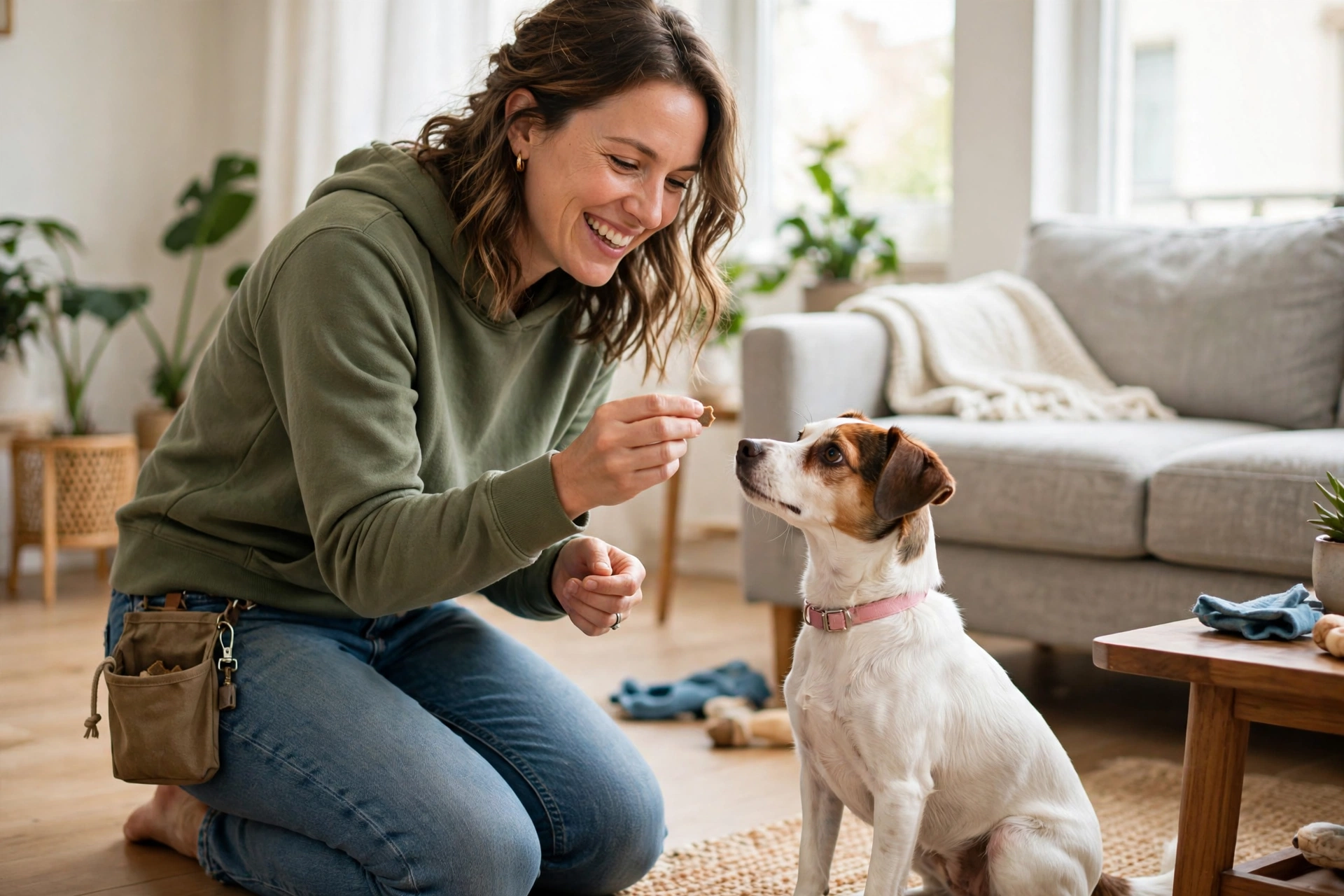
Keep training sessions to 3–5 minutes of positive reinforcement during the first 3 weeks.
Phase 2: The First 3 Weeks — Learning the Routine
What to expect: Around week two or three, your dog’s real personality starts surfacing — and this surprises people. The shutdown dog may suddenly get zoomies, start testing boundaries, or show behaviors (chewing, barking, counter-surfing) you hadn’t seen. This isn’t regression. This is your dog feeling safe enough to be herself.
Step 4: Build a Predictable Daily Routine
Feed, walk, play, and crate/rest at the same times every day. Dogs learn through patterns, and a reliable rhythm tells her nervous system the world is safe. Post the schedule on your fridge so everyone in the household follows it.
Step 5: Start Gentle Positive-Reinforcement Training
Keep sessions to 3–5 minutes, once or twice a day. Reward the behaviors you want — sitting calmly, checking in with you, settling on the bed — with treats and praise. Never punish accidents, chewing, or fear reactions; punishment during this phase teaches her that the new home is scary, which is the opposite of what you want.
Step 6: Introduce New Things Slowly, One at a Time
This is the window for carefully expanding her world — one new walking route, one calm visitor, one brief car ride. Watch her body language: a loose waggy body means “this is fine,” while tucked tail, yawning, lip-licking, or freezing means “too much, too fast.” Back off and try again later.
Step 7: Don’t Make Big Decisions Yet
This is not the time to decide she’s “not a good fit” because she’s chewing shoes or barking at the mail carrier. Many returns to shelters happen in weeks 2–4, right when the dog is finally decompressing enough to show her real self. Give her the full three months before judging the match.

By month three, most rescue dogs have bonded deeply and show their true personality.
Phase 3: The First 3 Months — Feeling at Home
What to expect: By month three, most rescue dogs have settled into the routine, bonded with their people, and revealed their true personality — the goofy, affectionate dog that was in there all along. Training “clicks” faster now because trust is built.
Step 8: Deepen Training and Enrichment
Now is the time to work on the bigger skills — loose-leash walking, recall, polite greetings with guests. Add puzzle feeders, sniff walks, and new games. A mentally tired rescue is a well-behaved rescue.
Step 9: Keep Reinforcing the Good
It’s easy to stop treating once the dog “knows” things. Don’t. Intermittent rewards (treats sometimes, praise always) keep behaviors strong for life. Celebrate how far she’s come — the frightened dog from day one is long gone.
Step 10: Stay Patient With Setbacks
A move, a new baby, a schedule change — any big disruption can temporarily push a rescue back a phase. That’s normal. Return to the basics (routine, safe zone, short positive sessions) and she’ll bounce back faster than the first time.
Common Mistakes New Rescue Parents Make
- Expecting too much, too soon. Asking for perfect leash manners and flawless house training in week one sets you both up to fail.
- Overwhelming her with affection and activity. The dog park, the pet store, the family barbecue — all of it can wait.
- Punishing fear or accidents. Yelling at a dog for peeing inside when she’s terrified teaches her to fear you, not to hold her bladder.
- Skipping the vet check. Book a vet visit in the first week or two to rule out pain or illness behind behavior issues.
- Comparing her to the shelter version. Shelters suppress behavior through stress. The dog at home in week three is closer to the real dog.
- Giving up during the 3-week “testing” phase. Testing boundaries means she finally feels safe.
How Long Does It Take for a Rescue Dog to Fully Adjust?
The honest answer: the 3-3-3 rule is a guideline, not a guarantee. Most dogs follow it loosely — decompressing in days, settling into routine in weeks, and truly bonding by three months. But some dogs, especially those from severe neglect or with deep trauma, may need six months or longer to fully relax.
A good rule of thumb: don’t evaluate the adoption until the three-month mark, and don’t panic about quirks before then. If by month three you still see extreme fear, aggression, or shutdown that isn’t improving, that’s the right time to bring in a certified positive-reinforcement trainer or a veterinary behaviorist.
As you work through the timeline, focus on helping your rescue get comfortable alone — separation anxiety is common in newly adopted dogs. Establish a consistent house training routine from day one, and read our guide on surviving the first week with your new dog. Don’t forget calming techniques for an overstimulated rescue when things get hectic.
Frequently Asked Questions
Is the 3-3-3 rule scientifically proven?
Not as a formal study — it’s a guideline built from decades of shelter and rescue observations, and it lines up with what we know about canine stress hormones, which can take weeks to normalize after major change. Treat it as a reassuring framework, not a rigid schedule.
What if my rescue dog is still fearful after 3 months?
Don’t panic, but do act. First, see your vet to rule out pain or illness. Then consider a certified positive-reinforcement trainer or veterinary behaviorist. Dogs from severe neglect or trauma can need six months or more.
Should I crate my new rescue dog during the first 3 days?
Only if she’s already comfortable with a crate. Never force a frightened dog into a crate; a small room or penned-off corner with an open crate works just as well as a safe zone.
Can I take my new rescue to the dog park in the first few weeks?
I’d wait. Dog parks are high-stimulation environments which is the opposite of what a decompressing dog needs. Stick to quiet walks in low-traffic areas for the first few weeks.
What was the funniest or most surprising thing your rescue did in those first three weeks? Tell us in the comments — we’d love to hear your story.

