
If you have ever searched “what age do puppies calm down” at midnight while your puppy ricochets around the living room, you are far from alone. Almost every new owner hits a phase where they wonder whether their puppy will ever stop biting, zooming, and bouncing off the furniture — and whether something might be wrong with their dog.
Here is the reassuring truth: a hyper puppy is a normal puppy. Wild energy, short attention spans, and chaotic zoomies are all part of healthy development. But “normal” does not mean permanent. Puppies do calm down — and there is a fairly predictable timeline for when it happens, driven mostly by breed size, individual temperament, and how the puppy is raised.
This guide walks through what age puppies calm down by breed size, why some stay wild longer than others, the signs that maturity is finally arriving, and the steps that genuinely help a puppy settle sooner.
What Age Do Puppies Calm Down? The Short Answer
For most puppies, the wildest phase peaks between 6 and 18 months — the canine equivalent of the teenage years. A noticeable settling usually begins around 12 to 18 months, and most dogs reach a genuinely calmer adult temperament between 2 and 3 years old.
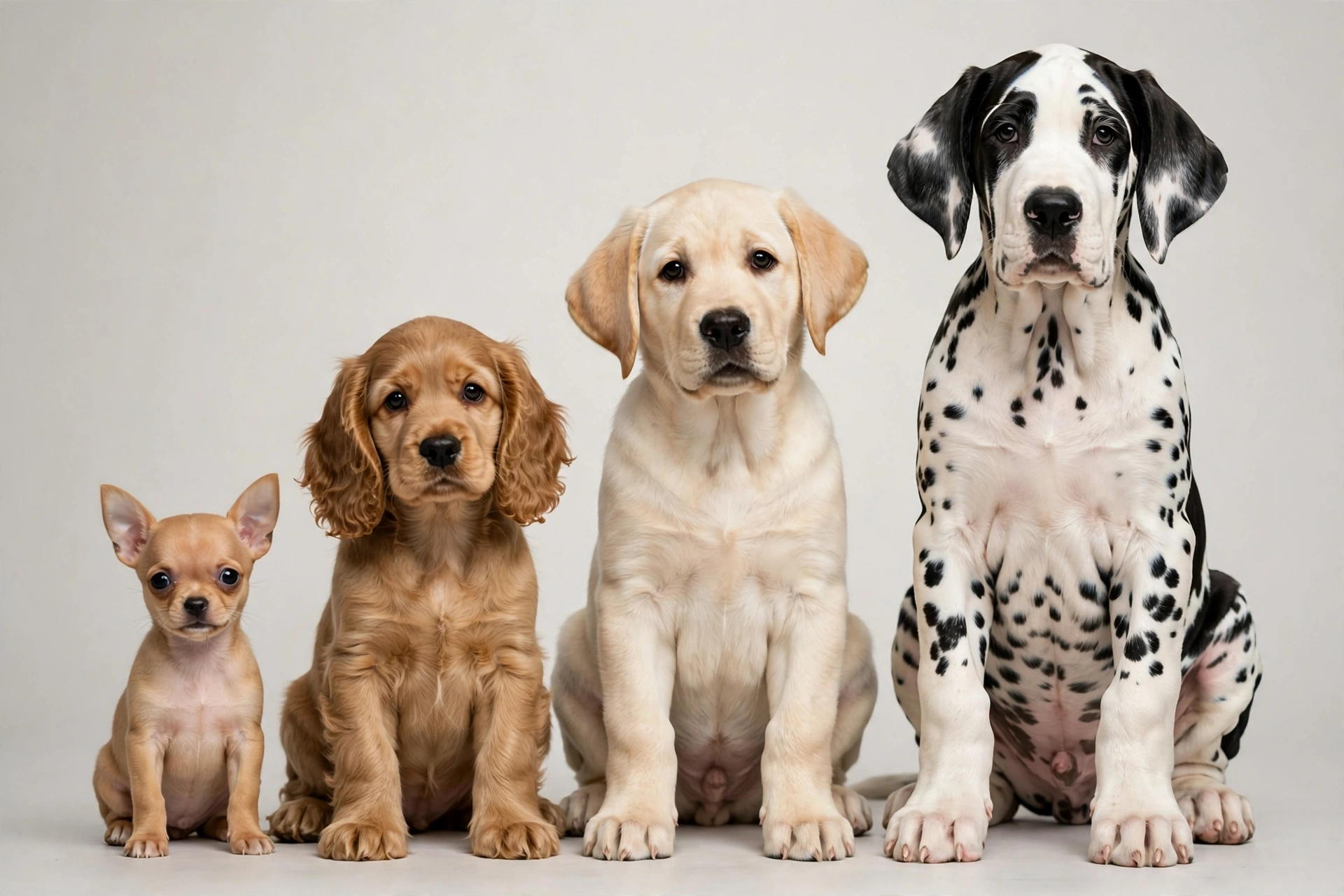
That said, breed size shifts the timeline more than almost anything else:
- Small breeds (under 25 lb) often settle by 12–18 months.
- Medium breeds (25–60 lb) typically calm down around 18–24 months.
- Large breeds (60–100 lb) commonly need 2–3 years.
- Giant breeds (100+ lb) may stay puppy-like until 3 years or beyond.
These are patterns, not promises. Two puppies of the same breed can mature months apart, and an individual dog’s energy level also depends on breeding lines, exercise, training, and daily routine. Think of the ranges below as the middle of the bell curve — where most puppies land — rather than a deadline your puppy must meet.
What Age Do Puppies Calm Down? Timeline by Breed Size
Why does size matter so much? Larger breeds simply take longer to mature — physically and mentally. A Great Dane is still growing at an age when a Chihuahua has long been a settled adult, and brain development follows a similar curve. High-energy working and sporting lines within any size group also tend to stay intense longer than calm companion lines.
| Breed size | Typical adult weight | Noticeable settling | Fully mature temperament |
|---|---|---|---|
| Small | Under 25 lb (11 kg) | 12–18 months | Around 18 months |
| Medium | 25–60 lb (11–27 kg) | 18–24 months | Around 2 years |
| Large | 60–100 lb (27–45 kg) | 2–3 years | Around 2.5–3 years |
| Giant | Over 100 lb (45 kg) | 2.5–3+ years | 3 years or more |
Small breeds: 12–18 months
Chihuahuas, Dachshunds, Shih Tzus, Yorkshire Terriers, and similar small breeds are usually the first to trade chaos for couch time. Most small-breed puppies show a clear drop in manic energy somewhere between their first and second birthdays.
That does not mean they become sedentary — many small breeds stay playful and spirited for life. But the frantic, unfocused puppy craziness typically fades first in this group. One caveat: small breeds are also the group most likely to develop “small dog syndrome” behaviors — excessive barking, jumping, and demanding attention — if those habits were accidentally rewarded during puppyhood. Calmness arrives on schedule only if manners were trained along the way.
Medium breeds: 18–24 months
Beagles, Cocker Spaniels, Border Collies, Australian Shepherds, and other medium breeds usually hit their stride as calmer companions around 18 months to 2 years. This is the most varied group, because it contains both laid-back companions and some of the highest-energy working breeds on earth.
A Cocker Spaniel may be a settled, gentle adult at 18 months, while a Border Collie or Australian Shepherd — bred to work all day — can stay intense well past 2 years unless their mental and physical needs are met. For herding and sporting breeds, “calm” is less about age and more about having a job: training, sports, or structured activity channels the drive that otherwise becomes hyperactivity.
Large breeds: 2–3 years
Labrador Retrievers, Golden Retrievers, German Shepherds, Boxers, and similar large breeds are famous for their long puppyhoods. It is completely normal for a 2-year-old Lab to still greet guests like a furry tornado — most large breeds do not reach a truly settled adult temperament until somewhere between 2 and 3 years old.
The extended timeline makes sense when you consider that large breeds are still physically maturing at 18–24 months. Their brains, impulse control, and emotional regulation develop on the same slow curve as their bodies. Owners of large breeds often report a distinct “switch flips” moment around age 2 or 3, when the dog that once counter-surfed and body-slammed suddenly starts choosing the dog bed on their own.
Giant breeds: 3 years and beyond
Great Danes, Mastiffs, Newfoundlands, Saint Bernards, and other giants are puppies the longest — often not mentally mature until 3 years old, sometimes later. The irony is that many giant breeds are actually calm-natured dogs; they just take longer to grow into that calmness.
Patience is essential with giants, because their size makes puppy misbehavior more consequential. A 120-pound “puppy” that jumps up is a safety issue, not a cute phase — which is why training calm behaviors early matters even more in this group, even though the payoff arrives later.
Why Some Puppies Stay Hyper Longer
If your puppy seems wilder than the timeline suggests, one of these factors is usually at play. None of them means anything is wrong — but each one can add months to the chaos.
1. Breed and breeding lines
Beyond size, purpose matters. Breeds developed for sustained work — herding dogs, retrievers, terriers, sled dogs — were selected for stamina and intensity. A field-bred Labrador will out-energize a show-bred one for years. And within every breed, individual lines vary: puppies from high-drive parents inherit high-drive brains.
2. The adolescent regression (6–18 months)
Many owners report that their sweet 5-month-old puppy turned into a wild stranger around 7–9 months. This is adolescence — hormones surge, previously learned behaviors seem to vanish, and testing boundaries becomes a full-time hobby. It is the most frustrating phase of puppyhood, and it is also temporary. Dogs that seem to get “worse” at 8 months are usually right on schedule to get dramatically better by 18.
3. Under-exercised body, under-worked brain
A puppy with unspent physical and mental energy does not become calm — they become creative, and their creativity looks like destruction. Ten minutes of training or scent games often settles a puppy more than an hour of aimless running, because mental work is genuinely tiring. Many “hyper” puppies are simply under-stimulated, not over-energetic by nature.
4. Overtiredness disguised as hyperactivity
This one surprises most owners: the wildest evening zoomies are often a sign of too little rest, not too much energy. An overtired puppy’s stress response looks like mania — biting harder, racing around, unable to settle. Puppies under 6 months still need 18–20 hours of sleep a day, and most will not choose rest on their own. Enforced naps frequently “cure” hyperactivity that exercise never touched.
5. Inconsistent rules and accidental rewards
Puppies repeat what works. If jumping gets attention — even scolding attention — jumping continues. If calm lying on the bed is never noticed or rewarded, the puppy never learns that calmness pays. In multi-person households, one family member who roughhouses while another enforces calm can keep a puppy wired for months longer than necessary.
6. Lack of a predictable routine
Puppies thrive on rhythm. A dog that never knows when the next walk, meal, or rest is coming lives in a state of low-grade arousal — always ready, never settled. Consistent daily structure teaches a puppy that downtime is safe and normal, which is half of calmness.
Signs Your Puppy Is Starting to Calm Down
Maturity rarely arrives all at once. Instead, watch for these gradual shifts — they are the early evidence that the timeline is working:
- Settling without being asked. The puppy that once needed to be lured onto the bed now wanders over and lies down on their own. Voluntary settling is one of the clearest maturity milestones.
- Longer focus during training. Sessions that once fell apart after three minutes now stretch to ten. Improved impulse control shows up first in training, then everywhere else.
- Greeting people more politely. The full-body launch at visitors softens into an excited but four-on-the-floor greeting — or at least a shorter burst of jumping.
- Playing more gently. Bite pressure softens, play bouts have natural pauses, and the puppy starts reading other dogs’ signals instead of bulldozing through them.
- Recovering faster from excitement. A doorbell or a squirrel still triggers a reaction, but the puppy comes back down in minutes instead of staying wired for an hour.
- Choosing rest. Perhaps the sweetest sign: the puppy that used to fight sleep now seeks out the sunny spot or the crate voluntarily when tired.
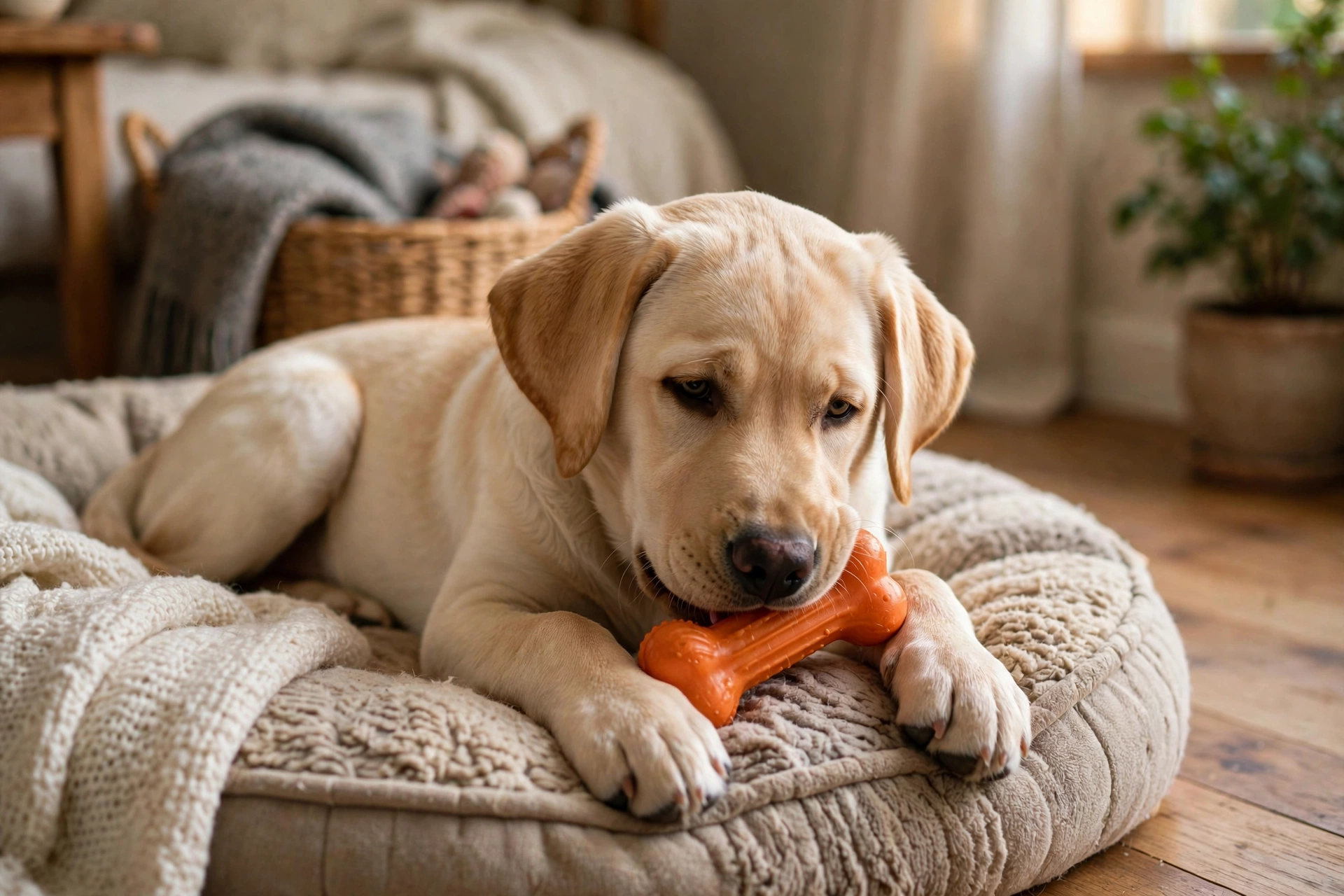
If you are seeing two or three of these, your puppy is maturing right on schedule, even if the zoomies have not fully retired yet. Progress in puppy behavior is measured in trends across weeks, not in perfect days.
How to Help Your Puppy Calm Down Faster
Age does most of the work, but your daily choices determine whether maturity arrives at 18 months or 3 years. These four pillars genuinely accelerate the process.
1. Exercise the right way
A tired puppy is a calmer puppy — but only if the exercise is appropriate. The widely used trainer guideline is about 5 minutes of structured exercise per month of age, up to twice a day (so a 4-month-old gets roughly two 20-minute sessions). Over-exercising a growing puppy risks joint damage, especially in large breeds, so more is not always better.
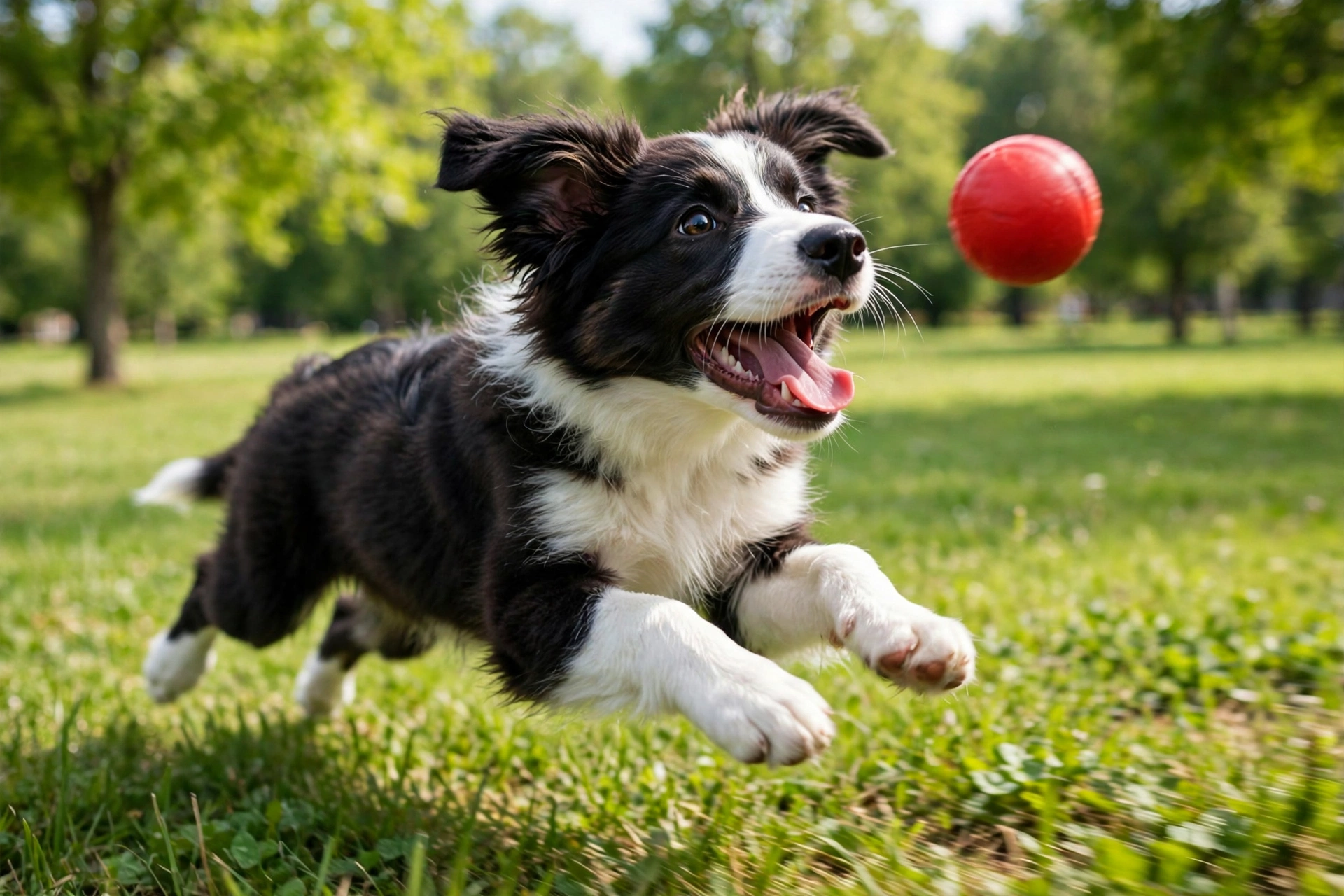
What matters most is the type of exercise. Free running in a safe area, fetch, and play with other friendly dogs burn energy naturally. But endless ball-chasing can build an adrenaline athlete that needs ever-longer sessions to tire — balance high-arousal play with calm sniff walks, where the puppy sets the pace and explores. Sniffing is surprisingly tiring and teaches the puppy that the world is interesting without being frantic.
2. Train calmness directly
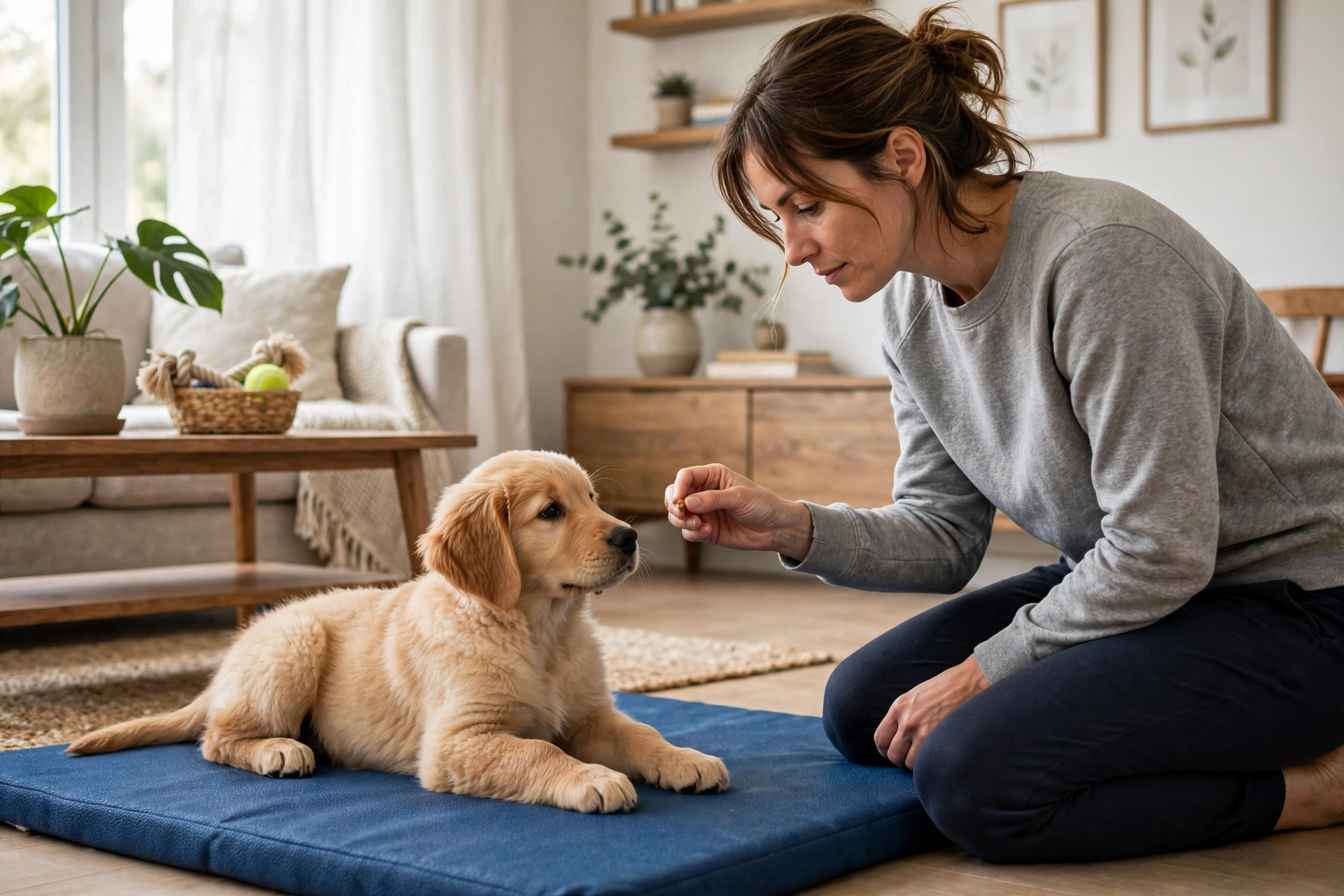
Most owners train “sit” and “stay” but never train the skill they want most: doing nothing. Calmness is trainable. Reward it every time you see it — a treat tossed quietly to a puppy lying calmly on the bed teaches more than any correction ever will.
Two exercises are especially powerful. Mat training (teaching a “place” or “settle” cue on a specific bed or mat) gives the puppy a clear job during exciting moments like guests arriving. Capturing calmness — simply marking and rewarding relaxed behavior throughout the day — turns calm choices into habits. Keep sessions short, end on success, and train before meals when motivation is highest.
3. Tire the brain, not just the body
Mental stimulation exhausts puppies faster than physical exercise, with none of the joint risk. Puzzle feeders, snuffle mats, frozen stuffed Kongs, and short training games all count. Scatter feeding — tossing kibble into grass for the puppy to find — turns dinner into 15 minutes of calming nose work.
Scent games are the secret weapon for hyper puppies. A dog’s nose is wired directly to the thinking brain; ten minutes of “find it” games leaves most puppies pleasantly drowsy. A mentally worked puppy does not just have less energy — they have better impulse control for the rest of the day.
4. Build a predictable routine
Puppies cannot relax into a day they cannot predict. Anchor the day around consistent wake, meal, walk, play, rest, and bedtime slots. Protect rest actively: most puppies under 6 months need enforced naps in a crate or pen after 1–2 hours awake, because they will not choose sleep while the world is exciting.
A calm wind-down routine before bed — last potty, a chew, lights low — teaches the puppy that evenings mean settling. Within a week or two of consistency, most puppies start anticipating each part of the rhythm, and the frantic “what’s next?!” energy fades.
When Hyperactivity Might Be a Concern
True behavioral disorders are rare, but a vet visit is worthwhile if you notice any of these:
- A sudden change. A previously calm puppy that becomes suddenly frantic, or vice versa, deserves a checkup — pain, thyroid issues, and other medical problems can masquerade as behavior changes.
- Inability to settle ever. If the puppy literally cannot rest even when clearly exhausted, in a calm environment, after appropriate exercise, talk to your vet.
- Repetitive compulsive behaviors. Constant tail chasing, light/shadow chasing, or flank sucking that the puppy cannot be interrupted from may signal a compulsive disorder rather than normal energy.
- Hyperactivity plus other symptoms. Excessive thirst, weight changes, digestive issues, or skin problems alongside behavior changes point toward a medical cause, not a training one.
For the vast majority of owners reading this, though, the answer is simpler and happier: your puppy is being a puppy, and time plus consistent training will do the rest.
Frequently Asked Questions
At what age do puppies calm down the most?
The biggest single drop in puppy craziness usually happens between 12 and 24 months, depending on breed size. Small breeds often show the change around their first birthday; large and giant breeds may not show it until 2–3 years. After that, mellowing continues gradually for life.
Do puppies calm down after being spayed or neutered?
Slightly, sometimes — but it is not the transformation many owners hope for. Neutering reduces hormone-driven behaviors like roaming and marking, but general puppy energy, mouthiness, and excitability are developmental, not hormonal. Do not expect surgery to replace training.
Why is my puppy hyper at night but calm during the day?
Evening zoomies are one of the most common puppy patterns, and the usual cause is overtiredness, not excess energy. A puppy that skipped daytime naps hits the evening wired. Enforced afternoon rest and a calm pre-bed routine fix this for most puppies within days.
Will my puppy ever stop biting?
Yes — mouthing and biting peak during teething (up to about 6–7 months) and fade as jaw discomfort ends and bite inhibition is learned. Consistent redirection to toys, plus yelping or withdrawing attention for hard bites, teaches gentle mouth manners. If hard biting persists past 8–9 months, step up training rather than waiting it out.
Do calm puppies exist, or is every puppy wild?
Both. Temperament varies enormously: some puppies are naturally thoughtful and mellow from 8 weeks old, while their littermates are chaos incarnate. A calm puppy is usually just an individual trait, not a sign of illness — though a sudden drop in energy in a previously lively puppy is worth a vet check.
How can I calm my puppy down quickly in the moment?
Remove stimulation first: step into a quiet room, offer a long-lasting chew or lick mat, and wait. Licking and chewing are physiologically calming for dogs. Avoid chasing, shouting, or high-pitched excitement — all of it rewards the arousal you are trying to end. Prevention (exercise, naps, routine) beats in-the-moment fixes every time.
The Bottom Line
So, what age do puppies calm down? For most, the corner turns between 1 and 2 years, with small breeds leading the way and giant breeds bringing up the rear at 3 years or more. The teenage months from 6 to 18 are the hardest — and also the most temporary.
You cannot rush maturity, but you can shape it. Age-appropriate exercise, direct training of calm behaviors, daily mental work, and a predictable routine with protected rest will bring the calm phase months sooner than waiting alone would. Reward the quiet moments, stay consistent through the adolescent chaos, and one ordinary day you will realize the wild puppy has been quietly replaced by a steady, settled dog.
Related reads
- Puppy Sleep Schedule by Age: How Much Sleep Do Puppies Need?
- Why Does My Puppy Eat Poop? Causes & How to Stop It Fast
- Puppy Teething Timeline: Week-by-Week Guide for New Owners

