
You clip on the leash, open the front door, take one hopeful step forward — and suddenly you are not walking a puppy anymore. You are in a tug-of-war with a tiny, furry alligator who has decided that the leash is the most exciting toy in the entire world. He grabs it, shakes it, growls at it, and gives you a look that says, oh, we are playing THIS game now? Excellent. If you have ever wondered why does my puppy bite the leash instead of just, you know, walking on it like a civilized creature, welcome to one of the most common — and most comically frustrating — puppy problems in existence.
Here is the reassuring part: leash biting is completely normal puppy behavior. It is not defiance, it is not dominance, and it does not mean your puppy is destined to be a nightmare on walks forever. It means you have a young dog with a mouth full of curiosity, a brain full of play drive, and a leash dangling at exactly mouth level. Of course he is going to grab it.
The even better news is that leash biting is one of the most fixable puppy habits out there — as long as you stop accidentally turning it into a game (most of us do, without realizing it). This guide covers the 7 real reasons puppies bite the leash, then gives you a 5-step positive plan to turn those chaotic walks into the calm, pleasant strolls you imagined. No punishment, no weird gadgets, no guilt. Just a plan that works with how puppies actually think.
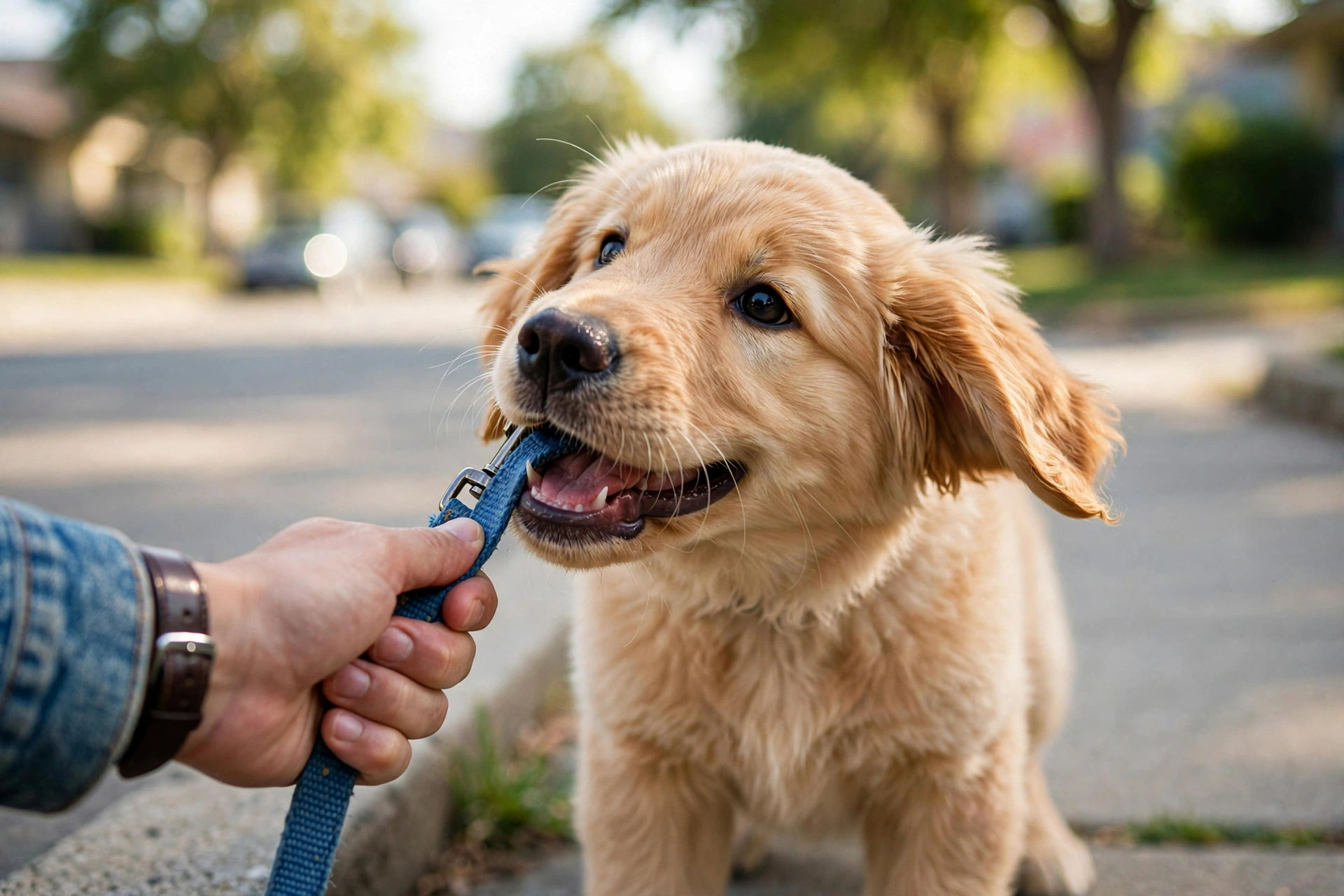
Why Does My Puppy Bite the Leash? 7 Reasons
Before you can fix it, it helps to understand that little head. Leash biting is usually a cocktail of mouthiness, playfulness, and the fact that you keep reacting in the most entertaining way possible. See which of these seven sound like your puppy.
Reason #1: He Explores the World With His Mouth
Puppies do not have hands, so they have mouths — and they use them for everything. Tasting, testing, chewing, and carrying are how a young dog investigates literally anything new in his environment. Shoes, furniture legs, your fingers, the remote control, and yes, the leash. To a puppy, mouthing an object is not misbehavior; it is research. He is gathering data the only way he knows how.
Now consider the leash’s position: it dangles right at mouth level, swings with every step, and is attached to the most interesting creature in the universe (you). Teething makes it even more compelling — sore, itchy gums between three and six months are desperate for something to chew, and the leash is always right there. He is not doing it at you. He is doing it because he is a baby with a mouth.
Reason #2: The Leash Looks Like a Toy
Think about this from the puppy’s perspective for a moment. What does a great dog toy look like? Something long, dangly, and fun to grab. Something that moves when you touch it. Something that makes the human do funny things. Congratulations — you have just described both a rope toy and a leash. To your puppy, these two objects belong to the exact same category: things I am clearly supposed to bite.
The resemblance gets stronger the second you react — the leash bounces and wiggles with every step, triggering the same chase-and-grab instincts as a tug rope. Rope toys and leashes even feel similar in the mouth: same texture, same satisfying resistance. In his mind, the leash’s purpose is obvious. It is a toy you were thoughtful enough to attach to his collar.
Reason #3: Biting Turns the Walk Into a Game
This is the reason most owners accidentally supercharge without realizing it, so read carefully. The moment your puppy grabs the leash, what do most of us do? We stop. We look at him. We talk to him — “no, drop it, come on, let go!” We pull the leash gently. We laugh. We get frustrated. Every single one of those reactions is, to a puppy, absolutely riveting entertainment. You have just turned a boring walk into an interactive game starring him, and the price of admission was one bite.
It gets worse. Pull back on the leash and you have initiated tug-of-war — the most reinforcing thing you can do to a leash biter. The harder you pull, the harder he grips, and now he is winning at tug. Even scolding counts as a reward, because dramatic human attention is still attention. Many puppies start biting the leash on purpose, within the first few walks, just to restart the game. The walk was supposed to be exercise. Your puppy has renegotiated it into recess.
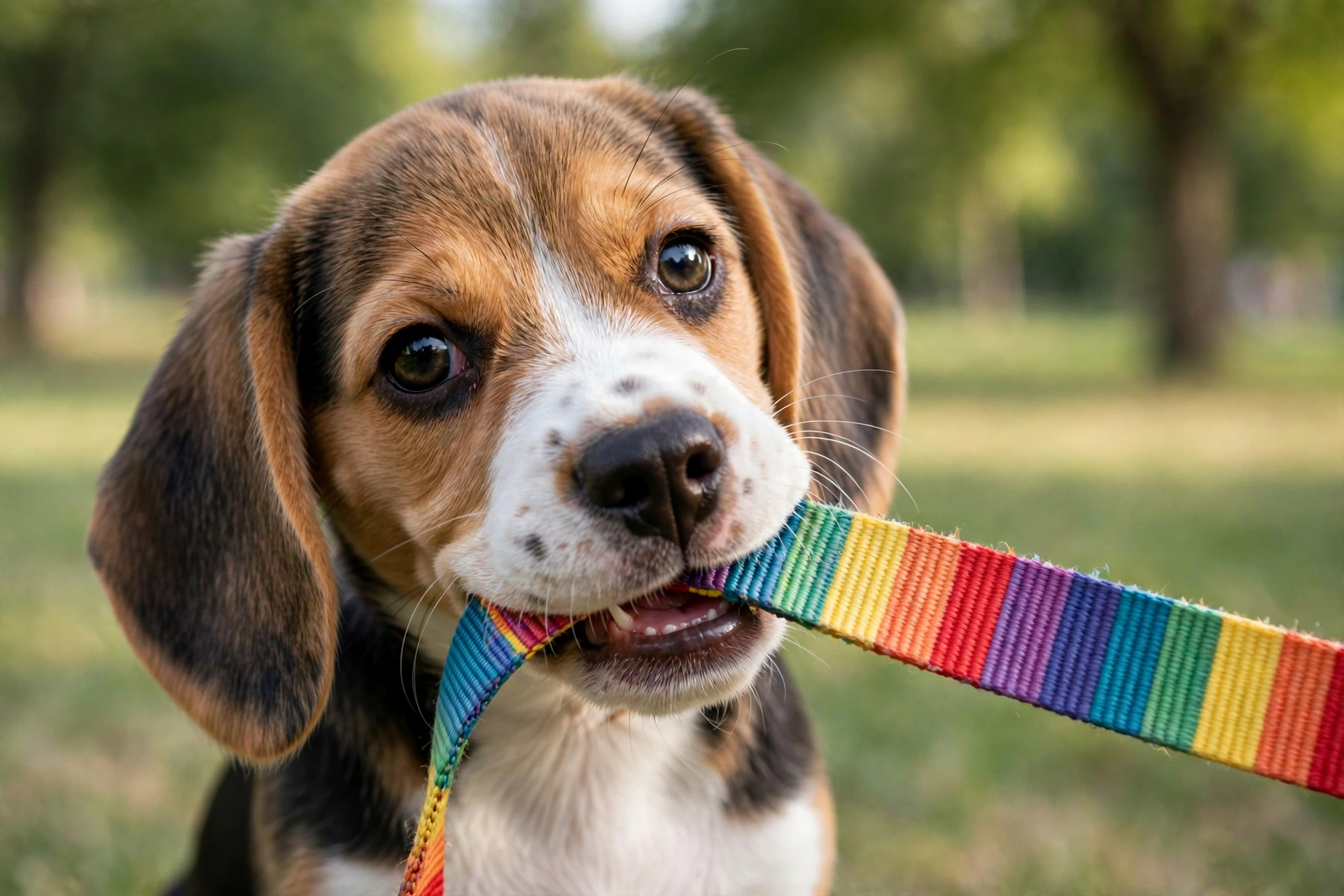
Reason #4: He Is Full of Energy With Nowhere to Put It
Some puppies bite the leash the way some kids bounce off the walls before dinner — because the energy has to go somewhere. An under-exercised puppy does not walk calmly beside you taking in the scenery. He explodes out the front door like a furry firework, and the first available outlet for all that bottled-up excitement is the thing swinging in front of his face. Leash biting becomes the pressure valve.
You will recognize this version: the biting is frantic, starts within the first minute, and comes with jumping, spinning, and joyful chaos. This puppy is not interested in the leash itself — he needs something to do right now, and the leash happened to be there. Owners misread this as a leash problem when it is really an exercise problem wearing a leash costume. Drain the tank before the walk and this whole category often evaporates on its own.
Reason #5: It Reliably Gets Your Attention
Dogs are ruthless little scientists, constantly running experiments on us. And your puppy has discovered one of the most reliable cause-and-effect relationships in his entire life: bite leash → human immediately engages. It works every single time. He does not even have to bark or jump or do anything elaborate. One chomp, and you are looking at him, talking to him, interacting with him. From a behavioral standpoint, that is a jackpot.
This is especially common in puppies who feel ignored on walks — and be honest, most of us spend walks looking at our phones. The puppy learns the leash is a big red button labeled “press for human attention.” Even negative attention counts: the “no! drop it! stop!” dance is still a dance with you. If he bites the leash, looks at you, and wags, you are not looking at a behavior problem. You are looking at a successful experiment with excellent results.
Reason #6: Walks Are Overwhelming
Not all leash biting is happy and playful. For some puppies — especially young ones, shy ones, or those still getting used to the big wide world — walks are a sensory assault. Traffic noise, strange dogs, bicycles appearing out of nowhere, that terrifying trash can that was not there yesterday. When a puppy’s brain hits overwhelm, he needs a coping mechanism, and the nearest available one is usually the leash. Biting and chewing are genuinely self-soothing behaviors for dogs; the rhythmic chomping helps discharge nervous energy.
Spot the anxious version by context: biting ramps up in busy places and fades in quiet ones, often with lip licking, yawning, tucked tail, or a refusal to keep walking. This puppy is not playing — he is telling you this is a bit much. Punishing a stressed puppy for coping adds fear on top of anxiety. He needs shorter, calmer walks in easier places while his confidence builds. Meet the emotion first, then train the behavior.
Reason #7: It Worked Before (You Trained It by Accident)
Here is the reason nobody wants to hear but almost everybody needs to: in many cases, we taught the puppy to bite the leash. Not on purpose — but dogs do not care about our intentions, only our patterns. Think about what typically happens when a puppy bites the leash mid-walk. The owner stops walking. Or the owner pulls out a treat to lure the puppy off the leash. Or the owner unclips the leash, laughs, and lets the puppy run around. Every one of those outcomes is a reward, and the puppy’s brain files it away with total clarity: biting the leash makes good things happen.
The treat-lure version is the sneakiest. If the sequence is always bite leash → get treat, you have not trained “don’t bite the leash” — you have built a vending machine: insert bite, receive snack. Now he bites the leash in order to get the treat. Treats are not the problem; timing is. Reward the walking nicely, not the ceasing of biting — your puppy understands that difference perfectly. The good news: anything accidentally trained can be deliberately re-trained with consistency.
How to Stop Your Puppy Biting the Leash
Now the part you came for. The goal is not to win a battle of wills — it is to make leash biting boring and walking nicely rewarding, until the new habit replaces the old one. Work these five steps in order; skipping ahead is the number-one reason this plan “doesn’t work.”
Step 1: Drain the energy before the walk, not during it. If your puppy explodes out the door already over threshold, you have lost before you started. Spend five to ten minutes on a short play session before you clip the leash on — fetch, tug with a proper toy, or a two-minute training burst. You are not exhausting him (an overtired puppy gets cranky and mouthy too); you are taking the frantic edge off so he can think during the walk. Many owners are stunned by how much leash biting disappears once this step becomes routine.
Step 2: Make the leash boring — be a tree. The instant teeth touch the leash, all movement stops. You become a tree: stand still, go quiet, look boring. No pulling back (that is tug-of-war — remember Reason #3), no chatting, no eye contact, no drama. The moment he lets go, movement resumes and life gets interesting again. The equation is crystal clear: teeth on leash = the walk freezes; mouth off leash = the adventure continues. He may escalate briefly at first, biting harder to see if the old game still works. Hold your tree pose — most puppies abandon it within a handful of walks. Boring is the most powerful training tool you own.
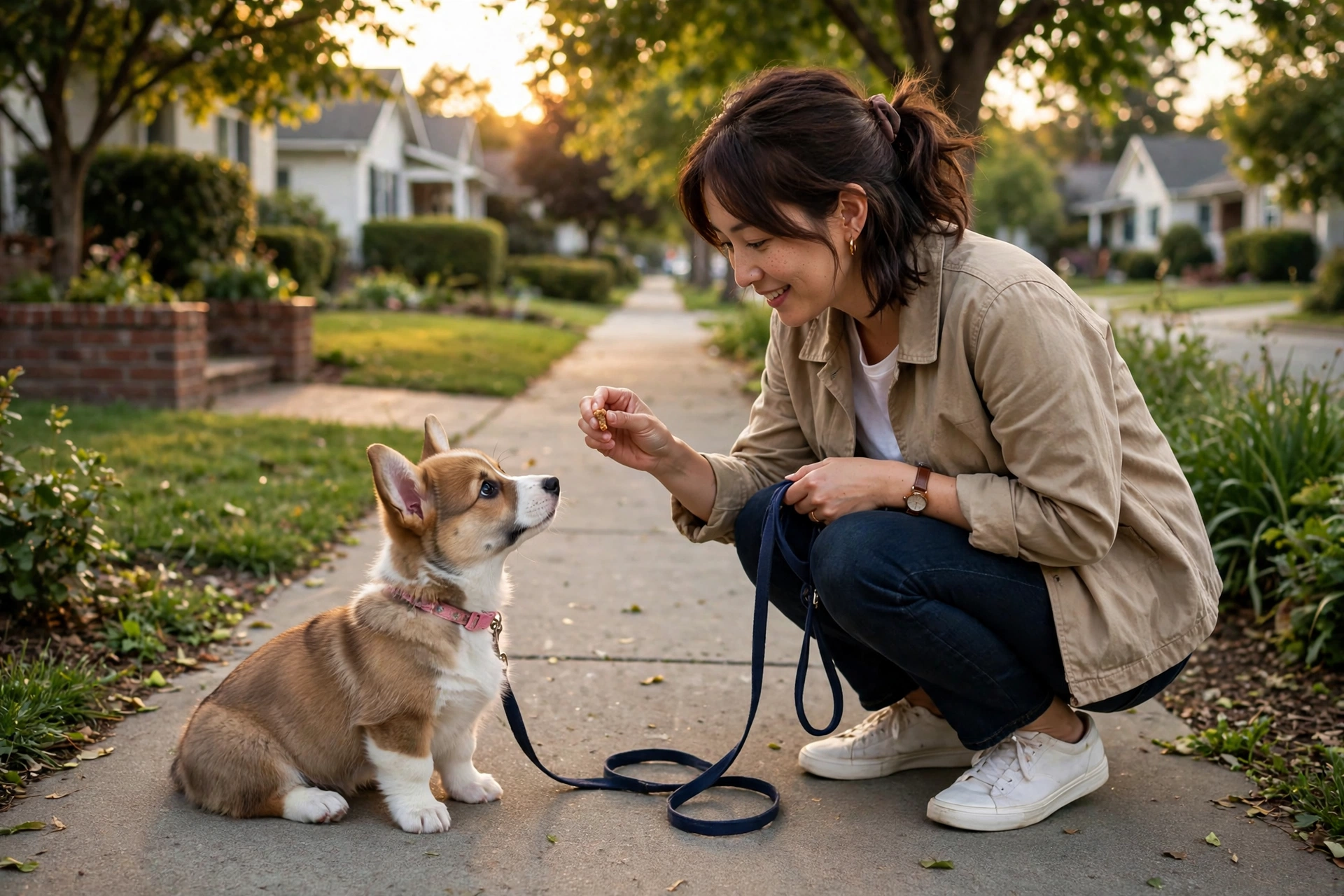
Step 3: Redirect and reward the walking, not the letting go. Once you are a tree and the puppy releases the leash, immediately redirect that mouth onto something better and reward the walking. Carry a small tug toy or high-value treats on every walk. The sequence: teeth off leash → praise → a few steps of lovely walking → treat or brief toy play. You are building a competing habit: walking nicely pays better than biting ever did. Crucially, you are not paying him for stopping the biting — you are paying for walking beautifully. Ten rewarded steps beat one rewarded release, and his brain does that math on its own.
Step 4: Teach “leave it” and “drop it” — for the leash specifically. Train these away from the walk first, in boring low-distraction settings. Start “leave it” with treats in your closed fist, then on the floor, then with toys — until he can disengage on one calm word. Practice “drop it” as a trade-up game: he holds a toy, you offer something better, he drops, he gets the better thing and often the original toy back. Dropping should always feel like winning. Once both cues are fluent indoors, apply them to the leash in the yard, then on short walks. Train the skill where it is easy, then spend it where it is hard.
Step 5: Manage the equipment while training catches up. Training takes a couple of weeks; management covers you meanwhile — every professional trainer does this. Honest options: a front-clip harness gives steering without throat pressure (many leash biters are also pullers, and throat pressure amps up frustration). Bitter apple spray is a mild taste deterrent that works for some puppies and nothing for others — worth one try, but if he chews happily through it by day three, move on. For the dedicated leash destroyer who chews through leashes, a chain leash cover makes chewing genuinely unpleasant — but frame it correctly: this is management, not training. None of these replace Steps 1 through 4.
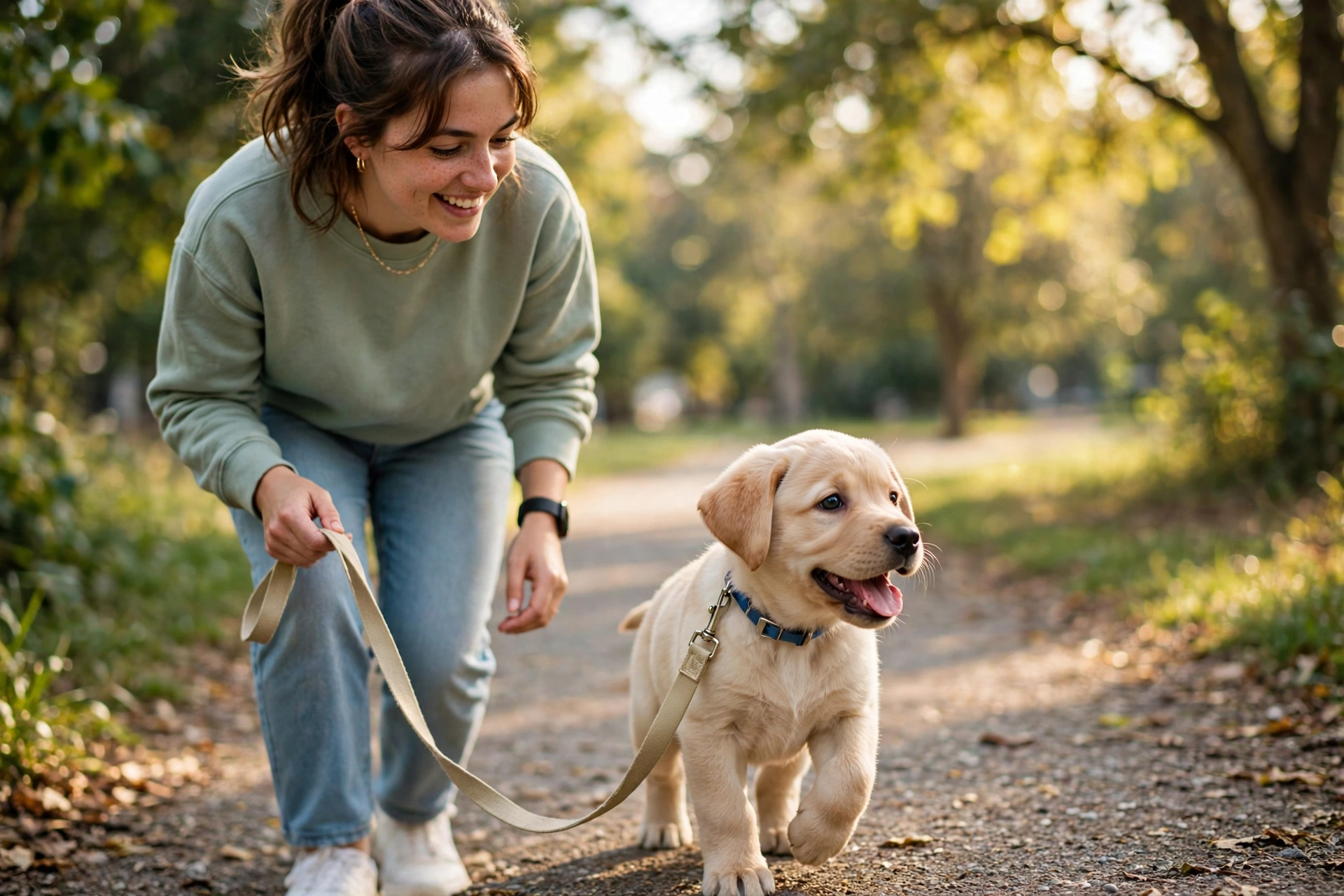
The realistic expectation: with consistent tree-posing plus rewarded walking, most puppies show clear improvement within one to two weeks. But some mouthiness often lingers right through teething (around six months) — that is normal, not failure. You are looking for a steady downward trend, not overnight perfection. A puppy who used to bite the leash fifty times a walk and now does it twice is a massive success story in progress.
Frequently Asked Questions
Why does my puppy bite the leash?
Short answer: he is a puppy and the leash is right there. Longer answer: why does my puppy bite the leash usually comes down to mouth-based exploration, the leash looking like a toy, play drive, excess energy, attention-seeking, or occasional overwhelm. Normal, common, fixable — match your puppy to the seven reasons above, then work the five-step plan.
Will my puppy grow out of leash biting?
Partly. Teething mouthiness usually fades as adult teeth settle around six months, and puppies naturally calm down with maturity. But habits that get rehearsed and rewarded stick around regardless of age — a puppy who learned that leash biting starts a fun game will play it at a year old too. Train it out now while he learns fast, rather than hoping maturity does the job alone.
Should I punish my puppy for biting the leash?
No. Yelling or leash pops might interrupt the biting for three seconds, but they teach nothing — and often make things worse by amping up arousal and damaging trust. Behaviors change fastest when the unwanted behavior stops paying off (be a tree) and the wanted behavior pays generously (reward the walking). Redirection beats punishment every time.
Why does my puppy only bite the leash at the start and end of walks?
Those are the two highest-arousal moments of any walk. At the start: peak excitement, new smells, unspent energy. At the end: a second wind of frustration or overtired silliness. Same fix for both — Step 1. A short play session before leaving takes the edge off the start; a calm, predictable finish (same route home, some sniffing time) smooths the end. Pattern, not willpower, tames these moments.
Is a harness or collar better for a leash-biting puppy?
For most leash biters, a well-fitted front-clip harness is better while training. A collar puts pressure on the throat, which can increase frustration in an already aroused puppy. A harness distributes pressure and gives steering control without the choke effect. It will not stop biting alone, but it removes one arousal source. Make sure it fits snugly — a loose harness on a wiggly puppy is an escape waiting to happen.
Can I use bitter apple spray on the leash?
You can, with honest expectations. For some puppies one lick is enough; for others it is merely a condiment. Spray the lower leash before the walk and see. But it is a management helper, not training — if he chews through it, go back to Steps 1 through 4. Never use anything stronger or homemade (hot sauce, vinegar concentrates); those irritate mouths and eyes and cross into punishment.
Related Reads
- Leash Training a Puppy Without Pulling — once the biting fades, the pulling usually needs work next; this is the no-pull roadmap that pairs perfectly with the plan above.
- How to Train Your Puppy to Walk Beside You — turn those chaotic outings into proper heel work with reward-based positioning your puppy will actually enjoy.
- 10 Puppy Training Mistakes New Owners Make (And How to Fix Them) — including the accidental-reward traps (like the leash-bite vending machine) that keep bad habits alive.

