
Picture this: your new puppy and your cat, curled up together on the couch, the picture of interspecies peace. Now picture the reality most owners get: the puppy spots the cat, the chase is on, the cat vanishes under the bed for three days, and you wonder if you’ve made a terrible mistake.
Here’s the truth: puppies and cats can become genuine friends — but the first week decides almost everything. A rushed introduction poisons months of cohabitation; a patient one builds a friendship that lasts years. In this guide, you’ll learn the 7 peaceful steps professionals use, the mistakes that ruin introductions, and exactly what to do when things go sideways.
Why the First Impression Is Permanent
Cats are masters of first impressions — and they hold grudges like nobody’s business. A single terrifying chase in the first meeting can teach your cat that the puppy is a predator, a lesson that takes months to unlearn. Puppies, meanwhile, learn habits at lightning speed: one successful cat-chase teaches them that chasing cats is the most fun game ever invented.

So the goal of the first week isn’t friendship — it’s neutrality. We want the puppy to learn “the cat is boring background furniture” and the cat to learn “the puppy is loud but harmless.” Friendship comes later, on its own schedule. Every step below is designed to prevent the two failure modes: the cat getting terrified, and the puppy learning to chase.
One more thing worth knowing: cats form these judgments fast but revise them slowly — and every cat’s timeline is different. Some cats adjust within days, while others need weeks or longer. So focus on body language and comfort rather than a fixed deadline: your calmest, most controlled work matters most right at the start, and the process gets easier from there.
The 7 Peaceful Steps
Step 1: Set Up the House Before They Meet
Before the puppy even arrives, build the cat a fortress. Designate one room as the cat’s safe room — door closed, with food, water, litter box, hiding spots, and a comfortable bed. Install baby gates in doorways (the cat can jump over; the puppy can’t). Add vertical space: a cat tree or cleared shelf where the cat can observe from above. Height is safety to a cat — a cat who can watch from above is a cat who stays calm.
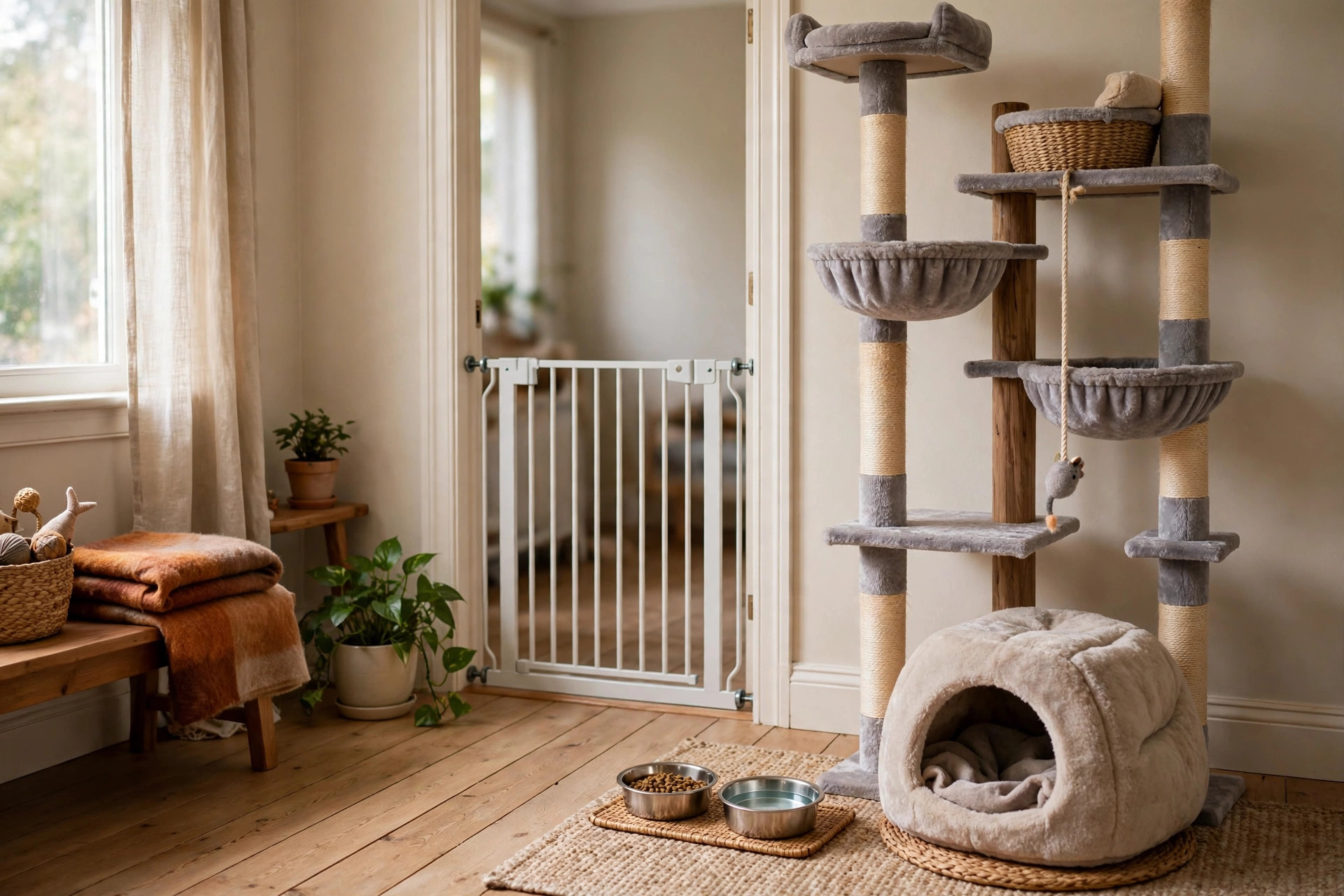
The golden rule of the whole process: the cat always has an escape route. Never corner the cat, never trap them in a room with the puppy, never hold the cat while the puppy approaches. The cat decides the distance, always. A cat who can leave is a cat who will eventually choose to stay.
Step 2: Scent Before Sight
For the first 2–3 days, the animals shouldn’t see each other at all — they should only smell each other. Swap cloths: rub a soft cloth on the puppy’s cheeks, place it near the cat’s food bowl (not in it — near it), and vice versa. Feed both animals on opposite sides of the closed safe-room door, so each learns “that weird smell predicts delicious food.”

This step is almost impossible to mess up, costs nothing, and does heavy lifting: by the time they see each other, the other animal’s scent already means good things. Skipping it is the most common shortcut — and the most regretted.
Step 3: Room Swaps
Now let each animal explore the other’s territory — without meeting. Put the puppy in another room (with a chew toy), open the safe room, and let the cat wander the house, sniffing where the puppy has been. Then swap: cat back in the safe room, puppy explores the cat’s room. No visual contact yet, just deep scent investigation.
Watch the cat’s body language during their exploration: relaxed sniffing and cheek-rubbing is great; flattened ears and slinking means slow down. This is the same gradual-exposure principle behind good puppy socialization — new experiences one at a time, always at a winnable level.
Step 4: Visual Contact Through a Barrier
Time for the first look — through a baby gate or a cracked door, never face-to-face. Keep sessions short: 3–5 minutes, with the puppy on leash at a distance. Feed both animals treats during the session so “seeing each other” predicts amazing things. End before anyone gets stressed.
Read the body language like a hawk. A hiss from the cat is not failure — it’s communication: “too close.” Calmly increase distance and try again later. Never punish the cat for hissing; you’d be punishing them for telling the truth. On the puppy’s side, whining and pulling toward the cat means arousal is too high — more distance, shorter sessions. Calm observation is what you’re rewarding, not excited fixation.
Step 5: The Leashed Meeting
The first real meeting: puppy on leash, cat completely free (never restrain the cat — a held cat who panics becomes a scratched owner and a traumatized cat). Keep the leash loose; a tight leash ramps up the puppy’s arousal. Let the cat approach on their terms — most cats will watch from a distance first, which is perfect.
Your job is the puppy’s brain: reward every moment of calm — a glance at the cat then looking away, a sit, a settled sigh. If the puppy lunges or fixates, calmly redirect with a treat or a toy, then increase distance. Here’s what most guides get wrong: don’t just distract the puppy’s interest away with treats. You’re teaching a skill — calm observation — not bribing them to look elsewhere. The puppy should learn “I see the cat, I stay chill, good things happen.” That’s a trained behavior, not a distraction trick.
Two obedience prerequisites make this step dramatically easier: a solid recall (your emergency brake if the puppy bolts toward the cat) and a settle-on-mat behavior (giving the puppy a job — “go to your mat” — during cat time). If you haven’t trained these yet, keep meetings extra short and managed.
Session length matters more than session count. Three calm 5-minute meetings beat one chaotic 20-minute one every time — arousal compounds, and a puppy who’s been staring at a cat for 15 minutes is a coiled spring. Watch for the early signs that a session should end: the puppy’s breathing quickens, the play-bows start, the whining creeps in. End there, cheerfully, with treats for everyone. You’ll get another session tomorrow — and the one after that will start from a better place because this one ended well.
Step 6: Supervised Off-Leash Time
Only when leashed meetings are boring — the puppy glances at the cat and looks away on their own, the cat walks through the room without altering course — do you increase freedom. Start with the leash held by an adult, in a clear, uncluttered space. If you use a lightweight trailing line, do so only under direct supervision where it cannot snag on furniture — and never step on it hard enough to jerk the puppy’s neck. Keep these sessions short: 10–15 minutes, always supervised, always with the cat’s escape routes open.
End every session on a win: while everyone is still calm, separate them cheerfully with treats. You’re building a highlight reel of peaceful coexistence in both animals’ memories. One bad session can undo five good ones, so quit while you’re ahead — always.
Step 7: Build the Routine Into Trust
Peace isn’t a single event — it’s a routine. Feed them in the same room (at a comfortable distance, gradually closer). Play with the puppy before cat time so the puppy arrives tired and calm. Give the cat daily undisturbed safe-room time even after introductions succeed — the cat’s sanctuary should never disappear entirely.
Unsupervised trust comes last, and only when you’ve seen weeks of boring coexistence: no chasing, no stalking, no ambushes. Many owners reach this in 4–8 weeks; some pairs take months. There’s no deadline — only the standard: would you bet the cat’s safety on it? If not, keep supervising.
5 Mistakes That Ruin Introductions
- 1. Rushing the timeline. “They’ll work it out” is how cats get traumatized and puppies learn to chase. Every skipped step is a gamble with the cat’s sense of safety.
- 2. Letting the puppy chase “just once.” One chase is all it takes to teach the puppy that cats are for chasing — and to teach the cat that the puppy is a predator. Manage it so it never happens, not once.
- 3. Punishing the cat for hissing. Hissing is the cat setting a boundary — exactly what you want. Punish it and you get a cat who skips warnings and goes straight to claws, or a cat who lives in fear.
- 4. No safe room. A cat with nowhere to retreat lives in chronic stress — over-grooming, hiding, litter box issues. The safe room isn’t optional equipment; it’s the foundation.
- 5. Treat-distracting instead of teaching calm. Shoving treats at the puppy every time they notice the cat teaches “cat = treat dispenser,” not calmness. Reward settled behavior around the cat — the calm itself is the skill being built.
Troubleshooting
“My puppy won’t stop staring at the cat.” Fixation is arousal building. Increase distance until the puppy can glance and disengage, reward the disengagement heavily, and keep sessions shorter. A tired puppy (exercise before cat time) fixates far less.
“The cat swatted the puppy.” Calmly separate them right away and check the puppy for injuries — especially around the eyes, where even a quick swat can cause a serious scratch. Don’t rely on the cat to teach the puppy boundaries through physical contact; that’s your job through management and training. Give the cat space, go back one step for a few days, and increase distance in the next session. If the cat is relentlessly hunting the puppy rather than defending, consult a trainer.
“My cat hasn’t come out from under the bed in days.” The introduction moved too fast. Go back to Step 2 (scent only) and rebuild slowly. Make sure the safe room is truly safe — no puppy sounds leaking through, food and water untouched by stress. Some cats need a full reset week; that’s normal, not failure.
“The puppy plays too rough — the cat is scared, not hurt.” Puppy play-chase instinct is the #1 failure mode. More exercise before meetings, longer leash phase, and a rock-solid recall. If the puppy’s prey drive toward the cat doesn’t fade with training, consult a certified trainer — some pairings need professional management plans.
Frequently Asked Questions
How long does a puppy-cat introduction take?
Plan on 2–4 weeks of structured steps before relaxed coexistence, and 2–3 months before unsupervised trust. Rushing is the only way to make it take longer.
Is it easier with a kitten or an adult cat?
Kittens are usually more adaptable; adult cats have firmer boundaries but clearer communication. Both work — the process is the same, only the timeline shifts.
What if my puppy just wants to play and the cat hates it?
That’s the most common dynamic. The puppy’s play must be managed (leash, recall, settle) until the puppy learns the cat is not a playmate — or until the cat decides otherwise on their own terms. Never force “friendship.”
Are pheromone diffusers worth it?
They’re a reasonable bonus, not a solution. Feliway (for the cat) and DAP (for the puppy) may take the edge off anxiety for some animals. Low cost, no downside — plug one in the safe room and one in the main living area.
My puppy is scared of the cat. Is that normal?
Completely — especially with confident adult cats who stand their ground. A slightly cautious puppy is actually easier to manage than an obsessed one. Let the puppy’s confidence build at their pace; fear periods can temporarily amplify it.
When should I call a trainer?
If the puppy’s chase instinct doesn’t fade after 3–4 weeks of consistent work, if the cat stops eating or over-grooms from stress, or if there’s any real aggression (not just hissing/swatting). Look for a certified professional (CPDT-KA) with multi-pet experience.
The Bottom Line
Peace between a puppy and a cat isn’t luck — it’s architecture. Safe room, scent before sight, barriers before meetings, leash before freedom. Each step is a brick in a foundation of trust.

Build it patiently, and one day you’ll look over to find them sharing the sunny spot on the rug — and you’ll realize the week of baby gates was the best investment you ever made.
Related Reads
- How to Teach a Puppy to Settle on a Mat (7-Step Calm Method)
- How to Train a Puppy to Come When Called
- How to Socialize a Puppy Properly

