
You reach for the vacuum. Your puppy — who was peacefully napping ten seconds ago — teleports behind the couch, trembling, barking, or bolting for another room. Every single time. And cleaning the house has become a hostage negotiation.
If your puppy is scared of the vacuum cleaner, here’s the reframe that matters: it’s not stubbornness, it’s survival software. To a puppy’s senses, a vacuum is a roaring, shaking, charging predator that blows air at their fur. Running from it is the correct instinct. And the fix isn’t forcing bravery — it’s a 7-step desensitization plan that rewires “predator” into “furniture.” This guide gives you that plan, plus the session rules trainers swear by, the mistakes that make it worse, and how to tell vacuum fear from a bigger noise problem.
Why Vacuums Terrify Puppies: The 4 Fear Ingredients
Vacuums are engineered to be maximally scary to a dog’s senses. Four ingredients combine into one perfect fear cocktail:
- 1. The sound. A typical upright vacuum roars at 70–80 decibels — and a puppy’s hearing is roughly four times more sensitive than yours. What’s “loud” to you is a physical assault to them.
- 2. The vibration. Vacuums hum through the floor, straight into a puppy’s paws and chest. They feel the vacuum coming before they see it.
- 3. The movement. It advances toward them, retreats, changes direction without warning. In nature, things that move like that are either prey or predators — and this one is way too big to be prey.
- 4. The airflow. That blast of air on their fur is deeply unnatural. Imagine a stranger blowing in your face while roaring — you’d run too.
Understanding this matters because desensitization targets each ingredient separately. You don’t fight the whole monster at once — you defuse it piece by piece.
Why NOW? The Timing of Vacuum Fear
Two timing stories, and most puppies are one or the other. Story one: the vacuum was never introduced during the prime socialization window (roughly 3 weeks to 4 months), when puppies file new things under “normal.” A vacuum met at 6 months lands in a brain that’s already decided what the world contains — and vacuums weren’t in it. This is why early socialization matters so much: every loud household object introduced calmly during that window is a fear you never have to fix later.
Story two: sudden fear out of nowhere. A puppy who was fine with the vacuum at 4 months starts panicking at 6 or 7 months. This isn’t regression — it’s a fear period, a developmental stage where puppies grow new fears of familiar things. Totally normal, totally temporary, and totally fixable with the same plan below. Don’t panic; just train through it gently.
The 7-Step Desensitization Ladder
The golden rule: each step must feel boring before you advance. The puppy sets the pace — your job is treats and patience. Most puppies need 2–4 short sessions per step. A session is 5 minutes, not 30.
Step 1: The Vacuum Is Furniture
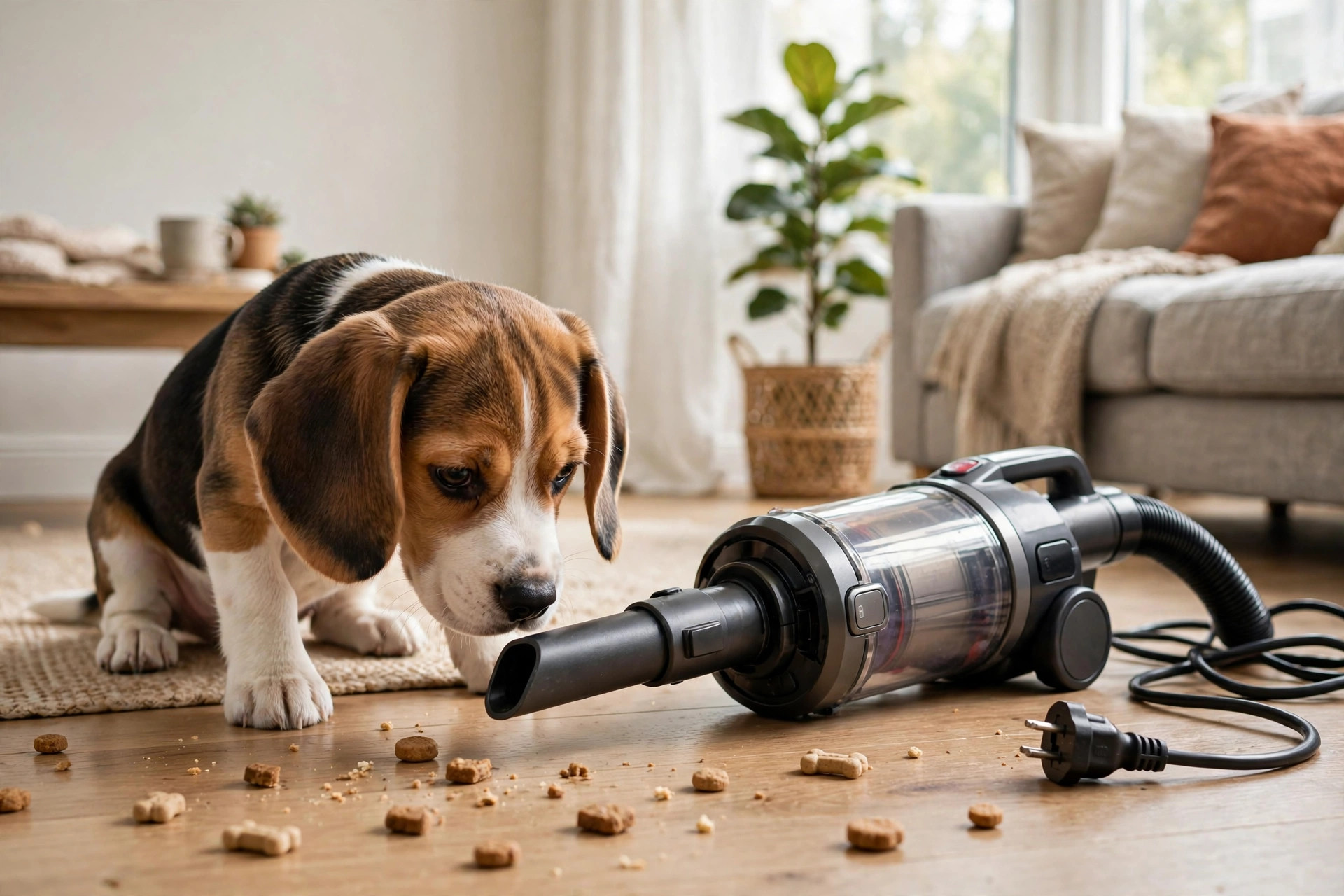
Park the vacuum (off, unplugged) in the middle of the room. Let the puppy investigate on their own terms. Every glance, sniff, or step toward it earns a high-value treat — cheese, chicken, the good stuff. Goal: the puppy voluntarily approaches the scary object. Don’t lure them to it; let curiosity win.
Step 2: Treats Rain Near the Vacuum
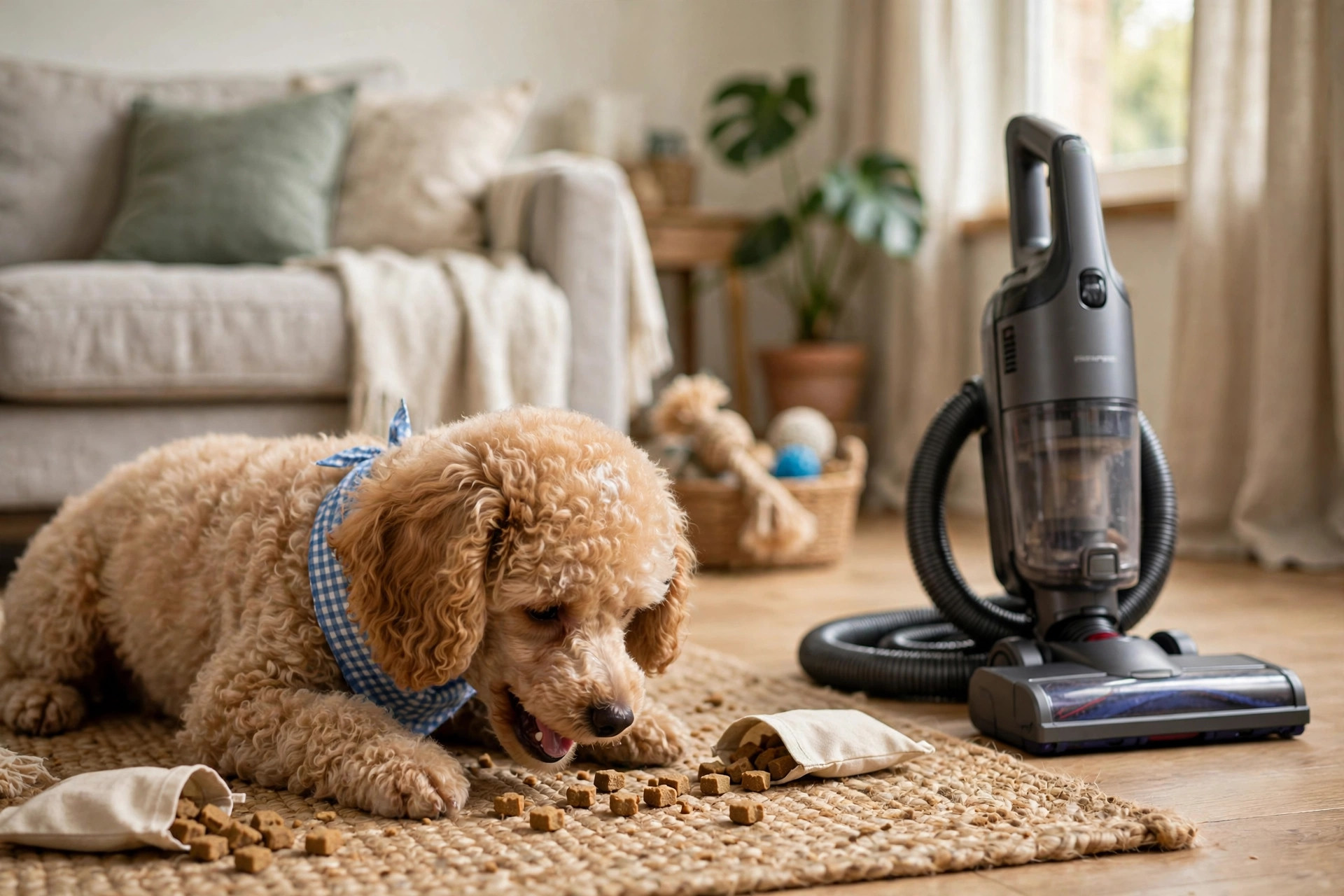
Now the vacuum becomes a treat dispenser. Scatter treats around it — near at first, then closer, then on top of it. Meals can happen next to the vacuum. You’re building the equation: vacuum proximity = amazing things happen. End every session while the puppy is still happy.
Step 3: The Vacuum Moves (Still Off)
Push the silent, unplugged vacuum a few feet while the puppy watches from a comfortable distance, feeding treats the whole time. Then closer. Then let the puppy follow it. The movement ingredient gets defused here — the thing that “charges” is now just a weird cart that predicts chicken.
Step 4: Sound From Another Room
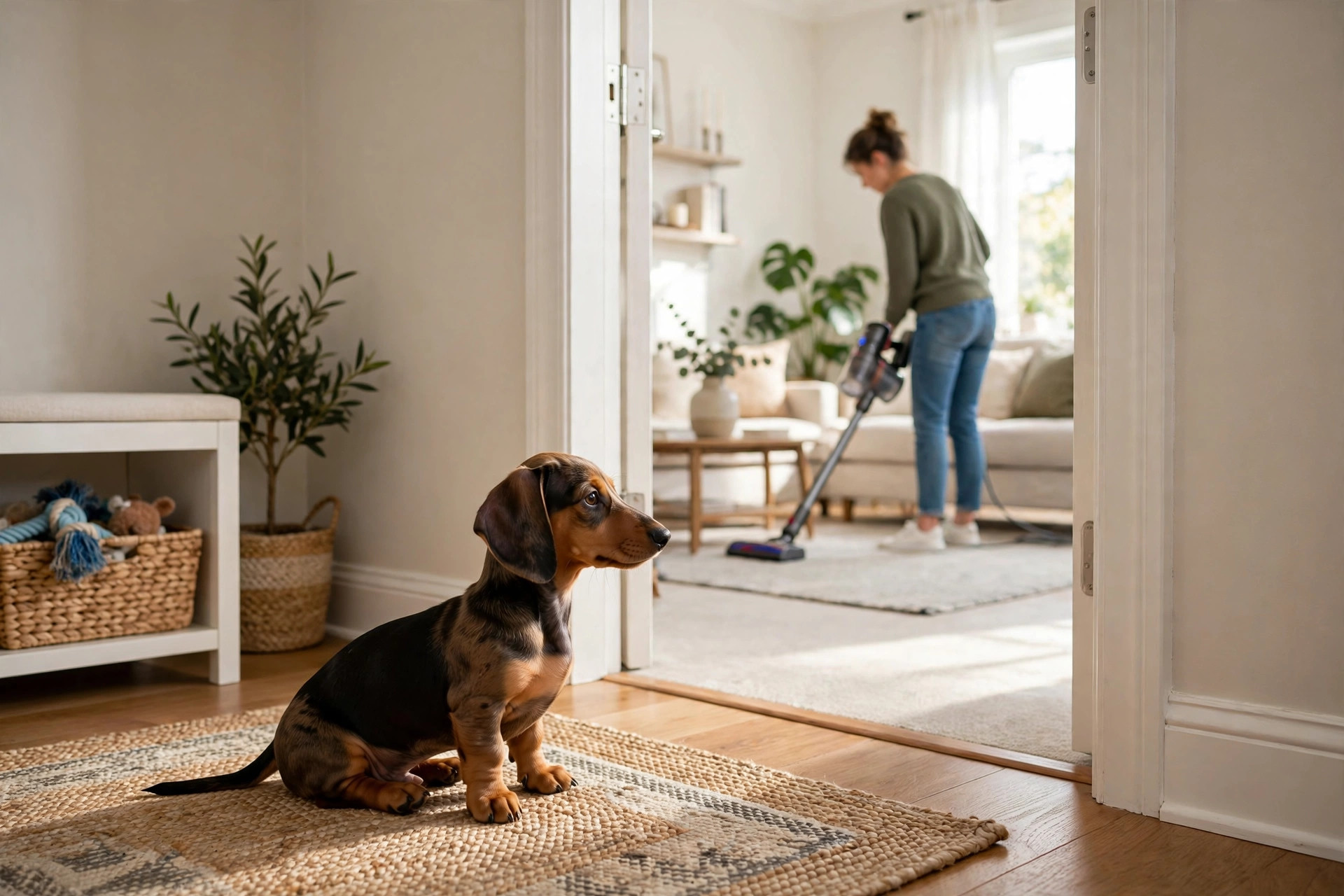
Here’s where most people rush — don’t. Have someone turn the vacuum on in another room (door closed if needed) while you feed the puppy a steady stream of treats. The sound is distant, muffled, and paired with the best food on earth. Over sessions, open the door, then move one room closer. Watch the body language: eating happily and soft body = good; freezing or refusing treats = too close, back up a stage.
Step 5: Sound in the Same Room, at a Distance
Vacuum on, same room, but far — the puppy at the opposite end, treats flowing. Gradually decrease the distance across sessions. This is the step where the reaction visibly flips: you’ll see the moment the puppy hears the roar and looks at you expectantly instead of bolting. That look is the whole game — it means “sound predicts treats” has replaced “sound predicts danger.”
Step 6: Vacuum On and Moving, Far Away
Now combine ingredients: the vacuum runs and moves, but at maximum distance, with you and the treats as the puppy’s anchor. Short bursts at first — 30 seconds on, then off, then treats and play. Lengthen gradually. The puppy learns the full monster is survivable because they’ve already survived each piece separately.
Step 7: Normal Vacuuming, Puppy Relaxed Nearby
The finish line: you vacuum normally while the puppy lounges nearby, maybe chewing a toy, thoroughly unimpressed. You don’t need treats forever — once the fear is gone, the vacuum is just background noise. Keep sessions positive for a few weeks after “graduation” to lock it in.
The 5 Session Rules
- 1. Highest-value treats only. Kibble won’t cut it against a roaring predator. Bring the currency that matters: real meat, cheese, whatever makes your puppy lose their mind.
- 2. Short sessions. Five focused minutes beat thirty exhausted ones. Quit while you’re ahead — always end on a win.
- 3. End on a win. If the puppy nails a step, stop there and celebrate. Never push “one more” after success; that’s how you snatch defeat from victory.
- 4. Never punish fear. Scolding a trembling puppy doesn’t teach bravery — it teaches that the vacuum and you are scary. Fear is an emotion, not disobedience.
- 5. The puppy sets the pace. Skipping steps is the #1 reason desensitization fails. A single flooding experience — too much, too fast — can undo weeks of work. Slow is fast.
What to Do on Vacuuming Day (Practical Management)
While you’re working the ladder, you still need clean floors. Management isn’t cheating — it’s preventing rehearsal of the fear while training does its work. Put the puppy in another room with a stuffed Kong or long-lasting chew during vacuuming. Use the vacuum’s quiet mode if it has one (under 65 dB is roughly normal conversation level). A settle-on-mat cue in the far room gives the puppy a job instead of a panic. And here’s a trainer trick: vacuum one room while the puppy enjoys a sniff walk with someone else — the puppy comes home to clean floors and zero stress, and the fear never gets rehearsed.
Mistakes That Make It Worse
- Dragging the puppy toward the vacuum. Forcing proximity to the scary thing is called flooding, and it deepens fear instead of curing it. The puppy must always have the choice to retreat.
- Laughing at the panic. It’s funny when they bolt — until it isn’t. Your amusement doesn’t reassure them; calm, boring neutrality does.
- Comforting the panic wrong. Here’s the nuance everyone gets wrong: calm petting does not “reward fear” (you can’t reinforce an emotion like you reinforce a behavior). But frantic, high-pitched “it’s okay baby!!” comfort signals that you’re worried too. Be a calm anchor, not a co-panicker.
- Skipping straight to Step 5. Turning the vacuum on near the puppy “to get them used to it” is the single most common mistake — and the fastest way to cement the fear permanently.
- Inconsistent training. Three great sessions, then a month of scary surprise vacuuming, then wondering why the fear is back. Maintenance matters — this is the same consistency principle behind building confidence around other fears too.
When It’s More Than the Vacuum
Some puppies aren’t vacuum-scared — they’re noise-scared, and the vacuum is just the loudest example. Warning signs of generalized noise phobia: panic at thunderstorms, fireworks, hair dryers, blenders, and traffic sounds too; trembling, drooling, or destructive escape attempts; fear that doesn’t improve after 3–4 weeks of proper desensitization. If that sounds like your puppy, talk to your vet — there are safe anti-anxiety options, and a certified behaviorist can build a broader sound-desensitization plan. Our separation anxiety guide covers the same “treat the emotion, not the behavior” principles for another common puppy fear. Medication isn’t failure; it’s a tool that lowers panic enough for training to work.
Frequently Asked Questions
Will my puppy outgrow vacuum fear on his own?
Sometimes — mild cases in young puppies can fade. But fear left alone more often hardens into a lifelong phobia. Two weeks of desensitization now beats two years of couch-hiding later.
How long does desensitization take?
Most puppies show real progress in 2–4 weeks of consistent short sessions. Severe fear can take 2–3 months. The only deadline is the puppy’s comfort — never the calendar.
Should I vacuum around him daily to “get him used to it”?
No — repeated full exposure without the gradual ladder is flooding, not training. Work the steps; manage the rest with another room and a chew toy.
Robot vacuum vs. upright — is one less scary?
Robot vacuums are often worse at first: they move unpredictably on their own, which reads as “living predator.” The same ladder works — start with it off and stationary, then on but docked, then moving at a distance.
Does comforting my scared puppy reinforce the fear?
No — you can’t reinforce an emotion with petting the way you reinforce a behavior with treats. Calm, quiet comfort is fine. What’s harmful is panicked, high-pitched comforting that tells the puppy you’re scared too.
What if my puppy attacks the vacuum?
Charging, barking at, and biting the vacuum is fear wearing an aggressive costume — fight instead of flight. Don’t punish it; go back to Step 1 and rebuild. A puppy who “fights” the vacuum is a puppy who needs the ladder most.
The Bottom Line
Your puppy isn’t being dramatic — they’re responding correctly to something that genuinely looks like a predator. The fix isn’t courage; it’s architecture: furniture first, movement second, sound at a distance third, everything together last.
Work the ladder patiently, and one day you’ll pull out the vacuum and your puppy won’t even look up from their nap. That’s not a small win — that’s a puppy who trusts that the scary things in their world are survivable. And that trust transfers to everything else.
Related Reads
- Puppy Fear Periods: What Every Owner Should Know
- How to Socialize a Puppy Properly
- How to Teach a Puppy to Settle on a Mat (7-Step Calm Method)

