
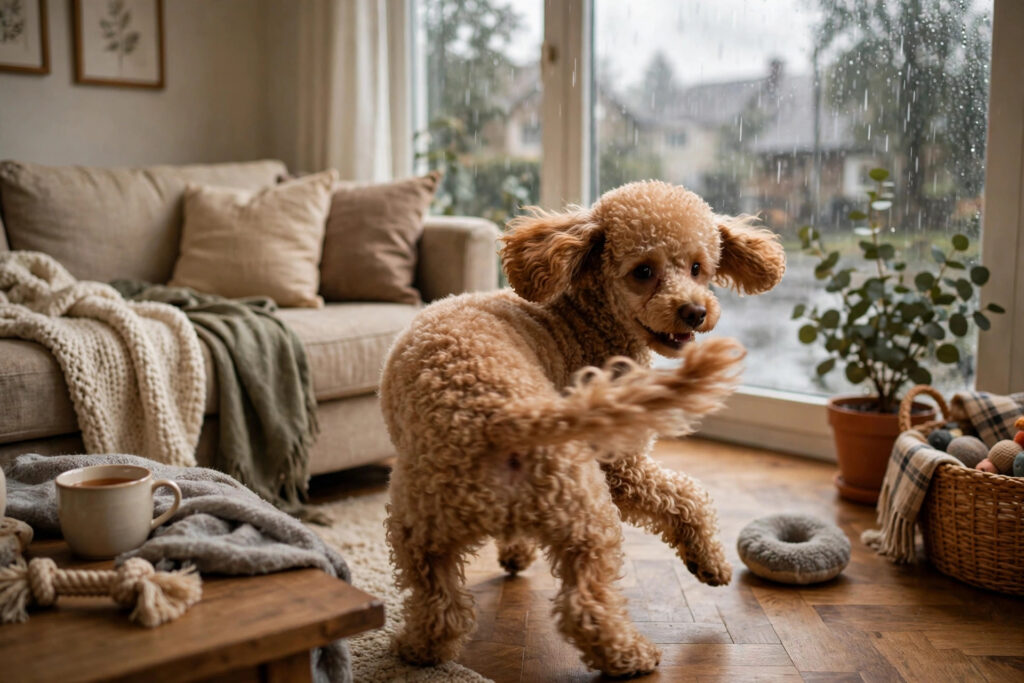
Your puppy spots something moving out of the corner of their eye. They whirl around. They chase it in a frantic circle — round and round, a blur of puppy — and finally catch it. It’s their own tail. And the proud look on their face says they have no idea it was attached to them the whole time.
Tail chasing is one of the funniest things puppies do — and one of the most misunderstood. Here’s the frame for this whole guide: occasional, brief tail chasing is completely normal puppy fun. But tail chasing has a second face, and knowing the difference between “cute” and “call the vet” is one of the most important things a puppy owner can learn. This article gives you both sides: the 4 harmless reasons, the redirect playbook, the red-flag checklist, and the medical causes explained simply.
Why does this distinction matter so much? Because the two faces demand opposite responses. Laugh at harmless spinning and you’ll accidentally train more of it. Ignore compulsive spinning and you’ll miss a medical problem that gets harder to treat the longer it runs. Getting the read right — in about thirty seconds of watching — is a genuine superpower for a puppy owner.
First, the Cute Truth
Puppies are brand new to the world — including their own bodies. A young puppy genuinely may not know the tail is theirs. That flickering thing in their peripheral vision? It moves, it’s interesting, and chasing it is hilarious. Most puppies discover their tail somewhere between 8 and 16 weeks, chase it enthusiastically for a while, and then… get bored of it. Like every other novelty, the tail loses its magic once the puppy’s brain files it under “mine, boring, moving on.”
So if your 10-week-old spins in a circle twice, catches the tail, looks confused, and goes back to napping
 — congratulations, you just witnessed normal puppy development. Enjoy the show.
4 Harmless Reasons Puppies Chase Their Tails
1. Play and Exploration
The #1 reason, and the most wholesome: it’s fun. Puppies explore the world with their mouths and their movement, and a tail is a built-in toy that never gets lost. Brief, bouncy, tail-wagging-while-spinning sessions are play, pure and simple. The tell: the puppy looks happy — loose body, play bows, stopping on their own to do something else.
2. Boredom and Excess Energy
The #1 fixable reason. A puppy with unspent energy will invent entertainment — and the tail is always available. If the chasing happens mostly when the puppy is under-exercised or understimulated (rainy days, long crate stretches, skipped walks), it’s self-entertainment, not a disorder. The fix is beautifully simple: a tired puppy doesn’t chase their tail. They chase a ball instead. Check our guide on how much exercise a puppy actually needs — most owners underestimate it.
3. Attention-Seeking (You Might Have Trained It)
Here’s the counterintuitive one: laughing at the spin trains the spin. So does scolding it, chasing the puppy, or filming it while giggling. To a puppy, any big reaction from you — positive or negative — is a reward. The puppy learns: “spin in circles = the humans go wild.” If the tail chasing reliably starts when you’re watching and stops when you’re gone, congratulations — you’ve been trained. (The fix is in the redirect playbook below.)
4. Breed Tendency
Some breeds are simply spinnier than others. Bull Terriers, German Shepherds, Jack Russell Terriers, Shiba Inus, and Dachshunds are genetically more prone to tail chasing — in Bull Terriers especially, it can tip toward compulsion more easily. If you own one of these breeds, enjoy the extra comedy, but watch a little more carefully for the red flags below. Breed doesn’t doom a puppy to problems; it just lowers the threshold where “fun” becomes “habit.”
The Redirect Playbook
For harmless-but-annoying tail chasing, you don’t need to punish the spin — you need to make everything else more interesting. Four moves:
Before the list, one principle that makes all four work: you’re not fighting the puppy, you’re outbidding the tail. The tail is free, always available, and mildly entertaining. Your job is to offer something better — consistently enough that the puppy’s brain re-ranks its options. Every strategy below is really just a different way of raising your bid.
- Exercise first. A well-exercised puppy is the foundation. Match activity to your puppy’s age and breed — and remember that mental exercise (sniff walks, puzzle feeders, training games) tires a puppy faster than physical exercise alone. Our calm-down routine guide pairs perfectly with this.
- Enrich the environment. Boredom is the enemy. Rotate toys so old ones feel new, add food puzzles, teach a new trick every week. A puppy with a job doesn’t need to invent one.
- Ignore the spin, reward the calm. When the spinning starts, don’t laugh, don’t scold, don’t even look — become boring. The instant the puppy stops and does literally anything else, mark and reward that. You’re not punishing the spin; you’re making “not spinning” pay better.
- Redirect, don’t react. If the puppy is mid-spin and you need to break it, don’t chase or shout — calmly produce a toy or start a short training game. You’re offering a better deal, not a confrontation. This is the same impulse-control principle behind teaching a puppy not to bite: redirect the energy, don’t fight it.
The Red-Flag Checklist: When to Call the Vet
Here’s the line where “cute” ends. Call your vet if you see any of these:
- Sudden onset — a puppy who never chased their tail starts doing it intensely, out of nowhere
- Can’t be interrupted — you call their name, offer a treat, squeak a toy, and the puppy doesn’t even register you. Normal play pauses; compulsion doesn’t.
- Biting the tail raw — chewing, gnawing, or breaking the skin on the tail or hindquarters
- Rear-end signs — scooting, licking the rear excessively, or visible irritation around the tail base
- Glazed or “absent” episodes — the puppy seems to zone out mid-spin, unresponsive, almost trance-like. This can resemble seizure activity and needs a vet’s eyes.
- It’s getting worse, not better — frequency and intensity climbing week over week despite exercise and redirection
Trust your gut here. You know your puppy’s normal — if the spinning feels wrong, it deserves a professional opinion. A vet visit for a false alarm costs a checkup; missing a real problem costs much more.
Medical Causes, Explained Simply
When tail chasing isn’t play, it’s usually the body talking. The common culprits:
A quick note on how to use this list: you’re not diagnosing — you’re deciding whether a vet visit is warranted. If any of these sound plausible for your puppy, that’s not a reason to worry; it’s a reason to book the appointment. Vets see these patterns daily, and most have simple fixes. The only wrong move is waiting to see if it “goes away” while the puppy suffers.
- Fleas and ticks — itching around the tail base drives frantic spinning and biting. Check the skin under the fur.
- Tapeworms — segments near the rear cause intense itching; scooting plus spinning is the classic combo.
- Impacted anal glands — uncomfortable fullness back there makes puppies spin, scoot, and lick. A quick vet expression usually fixes it.
- Tail injury — a sprain or fracture (tails get caught in doors) makes the puppy obsess over the painful spot.
- Allergies — environmental or food allergies often show up as rear-end itching first.
- Canine compulsive disorder (CCD) — the serious end: the dog equivalent of OCD in humans. Repetitive, ritualistic spinning the dog can’t stop, sometimes for hours. It’s a genuine neurological condition — treatable with behavior modification and sometimes medication, but it needs a veterinary behaviorist, not just more walks.

What NOT to Do
- Don’t chase him back. Joining the game teaches the puppy that spinning summons playtime with you. You’ll never un-train that.
- Don’t laugh-reward it (or scold-punish it) if you want it to stop. Both are attention, and attention is fuel. Be boring about the spin.
- Don’t punish the spinning. Yelling at or startling a mid-spin puppy doesn’t teach “stop” — it adds anxiety to whatever was driving the behavior, which makes compulsive patterns more likely, not less.
- Don’t ignore a sudden change. New, intense, or escalating tail chasing is information. The puppy is telling you something — listen with a vet visit, not with hope.
Frequently Asked Questions
Is tail chasing normal in puppies?
Brief, occasional, happy tail chasing is completely normal — it’s play and exploration. It becomes a concern when it’s frequent, intense, uninterruptible, or paired with self-injury.
Will my puppy grow out of it?
Most do — the novelty wears off as the puppy matures, usually by 6–12 months, especially with good exercise and enrichment. If it’s escalating instead of fading, see the red flags above.
How much exercise stops tail chasing?
There’s no magic number — it depends on breed, age, and the individual puppy. But as a rule: if the chasing clusters around under-exercised days, more activity is the answer. Both physical and mental exercise count.
Can tail chasing become compulsive?
Yes — that’s the real risk, especially in predisposed breeds. The progression is: fun → habit → compulsion. Catching it at “habit” with redirection and enrichment is easy; treating full CCD needs professional help. Early action matters.
Do docked tails matter?
Puppies with docked tails still “chase” — they spin toward the stub. The behavior and its meanings are the same; the medical red flags apply equally.
Should I film it for the vet?
Yes — absolutely. A 30-second video of the behavior is worth a thousand words in the exam room. Vets diagnose patterns they can see far better than patterns you describe. Film the concerning episodes, not the cute ones.
The Bottom Line
Most tail chasing is a puppy discovering their own body and having a blast doing it — enjoy it, film it, laugh (quietly, so you don’t train it). But keep one eye on the line: sudden, intense, uninterruptible, or self-injuring spinning isn’t comedy anymore. That’s a vet visit.
The beautiful thing about this particular behavior is that the fix for the harmless version is the same prescription behind almost everything in puppyhood: exercise, enrichment, and calm consistency. A puppy with a full, interesting life doesn’t need to chase their own tail for entertainment — they’re too busy living.
And if your puppy is mid-spin right now as you read this? Smile. Then go grab a ball. The tail will still be there tomorrow — and ideally, it’ll be a lot less interesting than the game you’re about to play.
One last thought for the worried owners — the ones who Googled this at midnight because the spinning looked scary: the fact that you’re reading a 2,000-word guide about your puppy’s behavior means you’re already doing the most important thing right. You’re paying attention. Most problems in this article are caught early by owners exactly like you, and early is when everything is fixable. Trust your eyes, trust your gut, and enjoy the comedy while it lasts.