
There’s nothing quite like the moment your puppy performs his first trick on cue — the proud little sit, the triumphant paw in your hand, the happy spin that ends in a treat. If you’re looking for easy tricks to teach your puppy, you’re in the right place. Tricks aren’t just party pieces for impressing guests; they’re one of the fastest ways to bond with your puppy, tire out his busy brain, and build the communication that makes all future training easier.
The beautiful thing about easy tricks to teach your puppy is that you don’t need any special talent or equipment — just treats, patience, and five minutes at a time. Every trick below is beginner-friendly, uses positive reinforcement only, and can be learned by most puppies within a few short sessions. We’ve ordered them from simplest to slightly more challenging, so you can work through the list in order and stack small wins.
Before we dive in, one important note: keep it fun. If your puppy (or you) gets frustrated, you’re pushing too hard. Trick training should feel like a game — because to your puppy, that’s exactly what it is. And here’s a bonus most people don’t expect: puppies who learn tricks tend to be easier to train in everything else, because they’ve learned the most important lesson of all — that listening to you pays off. Ready? Let’s teach some tricks.
Before Trick #1: The 3 Rules of Trick Training
These three rules apply to every trick on this list. Get them right and everything else becomes dramatically easier:
Rule 1: Keep sessions ridiculously short
Five minutes. That’s it. Puppies have the attention span of a goldfish with somewhere better to be, and ending while he’s still having fun keeps him hungry for the next session. Two or three five-minute sessions a day beats one exhausting half-hour session every time. If you’re wondering how training fits into his day, our puppy training schedule by age shows exactly what a balanced training day looks like at every stage.
Rule 2: Pay well and pay fast
Use small, soft, smelly treats — cheese, boiled chicken, freeze-dried liver. The reward must land within 2–3 seconds of the correct behavior, or your puppy won’t connect the dots. For tricks, “jackpot” generously in the early stages: three or four treats for a breakthrough moment tells him that was the thing you wanted.
Rule 3: Name it last
This is the mistake almost every beginner makes: saying “shake! shake! shake!” while the puppy has no idea what you want. Instead, lure or shape the behavior first, reward it several times, and only then add the verbal cue. The word should predict a behavior he already understands — not confuse him while he’s guessing.
The 10 Easy Tricks (In the Best Order to Teach Them)
Work through these in order. Each trick builds confidence and communication for the next one.
1. Sit — the foundation of everything
Difficulty: Easiest | Typical learning time: 1–3 sessions
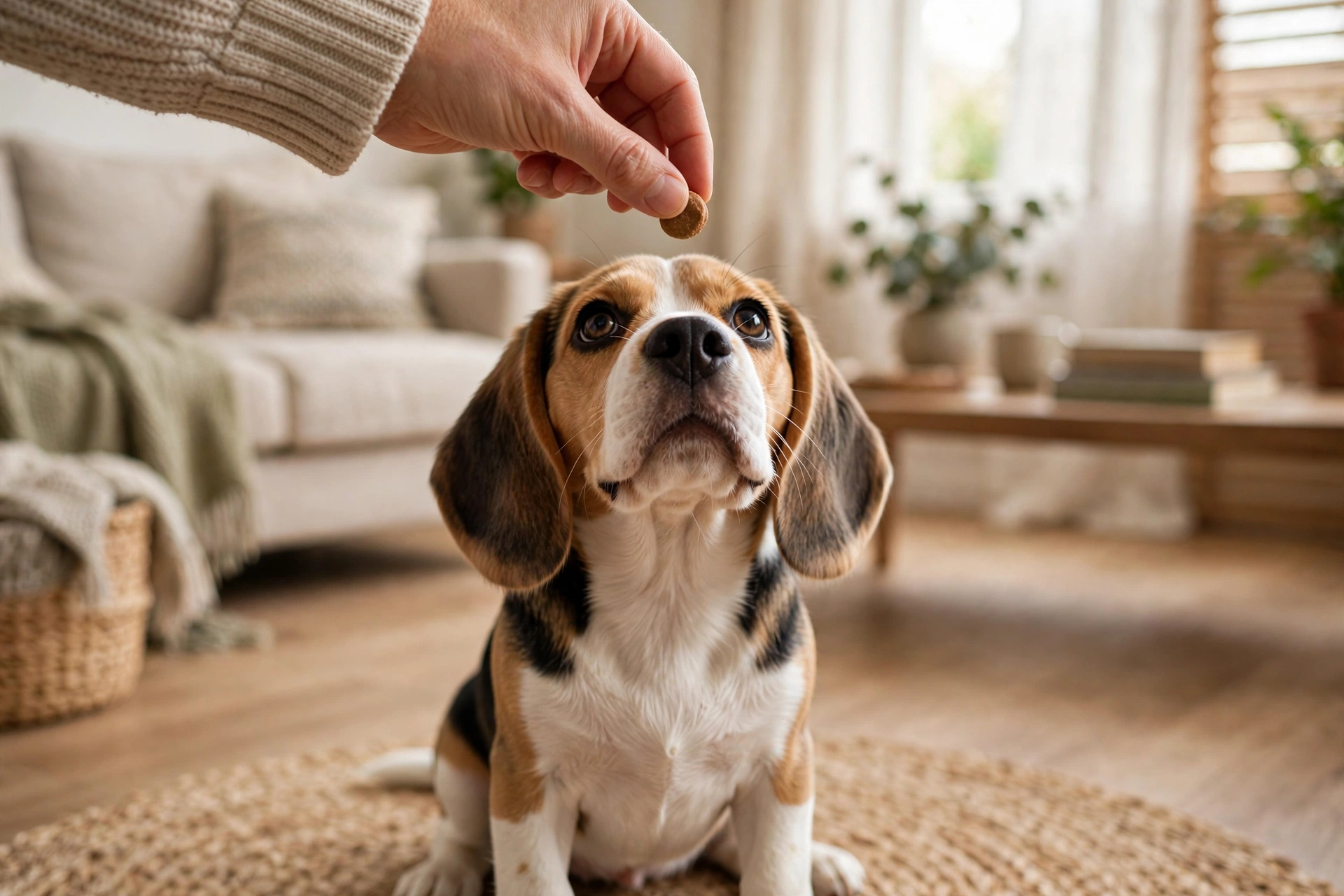
The classic first trick, and the foundation half of all other tricks are built on. Hold a treat close to your puppy’s nose, then slowly move your hand up and back over his head. As his nose follows the treat up, his bottom naturally drops down. The instant his bottom touches the floor, mark it (“yes!”) and reward. Repeat a handful of times, then start adding the word “sit” just before you lure. We’ve covered this one in full detail in our step-by-step sit guide if you want the deep dive.
Pro tip: Never push his bottom down. The lure does the work — forcing it creates a puppy who hates the whole game.
2. Shake / Paw — the crowd-pleaser
Difficulty: Easy | Typical learning time: 2–4 sessions
Once he can sit, shake is the natural next step. With your puppy sitting, hold a treat in your closed fist and present it near his chest. Most puppies will paw at your hand trying to get it — the moment a paw lifts off the ground, mark and reward. After a few repetitions, start offering your open palm and add the cue “shake.” Soon he’ll be offering his paw before you even ask (which is adorable and slightly annoying in the best way).
Pro tip: If he mouths your hand instead of pawing, keep your fist closed and be patient. The paw always comes eventually.
3. Down — calm on cue
Difficulty: Easy | Typical learning time: 2–5 sessions
Start with your puppy in a sit. Hold a treat at his nose, then lower it straight down to the floor between his front paws, then slide it slightly toward you along the ground. His body follows the treat into a down. Mark and reward the moment his elbows touch the floor. Some puppies pop their bottoms up — if yours does, reward in stages: first for the elbows bending, then for the full down.
Pro tip: Practice on a non-slippery surface. Puppies hate sliding into a down on tile and will simply refuse.
4. Touch (hand target) — the most useful “trick” here
Difficulty: Easy | Typical learning time: 1–3 sessions
Hold your flat palm out near your puppy’s nose. The moment he sniffs or bumps it with his nose, mark and reward. That’s it — that’s the whole trick, and most puppies get it within minutes. Once it’s reliable, you can use “touch” to redirect his attention anywhere, guide him into positions, and even build a bulletproof recall foundation later. This one looks simple but quietly becomes the most-used tool in your training kit.
Pro tip: Present your hand, don’t chase his nose with it. Let him come to you.
5. Stay — impulse control in disguise
Difficulty: Easy-medium | Typical learning time: 1–2 weeks of short practice
Ask for a sit, show your flat palm like a stop sign, say “stay,” and take one step back. If he holds position for even two seconds, rush back, reward, and release him with an “okay!” Build duration before distance: five seconds before five steps. The release word matters as much as the stay itself — it teaches him that holding still ends with permission, not with you drifting away forever. For the full progression from seconds to minutes, see our stay training guide.
Pro tip: If he breaks, you’ve asked for too much too soon. Make the next rep easier, not harder.
6. High Five — shake’s flashy sibling
Difficulty: Easy | Typical learning time: 1–3 sessions
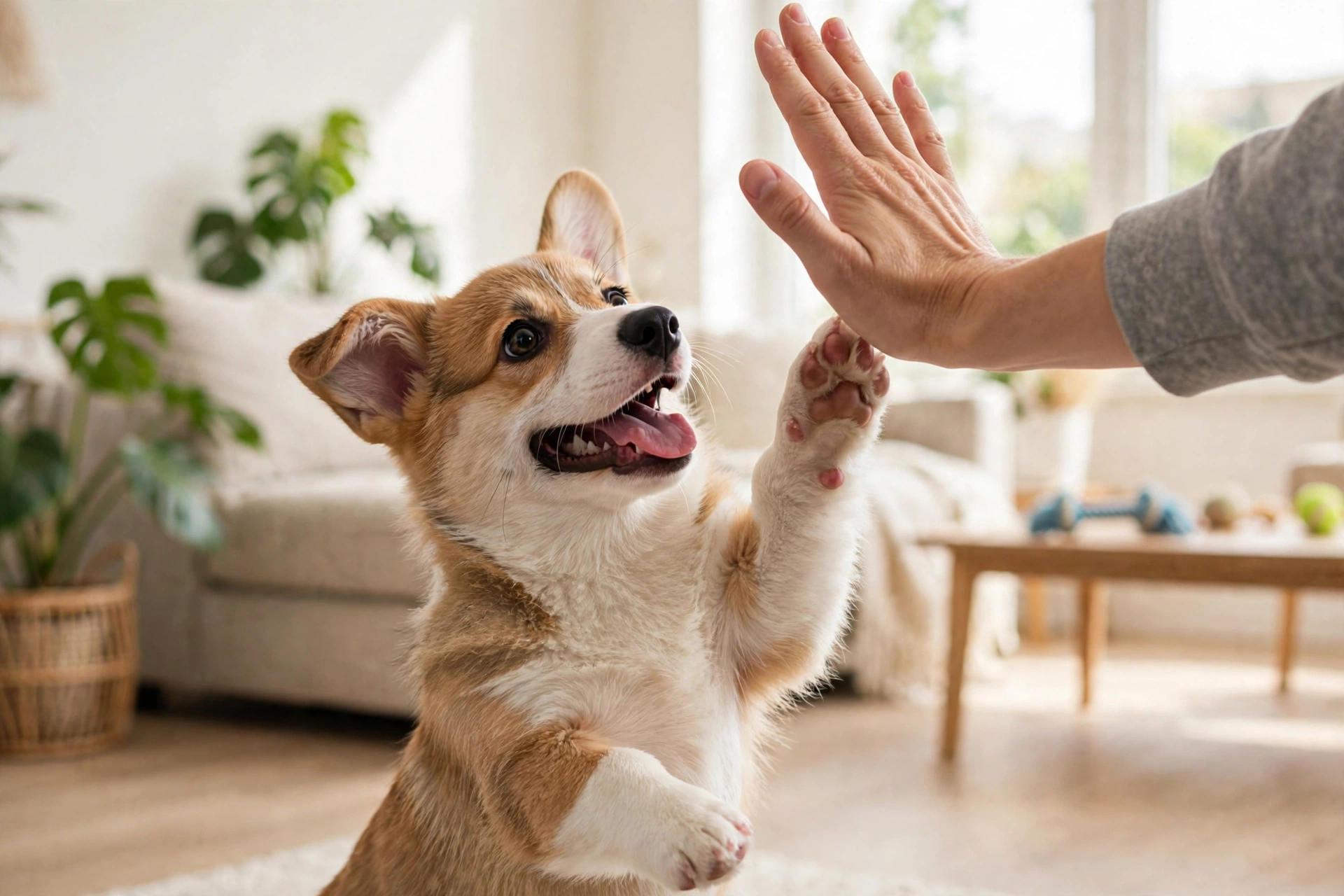
This is just “shake” with your hand held vertically instead of horizontally. Ask for a sit, raise your palm like you’re stopping traffic, and wait. He’ll paw at it the same way he learned for shake — mark, reward, add the cue “high five!” Puppies usually pick this up almost instantly once they know shake, which makes it a fantastic confidence booster early in your trick journey.
Pro tip: Keep your hand steady. Waving it around turns the trick into a swatting game.
7. Spin — the energy burner
Difficulty: Easy | Typical learning time: 2–4 sessions
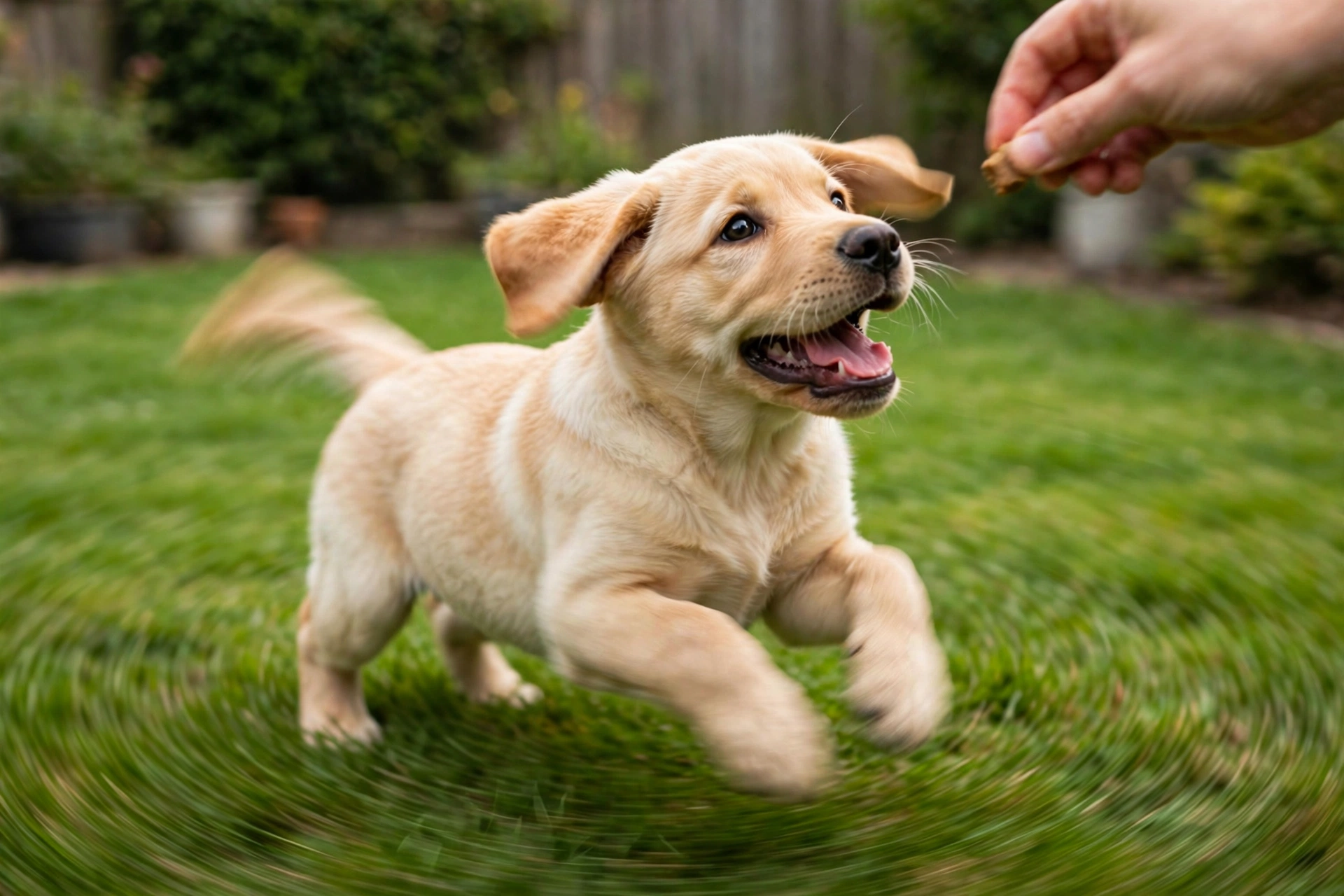
Hold a treat at your puppy’s nose and slowly move it in a wide circle. His body follows his nose, and around he goes. Mark and reward the moment he completes the circle. Start with big, slow circles and tighten them as he gets the idea. Teach one direction first (“spin”), then the other (“twist”) — puppies, like people, usually have a preferred turning side.
Pro tip: Dizzy puppies lose interest fast. Three or four spins per session is plenty.
8. Roll Over — the showstopper
Difficulty: Medium | Typical learning time: 3–7 sessions
Start from a down. Hold a treat at his nose and slowly arc it toward his shoulder, encouraging him to flop onto his side. Reward the side-flop first — it’s a big deal for a puppy to offer it voluntarily. Then continue luring the treat over his shoulder so momentum carries him all the way around. Add the cue “roll over” once he’s completing the motion. Break it into stages (down → side → full roll) and celebrate each stage like he just won a championship.
Pro tip: Some puppies dislike exposing their belly at first. Never force it — reward every inch of progress and the full roll will come.
9. Bow — the natural performer
Difficulty: Medium | Typical learning time: 3–6 sessions
Here’s a secret: puppies bow naturally when they stretch or invite play. The trick is simply catching it. When you see that play-bow stretch (front down, rear up), say “bow!” and reward immediately. To teach it deliberately, lure from a stand: treat at his nose, down to the floor between his paws — but the moment his elbows bend, reward before his rear drops into a full down. You’re rewarding the in-between moment, which is exactly what a bow is.
Pro tip: This is the trick guests ask about most. “How did you teach him THAT?” gets old in the best way.
10. Find It — nose work for beginners
Difficulty: Easy | Typical learning time: 1–2 sessions
Let your puppy watch you place a treat on the floor a few feet away, say “find it!”, and let him go get it. Gradually make it harder: place treats while he’s in another room, hide them under cups, tuck them into corners. This trick is secretly genius — ten minutes of sniffing tires a puppy out more than a thirty-minute walk, and it channels his natural instincts instead of fighting them.
Pro tip: Start ridiculously easy. Early wins build the searching habit; difficulty comes later.
Level Up: Chaining Tricks Into Routines
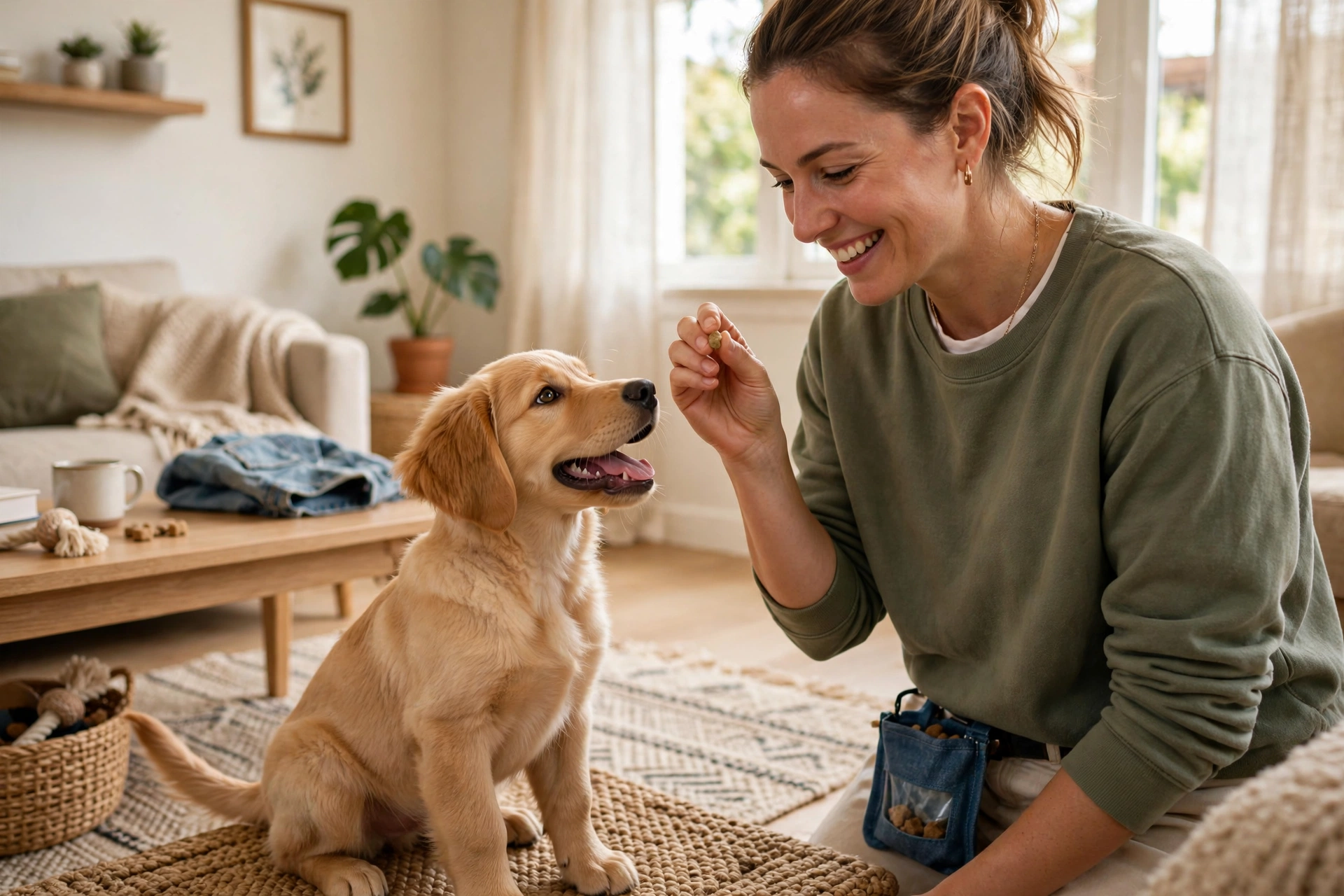
Once your puppy knows three or four tricks, the real fun starts: chaining them together. Ask for a sit, then a shake, then a spin — rewarding only at the end of the sequence. Start with two-trick chains, then build to three or four. Chaining teaches your puppy to listen through multiple cues without a treat after every single one, which is exactly the skill he needs for real-world obedience.
Keep chains short and always end with his favorite trick — you want the sequence to finish on a high. And don’t be surprised when he starts anticipating: offering a spin before you cue it just means he’s thinking ahead, which is precisely what you want. Simply wait for the actual cue before rewarding, and the anticipation sorts itself out within a few sessions.
Troubleshooting: When a Trick Isn’t Clicking
Stuck on one of the easy tricks to teach your puppy? Run through this checklist:
- He loses interest after a minute. Your sessions are too long or your treats are too boring. Cut to three minutes, upgrade to real meat or cheese, and try again later. A tired or full puppy is a bad student — train before meals, not after.
- He knows it at home but “forgets” outside. He hasn’t forgotten — distractions are just harder. Every new location resets the difficulty. Retrain each trick in new places starting from the easiest version.
- He offers random behaviors frantically. He’s guessing because the criteria are unclear. Go back one step to the last thing he got right, reward that generously, and rebuild more slowly.
- He won’t take treats. He’s either stressed, over-faced, or full. End the session on a happy note and try later with higher-value rewards. Stress kills appetite and learning together.
- He was doing great, then suddenly “forgot” everything. Regression is a normal part of learning — especially during adolescence. Don’t panic and don’t punish; just go back to easier reps and rebuild from the last thing he got right.
- He only performs for one family member. Dogs don’t generalize well — “sit” for mom is a different cue than “sit” for dad in his mind. Have every family member train each trick using the same cues and the same rewards, and he’ll figure out it applies to everyone.
- You feel like you’re doing it wrong. You’re probably making one of the classic beginner errors — training too long, repeating cues, or luring forever without fading the lure. Our puppy training mistakes guide covers the big ones and how to fix each.
Remember: the goal was never a perfect performance. A puppy who joyfully offers a wobbly spin is learning far more than a drilled puppy performing a flawless routine he hates. Keep it light, keep it fun, and the tricks will come.
Frequently Asked Questions
What age can I start teaching my puppy tricks?
As early as 8 weeks! Young puppies are learning machines. Keep sessions to 2–3 minutes at that age and focus on sit, touch, and find it — the simplest of the easy tricks to teach your puppy. Formal training can wait; fun learning starts now.
How many tricks should I teach at once?
Work on one or two at a time. Puppies learn faster with focused repetition, and juggling five half-learned tricks just creates confusion. Master one, then add the next while maintaining the first with occasional practice.
My puppy only does tricks when he sees treats. What do I do?
Totally normal — it means the behavior isn’t fully learned yet. Keep rewarding every time during learning, then gradually shift to a variable schedule: reward the fastest, happiest responses and occasionally surprise him. Fade the visible lure (treat in hand) before you fade rewards themselves.
How long should trick training sessions be?
Three to five minutes for young puppies, up to ten for adolescents. Always end while your puppy still wants more — quitting on a high note is the single best thing you can do for tomorrow’s session.
Can I teach tricks to an older puppy or adult dog?
Absolutely — dogs learn at every age. The same easy tricks to teach your puppy work for adolescents and adults; you may just need slightly higher-value rewards to compete with established habits.
What if my puppy just isn’t interested in training?
Check the basics first: is he tired, full, stressed, or distracted? Then upgrade your rewards and shorten sessions. If disinterest persists across days, rule out anything medical with your vet — a puppy who won’t engage at all is telling you something.
Related Reads
- How to Train a Puppy to Sit: Step-by-Step
- Puppy Training Schedule by Age: What to Teach When
- Why Does My Puppy Ignore Me? (And How to Get Him to Listen)

