
Your sweet, wiggly puppy is happily chewing a bone — and then you walk past his bed, and a low growl rumbles out of him. Or you reach for the sock he just stole, and he freezes, stares hard, and curls his lip. It is an unsettling moment. The puppy who licks your face in the morning just sounded… threatening. If you have been searching for puppy resource guarding with a knot in your stomach, here is what you need to hear first: this is one of the most common puppy behaviors, it is explainable, and it is fixable — but only if you handle it the right way. The wrong response can make it much worse.
This guide explains what resource guarding really is (spoiler: it is not your puppy being “dominant” or “bad”), why puppies do it, the warning signs to watch for, the mistakes that escalate it, and a positive, step-by-step plan to fix it. We will also be honest about when this stops being a DIY project and becomes a call-a-professional situation — because with guarding, safety always comes first.
What Puppy Resource Guarding Actually Is
Resource guarding is when a dog uses body language — freezing, staring, growling, snapping — to keep someone away from something he values. Food bowls are the classic trigger, but puppies guard all kinds of things: chew bones, favorite toys, a stolen sock or tissue, a comfortable resting spot, and sometimes even a favorite person.
Here is the part most owners find surprising: guarding is a normal, natural behavior. Dogs evolved from animals that had to protect their food to survive. A puppy who stiffens over a bone is not being “dominant,” spiteful, or badly behaved — he is running ancient software that says valuable things get taken, so protect them. Understanding this changes everything about how you respond to it.
That does not mean you ignore it. Guarding is normal, but it is not something you want rehearsed and strengthened — especially in a house with kids or other pets. The goal is not to punish the behavior out of your puppy. The goal is to change how he feels about people approaching his stuff: from “threat — protect it” to “oh good, people coming near my food means even better things happen.” That shift is entirely achievable with patient, reward-based training.
Why Puppies Guard: 6 Causes
Guarding does not come out of nowhere. One or more of these factors is usually behind it, and knowing which ones apply to your puppy helps you train smarter.
1. Instinct — Guarding Is Hardwired
Every puppy is born with some guarding instinct; it is part of the canine operating system. Some individuals and some breeds simply feel it more strongly than others. A puppy does not need a bad experience to guard — sometimes the instinct alone is enough, especially around extremely high-value items like a fresh bone. This is why even well-raised puppies from loving homes can guard.
2. Learned Scarcity — He Once Had to Compete
Puppies who had to compete for food with littermates, or who come from shelter or rescue backgrounds where resources were unpredictable, often guard more intensely. If early life taught your puppy that food disappears or that he has to eat fast before someone else gets it, guarding is a completely logical strategy from his point of view. Scarcity thinking can linger long after the scarcity is gone.
3. High-Value Items Trigger Stronger Guarding
Notice that your puppy could not care less when you walk past his kibble, but growls over a bully stick? That is textbook. The more valuable the item feels to the puppy, the stronger the guarding. Novel items, smelly chews, stolen “contraband” like socks, and anything he is not allowed to have all rank high on the puppy value scale. Guarding intensity follows value, not logic.
4. Unintentional Training — Humans Taught Him People Mean Loss
This is the big one, and it is painfully common. Every time an owner repeatedly swoops in and takes the food bowl away “to teach him a lesson,” or constantly snatches toys from his mouth, the puppy learns a clear lesson — just not the intended one. He learns that people approaching his things means his things disappear. Of course he starts guarding. The human created the very problem they were trying to prevent.
5. Stress, Tiredness, or Pain Lower His Tolerance
A puppy who never guards at breakfast might growl over an evening chew. Just like people get snappier when they are exhausted, a puppy’s tolerance drops when he is overtired, overstimulated, stressed from a busy day, or dealing with discomfort like teething pain. If guarding appears suddenly or only at certain times, look at what else is going on in his day before assuming the worst.
6. Adolescence Can Intensify It
Many owners report guarding getting bolder between 6 and 14 months. Adolescent brains are rewiring, confidence is shifting, and behaviors that were mild in a young puppy can sharpen. This is also the age when owners sometimes relax their training — which is exactly the wrong moment to relax it. Consistent, positive practice through adolescence keeps mild guarding from hardening into a serious habit.
The Warning Ladder — How Guarding Escalates
Guarding almost never jumps straight to a bite. Dogs give a ladder of escalating signals, and each rung is communication — your puppy telling you he is uncomfortable before doing anything about it. Learning to read this ladder is one of the most important skills a dog owner can have.
From subtlest to most obvious, the rungs look like this:
- Freezing or stiffening over the item — his body goes still, muscles tense. This is the earliest and most commonly missed signal.
- Hard stare — a fixed, intense look at the approaching person, sometimes with a “whale eye” (whites of the eyes showing).
- Lip lift or showing teeth — the muzzle wrinkles and teeth appear. He is raising the volume.
- Growl — the famous warning. It sounds scary, and that is exactly its purpose: to make the threat back off without a fight.
- Snap — a quick bite at the air, deliberately missing. The final warning.
- Bite — actual contact. This is what every earlier rung was trying to prevent.
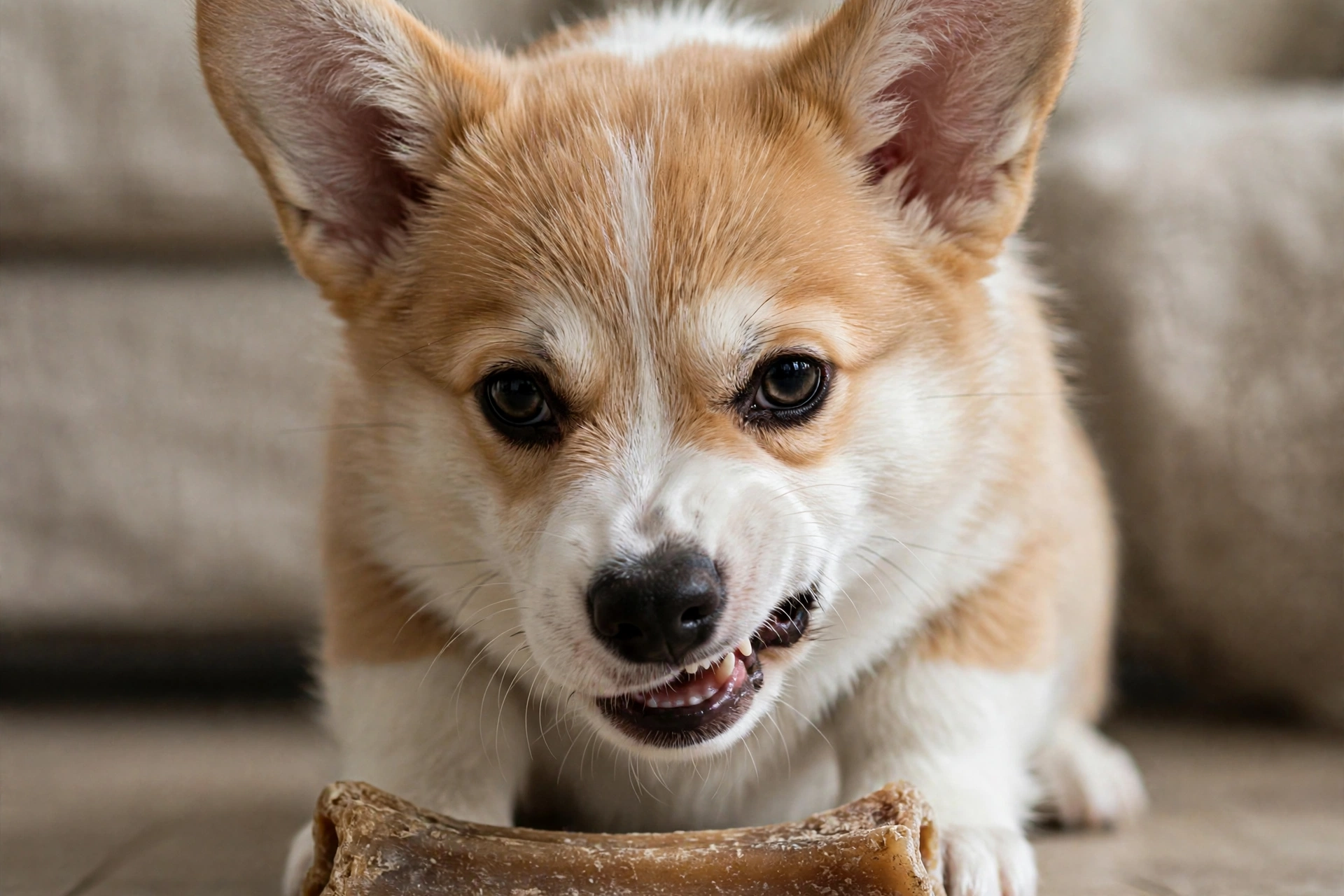
Here is the critical insight: the growl is a gift. A puppy who growls is a puppy who is still choosing communication over action. Dogs who are punished for growling do not stop feeling threatened — they just learn to skip the warning. That is how you end up with a dog who “bites out of nowhere.” He did not bite out of nowhere; his warnings were punished away one by one.
The golden rule of guarding: never punish the warning. A growl is information, not defiance. Your job is to change the feeling underneath the growl, not to silence the growl itself.
What NOT to Do: Mistakes That Make Guarding Worse
With guarding, the instinctive human responses are almost all counterproductive. Each of these common mistakes teaches your puppy the exact opposite of what you want him to learn.
Do not punish or scold the growl. Yelling at, scruffing, or otherwise punishing a growling puppy does not make him feel safer about people near his food — it confirms that people near his food are dangerous. Worse, it teaches him that warning you gets him punished, so next time he may skip the growl and go straight to the snap. You have not fixed the guarding; you have removed the early-warning system.
Do not repeatedly take the food bowl away “to show who’s boss.” This old-school advice is one of the most damaging myths in dog training. There is no “boss” lesson being learned. What your puppy learns is that humans approaching his bowl predict loss — which is precisely what makes a guarder guard harder. If you want him relaxed about people near his food, people near his food need to predict good things, not theft.
Do not corner, intimidate, or physically force him off items. Backing a guarding puppy into a corner, looming over him, or prying his jaws open turns a manageable situation into a confrontation. A frightened, cornered dog with a high-value item is the most likely dog to bite. Every confrontation also deposits another bad memory into his “people near my stuff = danger” account.
Do not let children test or tease a guarding puppy. Kids should never be used to “proof” a puppy’s tolerance — no taking his bone to see what happens, no hugging him while he eats, no “playing” keep-away with guarded items. Children are the most common bite victims in guarding incidents, partly because they miss the early warning signals and partly because they are at face height. Management and kid-rules are non-negotiable (more on that below).
Do not assume it will just go away on its own. Mild guarding in a very young puppy sometimes fades — but rehearsed guarding strengthens. Every successful growl that makes a person retreat teaches the puppy that guarding works. Left alone, guarding typically spreads: from the food bowl to chews, to toys, to stolen items, to resting spots. Early, positive intervention is far easier than undoing an entrenched habit.
The Positive Fix: A 5-Step Training Plan
Now the good news. Puppy resource guarding responds beautifully to reward-based training, because the whole problem is an emotional one: your puppy feels threatened when people approach his things. Change the emotion, and the behavior follows. Work through these steps in order, at your puppy’s pace — not yours.
Step 1: Stop All Confrontations Immediately — Management First
Before training starts, the rehearsals stop. No more snatching things from his mouth, no more bowl-grabbing “lessons,” no cornering him to get a sock back. If he has something dangerous, trade for it (Step 4) or manage the environment so he cannot get it — do not chase or wrestle. Every confrontation-free day is a day his “people = threat” association gets weaker instead of stronger. Management is not giving up; it is the foundation training stands on.
Step 2: The Trade-Up Game — Approach Means Good Things
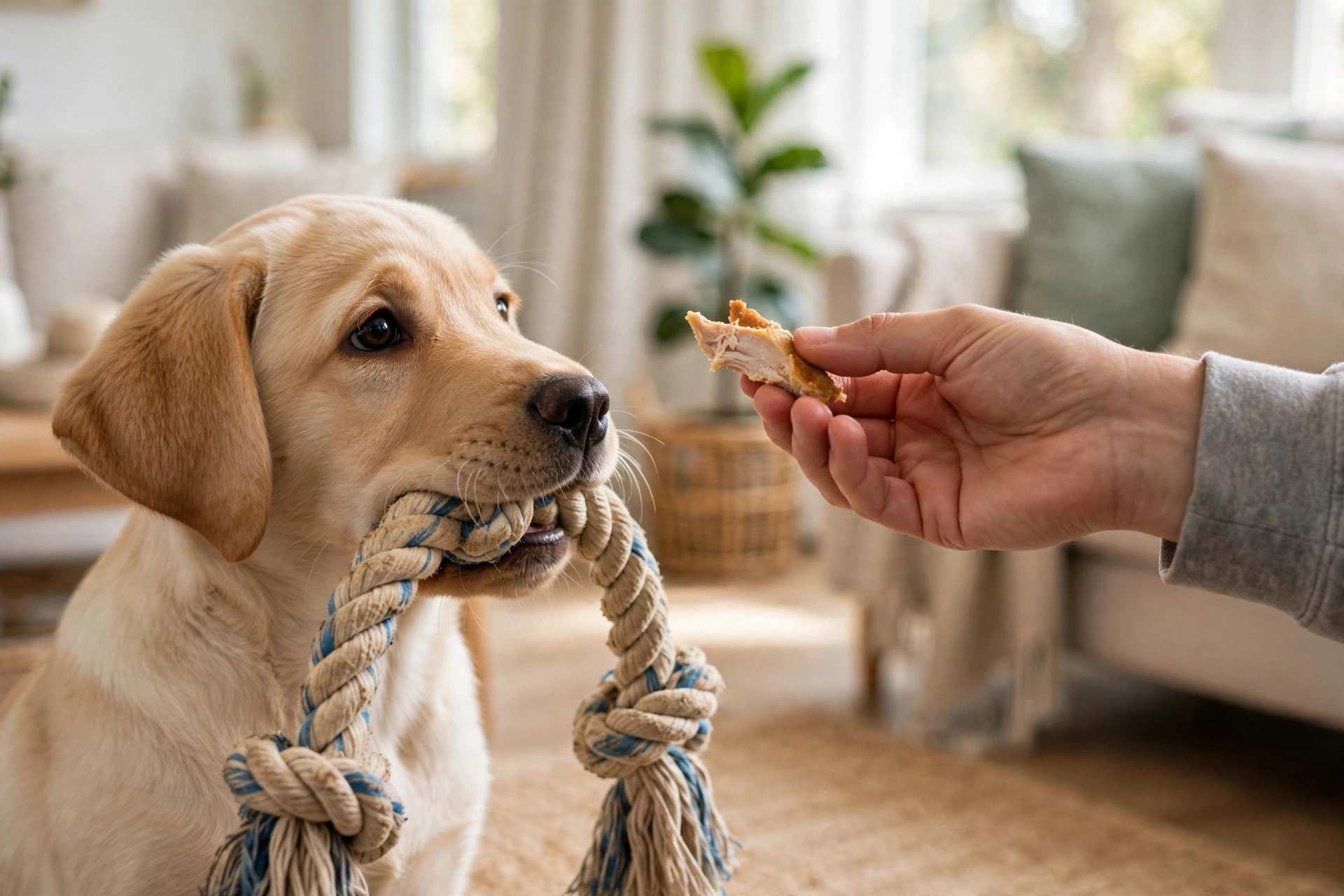
This is the core exercise, and it is beautifully simple. While your puppy is eating or chewing, walk past at a comfortable distance and toss a high-value treat (chicken, cheese — something better than what he has) near him, then keep walking. Do not reach for his food. Do not linger. Just: human appears → amazing treat rains from the sky → human leaves.
Repeat this many times over many days. You are rewriting the association from the ground up: people approaching his resources used to predict loss; now they predict bonus. Most puppies start perking up happily at human approaches within a couple of weeks. That tail wag when you walk toward his bowl is the sound of guarding dissolving.
Step 3: Gradually Decrease Distance Over Sessions
Start the trade-up game at whatever distance your puppy is completely relaxed — across the room is fine. Over sessions (not minutes), let that distance shrink naturally as his comfort grows. If you ever see stiffening, a hard stare, or a lip lift, you moved too fast: calmly increase distance again and rebuild. Progress is not a straight line, and a “bad day” just means yesterday’s distance was today’s starting point. Patience here is the entire game.
Step 4: Teach “Drop It” and “Leave It” With Trades, Never Force
You still need a way to get dangerous items back — but it has to be voluntary. Teach “drop it” separately, in fun training sessions away from guarding situations: offer a boring toy, and the instant he drops it, mark it (“yes!”) and trade for a spectacular treat, then give the toy back. The pattern he learns: dropping things = jackpot + usually getting the thing back. Practice with low-value items first and build up slowly. Never chase a puppy to pry something from his mouth — chasing teaches him to swallow faster and guard harder.
Step 5: Build a Calm Feeding Ritual
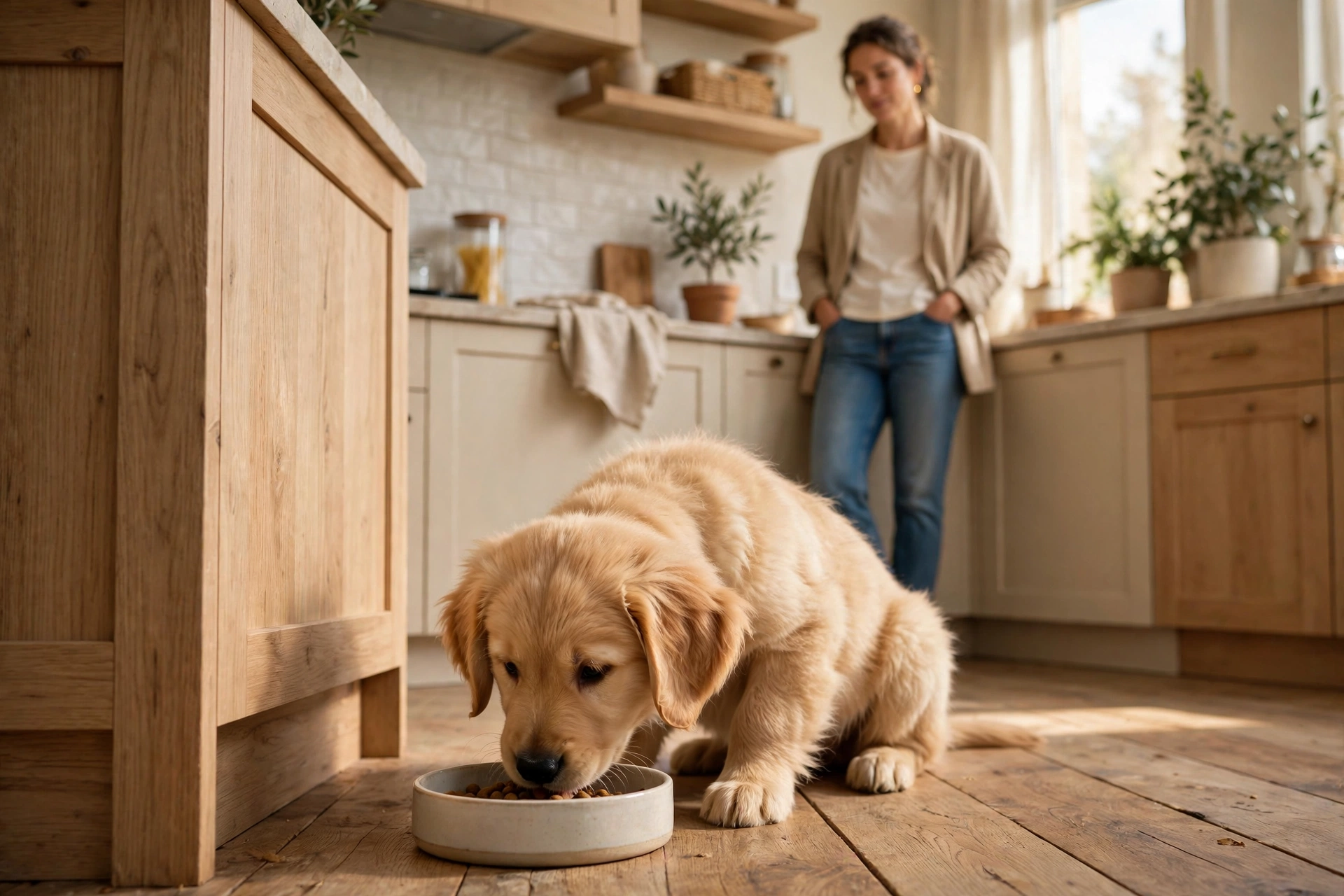
Make mealtimes boring and predictable. Same quiet spot, bowl placed down calmly, and then — this is the hard part for anxious owners — walk away and let him eat in peace. No hovering, no petting him while he eats “to get him used to it,” no reaching into the bowl. A puppy who eats undisturbed, day after day, has nothing to guard against. Add the trade-up game a few times a week (toss the bonus treat and leave), and mealtimes become the least dramatic part of his day.
What success looks like: your puppy notices you approaching his bowl and his body stays loose — maybe his tail even wags, because your approach has started to mean “something good is coming.” That relaxed body is the real goal, not just the absence of growling.
Management While You Train
Training rewires the emotion; management prevents rehearsals while you work. Both matter.
- Feed in a quiet, low-traffic spot. A corner of the kitchen away from foot traffic beats the middle of a busy hallway. Less ambient stress means less guarding.
- Pick up high-value chews when you cannot supervise. Bully sticks and stuffed bones come out for calm, supervised chew time — then get put away. No unsupervised guarding rehearsals.
- Give each pet separate feeding areas. In multi-pet homes, feed dogs in different rooms or crates. Removing competition removes a huge guarding trigger.
- Puppy-proof the “contraband.” Socks, tissues, and trash are prime stolen treasures. Closed hampers and lidded bins prevent the steal-and-guard cycle from starting.
- Teach kids the rules — and enforce them. Never bother a dog who is eating or chewing. No hugging the puppy over his bowl, no taking his toys “to play.” If kids are too young to follow the rules reliably, use baby gates to separate them during meals and chew time. This is a safety rule, not a suggestion.
Red Flags: When to Call a Professional
Most mild puppy guarding improves with the plan above. But guarding is the one puppy behavior where you should have a low threshold for getting expert help — because the downside of getting it wrong is a bite. Treat this section seriously. Call a qualified professional if any of these are true:
- Any bite or bite attempt that broke skin. This is the clearest line. A puppy who has bitten is telling you his warnings were not enough, and the next incident could be worse. Do not wait to see if it happens again.
- Guarding is escalating despite 2–3 weeks of consistent positive work. If you have been doing the trade-up game faithfully, managing the environment, avoiding confrontations — and the guarding is getting more intense, starting at greater distances, or spreading to new items — you need expert eyes on the situation.
- Guarding is spreading to new items, places, or people. Guarding that started with the food bowl and now includes toys, resting spots, doorways, or family members is a pattern widening, not fading.
- Guarding is directed at children. Any guarding toward a child warrants professional guidance immediately, even if it seems mild. The stakes are simply too high to DIY.
- Your puppy freezes and will not disengage. A puppy who locks up rigidly over an item and cannot be called away or redirected is showing an intensity level that needs professional assessment.
When choosing help, look for credentials like CPDT-KA or IAABC membership and a clear, stated commitment to reward-based methods. Ask directly: “Do you use prong collars, shock collars, choke chains, or physical corrections?” If the answer is anything but a clear no, keep looking. For guarding specifically, a veterinary behaviorist (DACVB) is the gold standard if one is available in your area — and talk to your regular vet too, since pain can drive sudden guarding.
Frequently Asked Questions
Is it normal for a puppy to growl over food?
Yes — growling over food is one of the most common forms of puppy resource guarding, and it comes from natural instinct, not bad character. It is normal, but it still deserves attention: handled with positive training it usually fades, while punishment or confrontation tends to make it worse.
Will my puppy grow out of resource guarding?
Sometimes mild cases fade — but do not count on it. Guarding that “works” (the growl makes people back off) gets rehearsed and usually strengthens over time, and it often spreads to new items. Puppies are at their most trainable right now, so addressing it early with reward-based methods is far easier than fixing an entrenched habit later.
Should I take my puppy’s food bowl away to teach him I’m the boss?
No — this is one of the most damaging myths in dog training. Repeatedly removing the bowl teaches your puppy that people near his food mean loss, which is exactly what makes guarding worse. There is no “boss” lesson being learned. Instead, use the trade-up game: your approach predicts bonus treats arriving, not food disappearing.
Can resource guarding be cured completely?
There is no fixed promise anyone honest can make, but many puppies improve dramatically — going from tense growling to relaxed, tail-wagging mealtimes — with consistent positive work over weeks to months. Think of it as management plus emotional retraining rather than a one-time “cure.” Severe or long-standing cases may always need some management, and that is a perfectly fine outcome.
Is resource guarding dangerous around kids?
It can be, which is why kid-safety rules are non-negotiable: children must never bother a dog who is eating or chewing, take his toys, or hug him over his bowl. Kids often miss the early warning signals (freezing, hard stare) and are at bite height. Any guarding directed at a child is an automatic call-a-professional situation.
My puppy only guards stolen items (socks, tissues) — is that the same thing?
Yes, it is the same behavior — guarding follows value, and stolen contraband is extremely high-value to a puppy precisely because it is novel and forbidden. It is also very fixable: puppy-proof to prevent the stealing, never chase him for it (chasing teaches him to swallow faster and guard harder), and build a strong, trade-based “drop it” in separate training sessions.
Related Reads
- Why Does My Puppy Bark at Other Dogs? Leash Reactivity Explained — big feelings on walks and big feelings over the food bowl often come from the same place; this covers the leash side.
- Puppy Fear Periods: Why Is My Puppy Suddenly Scared of Everything? — fear and guarding overlap more than owners realize; know the developmental fear stages too.
- Puppy Training Schedule: What to Teach by Age — fit “drop it,” “leave it,” and trade games into the full age-by-age training roadmap.

