
A puppy’s first year is a period of extraordinary growth. A medium-sized breed puppy can multiply its birth weight twentyfold or more before reaching adulthood, and every stage of that sprint has different nutritional demands. Feed too little and growth stalls; feed too much and a puppy can grow too fast, laying down excess weight that stresses developing joints. A consistent feeding schedule — the right food, in the right amounts, at the right times — is one of the simplest ways to set a dog up for a healthy life.
This guide lays out a complete puppy feeding schedule by age, from the nursing weeks through the transition to adult food. It covers how often to feed at each stage, how much food to offer based on size, and the most common mistakes to avoid. Because every puppy is different, treat these as starting points and confirm the plan with a veterinarian.
Birth to 4 Weeks: Mother’s Milk Does It All

For the first four weeks of life, a puppy’s diet needs no planning at all: mother’s milk provides complete nutrition. Newborn puppies nurse frequently — roughly every two hours around the clock — and spend most of their time sleeping between feeds. During this stage the mother’s health matters more than anything, since her nutrition directly shapes the quality of her milk.
Orphaned or rejected puppies are the exception. They need a commercial puppy milk replacer fed from a bottle, following the product’s directions closely. Never substitute cow’s milk or a homemade formula without veterinary guidance — a newborn puppy’s digestive system cannot handle them, and the wrong substitute can cause dangerous dehydration.
Around three to four weeks, tiny teeth begin to appear and puppies start showing curiosity about their mother’s food. That curiosity marks the beginning of the next stage, but milk should remain the main diet until weaning is properly underway.
4 to 8 Weeks: The Weaning Window
Weaning is a gradual process, not an overnight switch. Between four and five weeks, puppies can start tasting solid food in the form of a gruel: high-quality puppy food softened with warm water (or puppy milk replacer) into a soupy porridge. Offer it in a shallow dish three to four times a day, and expect a mess — puppies walk through it, sit in it, and wear more than they eat at first.
Over the next few weeks, gradually thicken the mixture by using less liquid until the puppies are eating softened food, then dry kibble. Nursing sessions naturally taper off as solid intake rises, and most puppies are fully weaned by seven to eight weeks. Fresh water should be available at all times once solid food enters the picture, since puppies now need to hydrate independently.
This is also the stage where food quality starts to matter. A formula designed specifically for puppies — or for “all life stages” — delivers the higher protein, fat, calcium, and calories that growing bodies need. Adult dog food simply isn’t concentrated enough for a weaning puppy.
8 to 12 Weeks: Settling Into a Routine
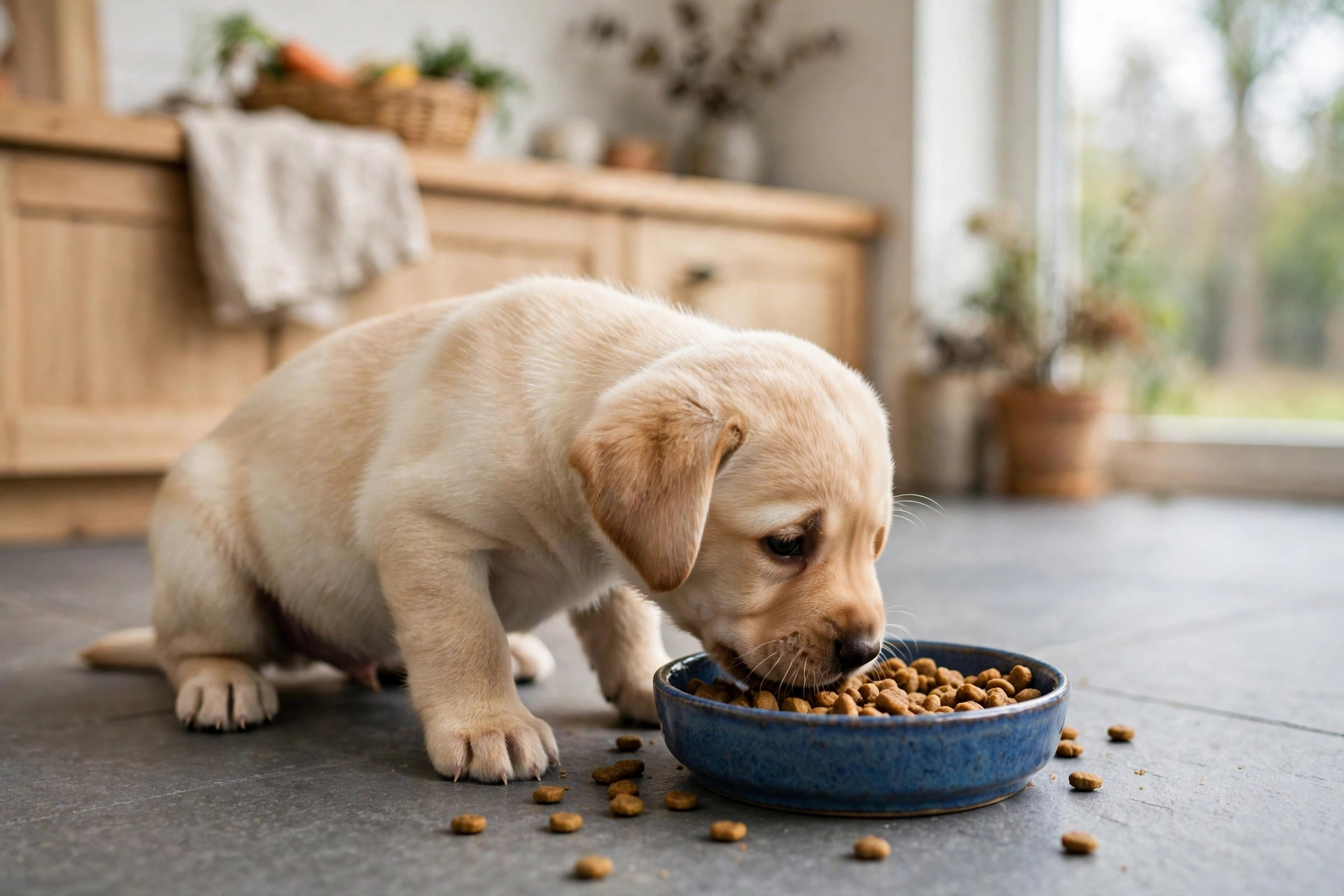
Eight weeks is the age most puppies join their new families, and it’s the perfect moment to establish a feeding routine. At this age, puppies need three to four meals per day, served at consistent times. A predictable schedule does more than regulate digestion — it makes housetraining far easier, since puppies typically need a bathroom break within 15–30 minutes of eating.
Keep feeding a puppy-specific formula. Puppies need roughly twice the calories per pound of body weight as adult dogs, along with extra protein and minerals to build bone and muscle. Measure every meal with a standard measuring cup rather than eyeballing it; portion creep is one of the easiest ways to overfeed.
Between meals, pick the bowl up. Leaving food down all day — known as free feeding — makes it impossible to track how much a puppy eats and undermines the routine. If a puppy walks away from a meal, remove the bowl after 15–20 minutes and offer the next meal at the regular time. A healthy puppy will not go hungry between scheduled meals.
3 to 6 Months: Growth Spurt Season
From three to six months, most puppies hit their fastest growth phase. Energy needs peak during this window, and three meals per day remains the right rhythm. This is also when teething begins in earnest — sore gums may make a puppy reluctant to crunch hard kibble, so softening food with a little warm water for a few weeks is perfectly fine.
Treats enter the picture now, as training ramps up. Every treat counts toward the day’s calories, so keep training rewards tiny and make sure treats and table scraps combined stay under 10% of total daily intake. Overfeeding during this phase is especially risky for large and giant breeds: growing too fast has been linked to skeletal problems, so steady, moderate growth is the goal — not maximum size as quickly as possible.
Watch the puppy’s body condition rather than the calendar alone. Ribs should be easy to feel under a thin layer of fat but not visibly protruding. If the waistline is disappearing, portions need trimming even if the feeding chart says otherwise.
6 to 12 Months: Slowing Down to Two Meals

Around six months, growth begins to decelerate and most puppies can transition from three meals to two per day — typically a morning and an evening meal. Smaller breeds mature faster and may be ready a little earlier; larger breeds often benefit from staying on three smaller meals a bit longer to avoid overloading the stomach at once.
Breed size increasingly shapes the plan from here. Small breeds may approach their adult size by nine or ten months, while large and giant breeds keep filling out well past their first birthday. Keep feeding a puppy formula until growth is nearly complete — switching to adult food too early can shortchange a still-growing dog on calories and minerals.
This is a good stage to establish the adult rhythm of life: two meals a day, roughly twelve hours apart, at the same times every day. Dogs thrive on predictability, and the routine built now will carry straight into adulthood.
Transitioning to Adult Food
The switch from puppy food to adult food should be timed to growth, not to a birthday. As a rough guide: small breeds (under 20 pounds expected adult weight) are usually ready between 9 and 12 months; medium breeds around 12 months; large breeds between 12 and 15 months; and giant breeds often not until 18 to 24 months. A veterinarian can confirm the timing based on the individual dog’s growth.
When the time comes, transition gradually over 7 to 10 days. Start by mixing about 25% adult food with 75% puppy food, then shift the ratio every couple of days until the bowl is 100% adult food. An abrupt switch commonly causes digestive upset — vomiting, diarrhea, or a hunger strike — while a slow blend lets the gut adjust. If digestive trouble appears, slow the transition down rather than pushing through it.
How Much to Feed: Portion Guidance by Weight
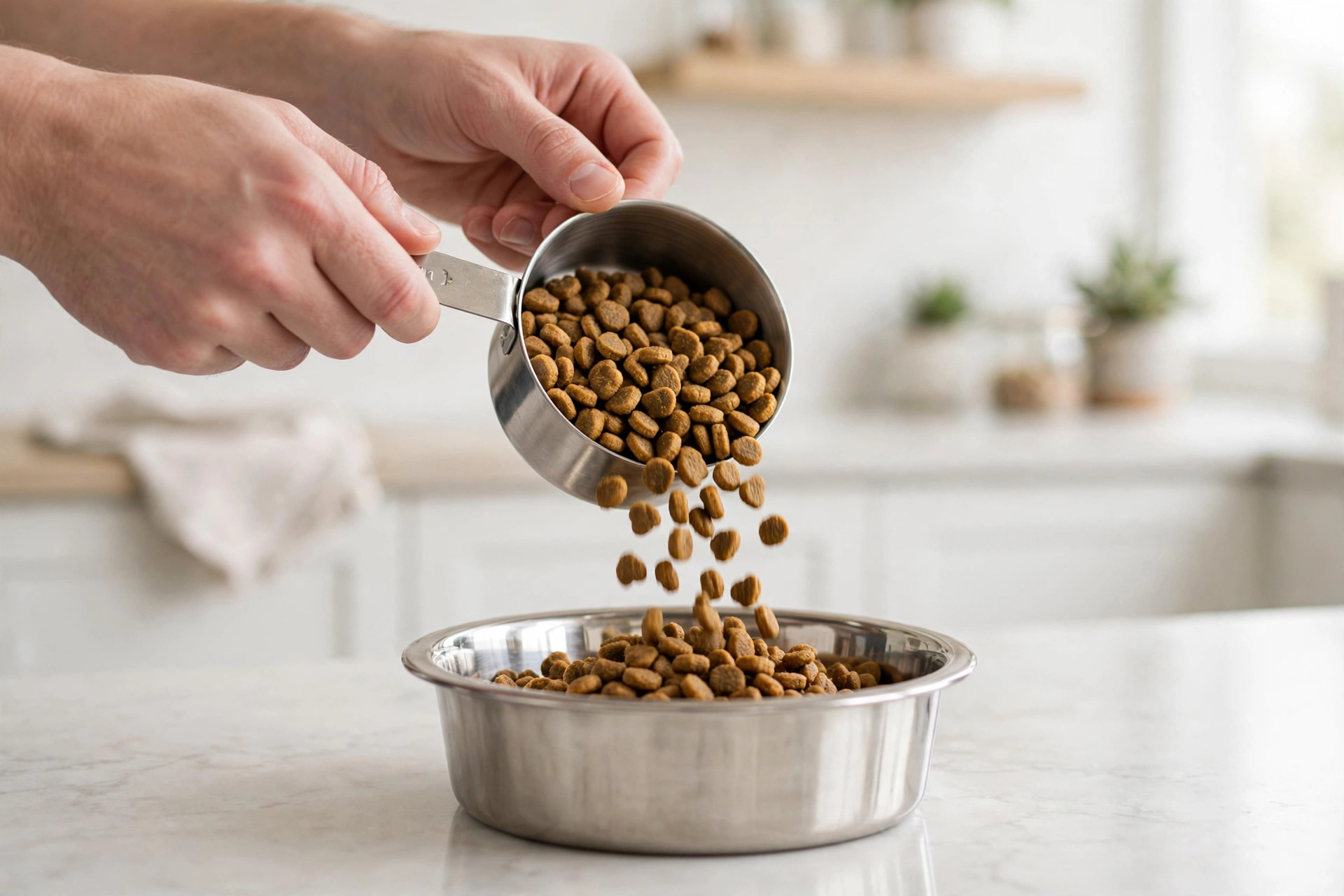
There is no single correct amount that fits every puppy. Portion size depends on the food’s calorie density, the puppy’s age, activity level, metabolism, and expected adult size. The table below gives general starting ranges for total daily dry food — always treat them as a starting point, not a prescription.
| Expected adult weight | Approximate daily amount (total) | Meals per day |
|---|---|---|
| Up to 10 lbs (toy) | 1/2 – 1 1/4 cups | 3–4 |
| 10–25 lbs (small) | 1 1/4 – 2 cups | 3–4 |
| 25–50 lbs (medium) | 2 – 3 1/3 cups | 3 |
| 50–90 lbs (large) | 3 1/3 – 4 1/4 cups | 3, then 2 |
| 90+ lbs (giant) | 4 1/4 – 5+ cups | 3, then 2 |
Three rules keep portions honest:
- Follow the food label first. Feeding guides on the bag are calibrated to that formula’s calories, making them more accurate than any generic chart.
- Adjust for body condition. If ribs are hard to feel, reduce portions by about 10% and reassess in two weeks. If the puppy looks thin and the vet agrees, increase slightly.
- Check in with the vet. Weight checks at vaccination visits are the perfect moment to ask whether the amount still fits the puppy’s growth curve.
Remember that these totals include everything the puppy eats in a day — meals plus training treats. When training is heavy, trim meal portions slightly to compensate.
Common Feeding Mistakes to Avoid
Even well-meaning owners trip over the same handful of errors. Avoiding them covers most feeding problems before they start.
- Free-feeding all day. Constant access to food removes portion control and makes it impossible to notice appetite changes — often the first sign of illness.
- Overdoing treats and table scraps. Treats are training gold, but they add up fast. Fatty scraps can also trigger pancreatitis, a painful and potentially serious condition.
- Switching foods abruptly. A sudden change of formula frequently causes digestive upset. Any switch deserves a 7–10 day gradual transition.
- Feeding adult dog food too early. Adult formulas lack the calorie and mineral density growing puppies need. Keep puppy food until growth is nearly complete.
- Offering cow’s milk. Most dogs are lactose intolerant to some degree, and cow’s milk commonly causes diarrhea in puppies. Stick to water and — for orphans — a proper milk replacer.
- Skipping the measuring cup. “About a scoop” drifts upward over time. Measured meals keep portions consistent and make adjustments meaningful.
- Feeding on an unpredictable schedule. Random mealtimes unsettle digestion and sabotage housetraining. Same food, same amounts, same times — every day.
Puppy Feeding FAQs
How many times a day should I feed my puppy?
Very young puppies (under 12 weeks) do best on three to four meals a day. From three to six months, three meals daily suits most puppies. Around six months, transition to two meals a day — a schedule that typically continues into adulthood.
How do I know if I’m feeding my puppy enough?
Use the food label’s guide as a baseline, then monitor body condition: ribs should be easy to feel but not visible, with a visible waist when viewed from above. Steady weight gain at vet checkups and good energy levels are reassuring signs. When in doubt, ask the vet.
Can puppies eat adult dog food?
Not as their main diet. Puppy formulas contain more calories, protein, fat, calcium, and phosphorus than adult foods — all essential for growth. Feeding adult food too early can leave a growing puppy short on key nutrients.
When should I switch from three meals to two meals a day?
Most puppies are ready around six months, when their growth rate starts to slow. Large-breed puppies sometimes do better staying on three smaller meals a little longer. Make the change gradually over about a week.
Is it okay to leave food out all day for a puppy?
It’s not recommended. Free-feeding makes portion control impossible, weakens the mealtime routine that aids housetraining, and hides appetite changes that can signal illness. Scheduled, measured meals are the safer choice.
What human foods are dangerous for puppies?
Chocolate, grapes and raisins, onions and garlic, xylitol (found in sugar-free gum and some peanut butters), alcohol, and cooked bones are all dangerous. Before sharing any human food, verify that it is safe — and keep portions tiny.
Conclusion
A good puppy feeding schedule is simple at its core: the right food for the growth stage, measured portions, and consistent mealtimes that evolve as the puppy grows. Start with frequent small meals, settle into three and then two meals a day, and switch to adult food only when growth is nearly complete. Pair the schedule with regular vet checkups and honest body-condition checks, and the feeding routine will quietly do its job — building a healthy, well-grown adult dog.
Related reads
- First Week With a New Puppy: Complete Survival Guide
- How to Potty Train a Puppy in 7 Days: Beginner Plan
- How to Train a Puppy to Sleep Through the Night | Easy Guide

