
Picture this: you’re out on a walk and your puppy suddenly lunges for a chicken bone on the sidewalk. Or he snatches a dropped grape in the kitchen before you can blink. In moments like these, one cue stands between your puppy and an emergency vet visit: “leave it.”
Learning how to teach a puppy “leave it” is one of the smartest investments you’ll ever make in training. It’s not just a party trick — it’s an impulse-control skill that keeps your puppy safe around food, trash, and dangerous objects for the rest of his life. The good news? Most puppies pick up the basics in just one to two weeks with short, fun daily sessions.
In this step-by-step guide, you’ll learn the exact method professional trainers use, the mistakes that slow most owners down, and how to proof the cue so it works in real life — not just in your living room.
What Does “Leave It” Actually Mean?
“Leave it” is an impulse-control cue. It tells your puppy: disengage from that thing and check back in with me instead. The “thing” could be food on the ground, a tempting shoe, another dog’s poop at the park — anything you don’t want him touching.
It’s different from “drop it,” which means “spit out what’s already in your mouth.” Think of it this way: “leave it” prevents the grab, “drop it” fixes it after the grab. Every puppy should learn both, but “leave it” is the one that keeps danger from ever reaching his mouth.
The cue pairs beautifully with a solid sit — together, the two cues give you calm, controlled behavior in almost any exciting situation.
Why Every Puppy Needs to Learn “Leave It”
This isn’t about obedience for obedience’s sake. “Leave it” is genuinely a safety skill:
- Dangerous foods: chocolate, grapes, raisins, xylitol gum, onions — all potentially deadly, and all things puppies love to snatch.
- Street hazards: chicken bones, discarded food wrappers, cigarette butts, dead animals on walks.
- Household risks: dropped medications, cleaning pods, kids’ small toys.
- Peaceful walks: no more being dragged toward every smell on the ground.
- Better impulse control overall: the self-control your puppy builds here transfers to waiting at doors, greeting guests calmly, and settling down.
What You’ll Need Before You Start
You don’t need fancy equipment — just the right setup:
- Two types of treats: boring, low-value treats (plain kibble works) to use as “decoys,” and exciting, high-value treats (tiny bits of chicken, cheese, or hot dog) as rewards. This contrast is the whole secret of the method.
- A quiet room with minimal distractions for the first few days.
- A leash for the later floor stages.
- Five minutes, once or twice a day. Puppies learn best in short bursts — keeping sessions short for your puppy’s age is one of the biggest factors in how fast training sticks.
How to Teach a Puppy “Leave It”: Step by Step
This method works for puppies as young as 8 weeks old, and it’s all reward-based — no scolding, no leash yanks, no fear. You’re going to teach your puppy that ignoring something tempting is the fastest way to earn something even better.
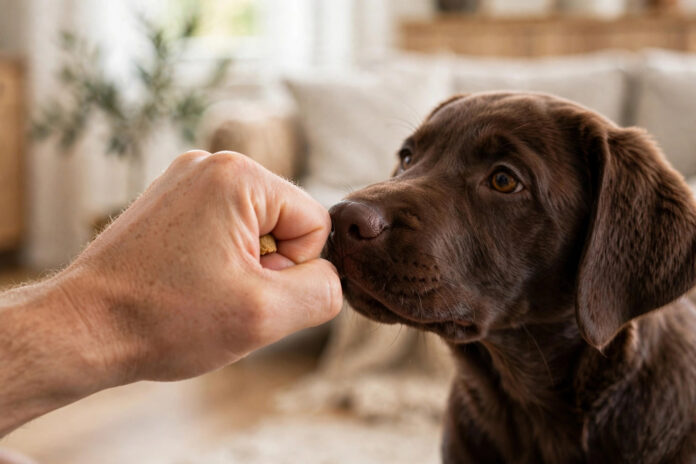
Step 1 — The Closed-Fist Game (Days 1–2)
Put a boring decoy treat (kibble) in your closed fist and hold it out to your puppy at nose level. He’ll sniff, nudge, maybe paw at your hand. Do nothing — just wait.
The instant he backs away from your fist even slightly — turns his head, steps back, looks away — mark it with an enthusiastic “Yes!” and immediately reward him from your other hand with a high-value treat.
Two critical rules here:
- Never open the decoy fist as the reward. The treat in your fist is never earned — this teaches him that pestering doesn’t pay, but disengaging does.
- Keep the energy fun and upbeat. If he gets frustrated and barks, you’re asking for too much too soon — end the session on a win and try again later.
Repeat 5–10 times per session. Most puppies “get” the game within a day or two.
Step 2 — Build a Little Duration (Days 2–3)
Once your puppy is reliably backing off your fist, start waiting for a slightly longer moment of disengagement before you mark and reward — two or three seconds of ignoring your fist instead of a split second. You’re shaping patience.
If he dives back in, no big deal. Just close your fist, wait again, and reward the next disengagement. Never scold — the game should always feel winnable.
Step 3 — Add the Cue: “Leave It” (Days 3–4)
Now give the behavior a name. As you present your closed fist, say “Leave it” once, in a calm, conversational tone — right before your puppy would naturally disengage. When he backs off, mark (“Yes!”) and reward from the other hand.
Say it only once per rep. Repeating “leave it, leave it, LEAVE IT” teaches your puppy that the first two don’t count — one of the most common training mistakes owners make.
Step 4 — Treat on the Floor (Days 4–7)
Time to raise the difficulty. Put your puppy on a leash, place a decoy treat on the floor, and cover it with your hand or foot. Say “leave it” once. The moment he disengages from the covered treat — even a head turn counts — mark and jackpot-reward him from your other hand with something amazing.

Over several sessions, gradually uncover the treat: first your hand hovers above it, then rests beside it, then you stand upright with the treat fully exposed. If he dives for it at any stage, calmly cover it again and retry at the easier level. Progress isn’t linear — dropping back a step is normal and smart.
Pro tip: practice this in different rooms. Puppies don’t generalize well — “leave it” in the kitchen doesn’t automatically mean “leave it” in the hallway until you’ve trained both.
Step 5 — Real-Life Proofing (Week 2 and Beyond)
Now take the show on the road. Practice on walks with low-value distractions first (a leaf, a boring stick), then work up to dropped food. Keep your puppy on leash, keep distances generous at first, and keep rewarding generously — real life is the hardest classroom there is.
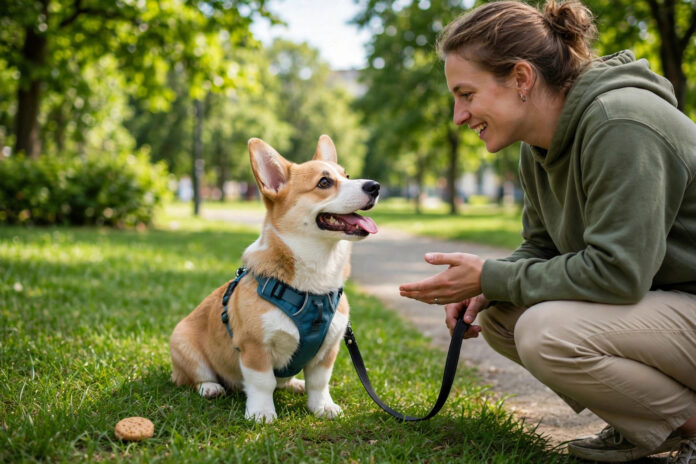
Proof the cue against the things that matter most to your life: food dropped in the kitchen, trash on walks, the cat’s food bowl. Each new context needs a few easy reps before you raise the difficulty. This is also where “leave it” teams up with a reliable recall — together, they’re the two cues most likely to keep your dog safe outdoors.
5 Common “Leave It” Mistakes to Avoid
Most “leave it” failures aren’t the puppy’s fault — they’re training errors. Dodge these five and you’ll be ahead of 90% of owners:
- Repeating the cue. “Leave it, leave it, LEAVE IT!” teaches your puppy to wait for the third (or the shouting) version. Say it once. If he doesn’t respond, you raised the difficulty too fast — go back a step instead of repeating.
- Rewarding with the decoy. If you ever let him have the treat from your fist or the floor, you just taught him that persistence pays off. The reward must always come from your other hand — and be better than the decoy.
- Punishing or yanking the leash. A sharp “no” or leash pop might stop the behavior in the moment, but it doesn’t teach impulse control — it teaches your puppy to snatch things faster before you notice. It’s also one of the classic training mistakes that damages trust.
- Skipping straight to real life. If the cue only works in your kitchen, it’s not trained yet — it’s just rehearsed. Proof gradually through new locations and harder distractions.
- Training a tired or wild puppy. An overtired puppy can’t learn impulse control. Train after a potty break and a little play, not at peak zoomie o’clock.
Troubleshooting: When “Leave It” Isn’t Working
“My puppy won’t back away from my fist at all.” Your reward isn’t beating the decoy. Upgrade what’s in your other hand (real chicken beats kibble every time) and downgrade the decoy to something truly boring.
“He’s perfect indoors but blows me off outside.” Completely normal — outdoor distractions are ten times harder. Go back to the closed-fist game in the new environment for a session or two, then rebuild. Distance is your friend: start far from distractions and close the gap over days.
“He grabs the thing and runs — now what?” Don’t chase (that’s a fun game to him). Work on “drop it” as a separate cue, and practice trade-up games: offer something better in exchange for what he’s holding. Prevention plus “leave it” reps will shrink these incidents over time.
“He only listens when I have treats.” You’re probably still in the teaching phase — that’s fine. Once he’s reliable, start rewarding intermittently (every second or third success, then randomly), but keep a treat on you for the hard reps. Real-life reliability is built on a long history of being rewarded, not on going cold turkey.
How Long Does It Take a Puppy to Learn “Leave It”?
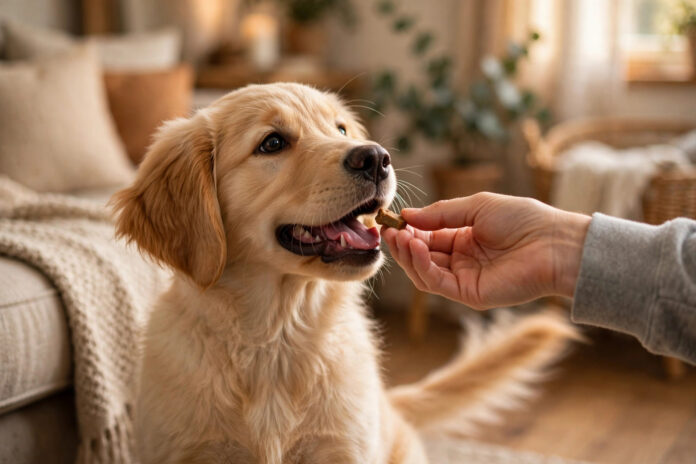
With one or two five-minute sessions a day, most puppies understand the closed-fist game within 3–5 days and can handle treats on the floor within 1–2 weeks. Reliable real-world proofing — ignoring chicken bones on walks without a second thought — typically takes 4–8 weeks of gradual practice.
Young puppies (8–12 weeks) often learn the fastest because everything is a game to them; adolescent puppies (6–12 months) may need more proofing because the world is suddenly way more interesting. Both get there with consistency.
Frequently Asked Questions
What age can I start teaching my puppy “leave it”?
As early as 8 weeks old. The closed-fist game is gentle, fun, and perfectly suited to baby puppies — no corrections involved, just a game where backing away wins treats.
What’s the difference between “leave it” and “drop it”?
“Leave it” means don’t touch it in the first place — it’s preventive. “Drop it” means spit out what’s already in your mouth — it’s a fix. Train “leave it” first, since preventing the grab is safer, then add “drop it” as your backup plan.
Why does my puppy obey indoors but ignore me outside?
Because he hasn’t generalized the cue yet — to him, “leave it” in the kitchen and “leave it” at the park are two different skills. Re-train each step briefly in every new environment, starting easy and building up. This is the step most owners skip.
Do I have to carry treats forever?
No — but don’t rush the fade. Once your puppy is reliable, switch to intermittent rewards (jackpot the hard reps, skip the easy ones), then gradually replace food with real-life rewards like praise, play, or permission to go sniff. Keep treats handy for high-stakes situations, though — a chicken bone on the sidewalk is worth a piece of cheese.
Can I teach “leave it” to an older dog?
Absolutely. The exact same steps work for adult dogs — you may just need higher-value rewards and a bit more patience if the dog has a long history of successful scavenging. Old dogs absolutely can learn this new trick.
Is it okay to just say “no” instead of teaching “leave it”?
“No” is vague — it doesn’t tell your puppy what to do instead, and most dogs learn to tune it out. “Leave it” is specific, trainable, and gives your puppy a clear alternative behavior (disengage and check in with you), which is why trainers strongly prefer it.
Related Reads
- How to Train a Puppy to Sit (The Foundation of Everything)
- How to Train Your Puppy to Stay
- How to Train Your Puppy to Come When Called

