
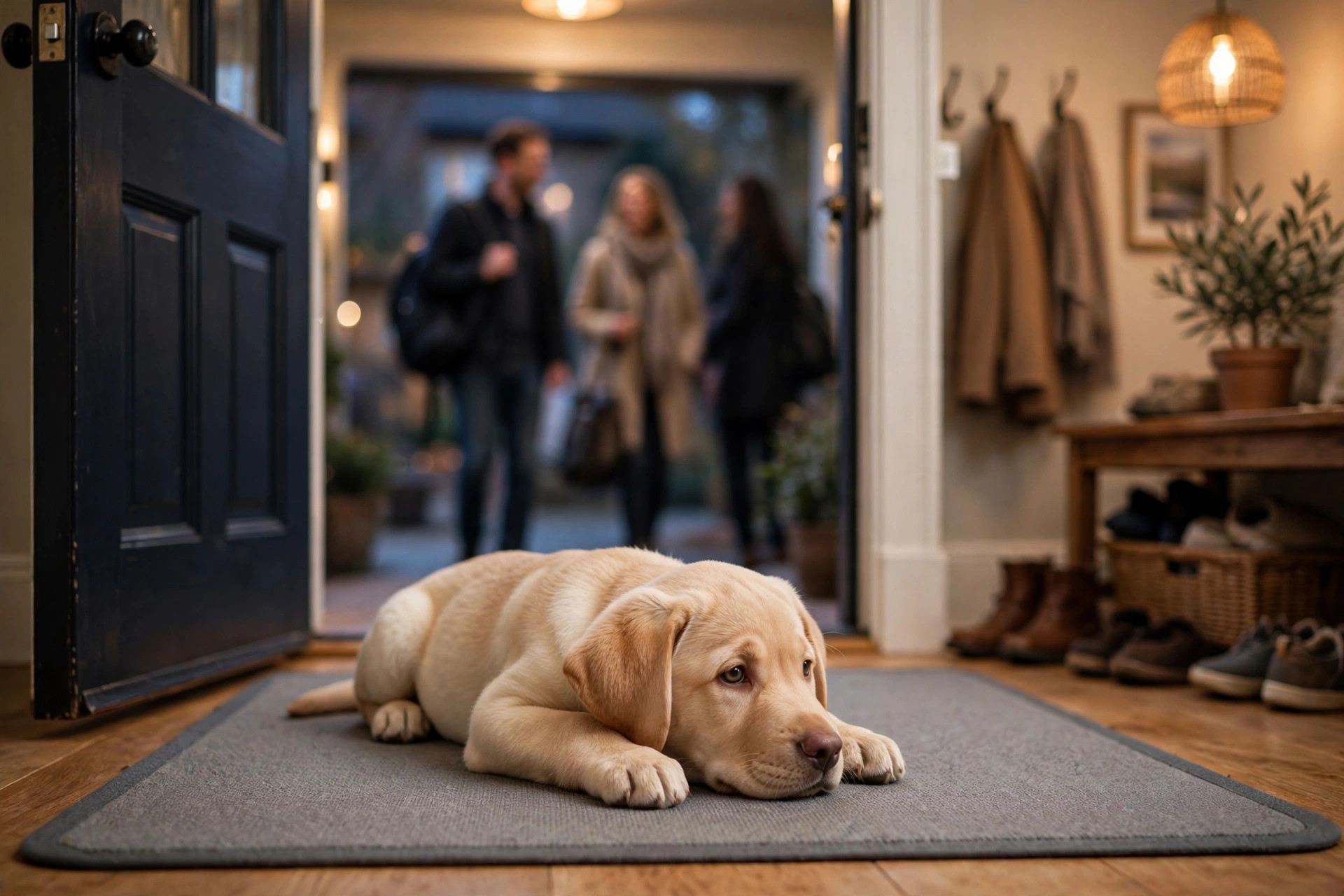
Imagine this: guests arrive, the doorbell rings, and instead of a whirlwind of jumping, barking chaos — your puppy calmly walks to their mat, lies down, and settles. No shouting. No leash wrestling. Just peace.
That’s the magic of mat training, also called “place” training. It’s one of the most practical skills you can teach a puppy, and it’s far easier than most owners expect. In this guide, you’ll learn exactly what mat training is, the 7-step method professional trainers use, the 5 mistakes that ruin it, and how to troubleshoot the most common problems.
What Is Mat Training? (And Why It Works So Well)
Mat training teaches your puppy that a specific mat (or bed, or rug) is the best spot in the house — the place where amazing things happen. Over time, the mat itself becomes a cue for calm behavior. See the mat → lie down → relax → treats appear.
Why does it work so well? Because it gives your puppy a job in exciting moments. Puppies don’t misbehave out of spite — they misbehave because they don’t know what else to do with big feelings. “Go to your mat” replaces chaos with a clear, rewarded alternative. It’s also one of the most useful tricks you can teach a puppy — practical every single day, not just a party trick.
Use it for: guests arriving, dinner time (no more begging), kids playing, vet waiting rooms, café patios, fireworks night, or anytime you need your puppy calm but present.
What You’ll Need
- A mat. A bath mat, yoga mat cut in half, or a dedicated dog training mat — anything portable with a clear boundary. Avoid using their main bed at first; you want the mat to be a special training tool.
- Tiny, high-value treats. Pea-sized pieces of chicken, cheese, or commercial training treats. You’ll use a lot of them in early sessions.
- 5 minutes, 2–3 times a day. Short sessions beat long ones — puppies learn fastest before they get tired or bored.
- Patience. The first session looks like nothing is happening. That’s normal. Trust the process.
The 7-Step Mat Training Method
Work through these steps in order. Don’t rush — each step builds on the last, and most puppies move through the whole sequence in 1–3 weeks. The underlying philosophy is simple: we never force the puppy onto the mat, never drag them there, never use the mat as punishment. Every single step is the puppy choosing the mat because great things happen there. That choice is what makes the behavior stick for life, long after the treats fade.
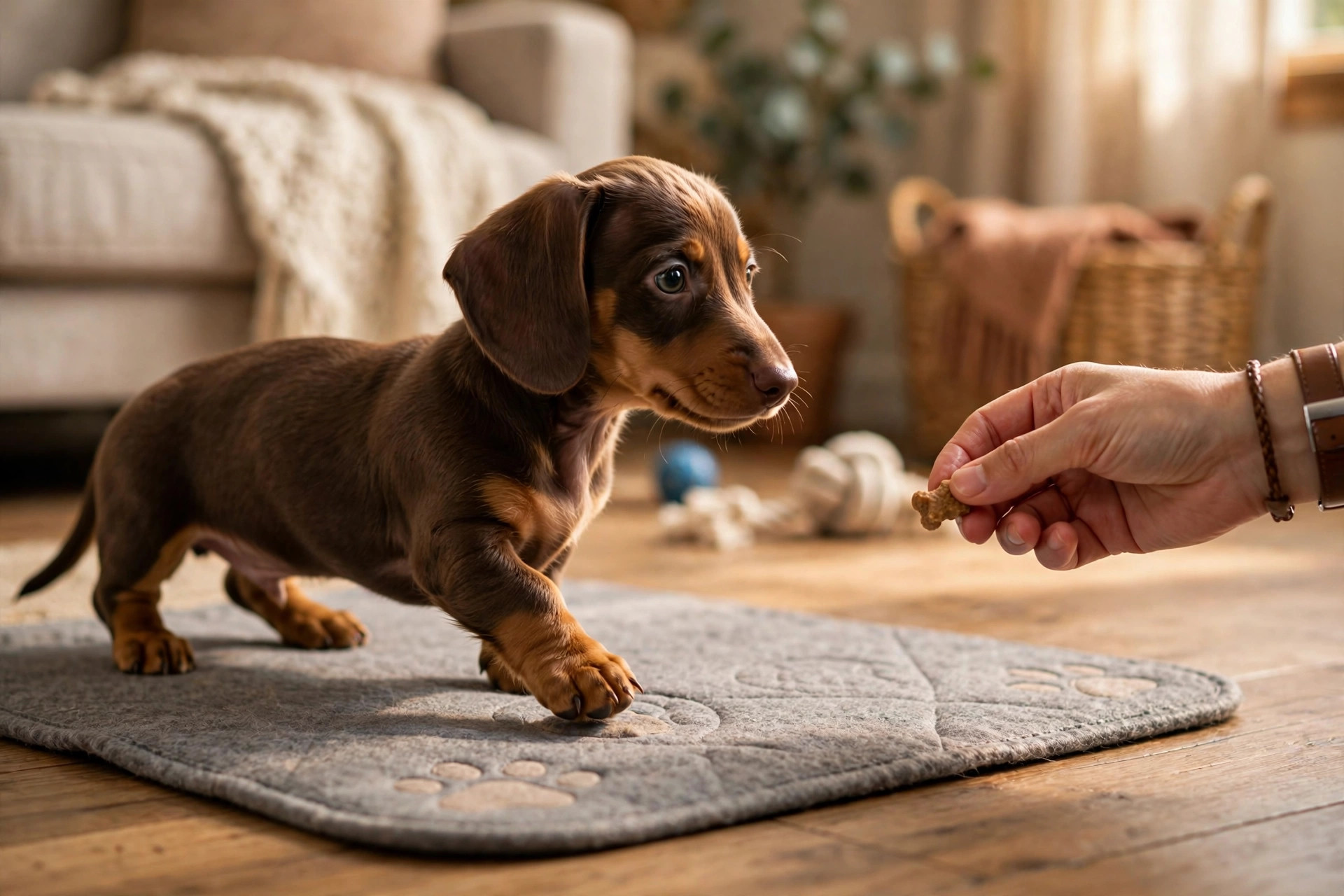
Step 1: Make the Mat Magical
Put the mat on the floor. The instant your puppy so much as looks at it — “Yes!” and treat. Sniffs it? Treat. One paw on it? Jackpot (3–4 treats). You’re not asking for anything yet. You’re just building the association: mat = amazing things happen here. Do this for 2–3 short sessions. End while your puppy still wants more.
Step 2: Reward Any Interaction
Now wait for more. Stand near the mat and let your puppy figure it out. Two paws on the mat? Treat. All four paws? Bigger treat. Most puppies start offering mat interactions eagerly within a session or two, because the mat has become a treat dispenser. If your puppy ignores the mat completely, toss a treat onto it to get things started — no shame in a hint.
Step 3: Shape the Down
Once your puppy is happily standing on the mat, wait. Don’t cue anything. Eventually — maybe after 30 seconds of standing there wondering why the treats stopped — your puppy will lie down. The instant elbows hit the mat: “Yes!” and a shower of treats. Repeat until your puppy runs to the mat and throws themselves into a down automatically. That’s the behavior clicking into place.
Step 4: Add the Cue (“Place” or “Mat”)
Only now — when the behavior is reliable — add your word. Say “place” (or “mat”) right as your puppy is moving toward the mat, then reward the down. After a dozen repetitions, try saying the cue before they move. If they go to the mat, huge reward. If not, no worries — go back to cueing mid-movement for a few more reps. Never repeat the cue over and over (“place… place… PLACE!”) — say it once, then help them succeed.
Step 5: Build Duration
A two-second down isn’t useful yet. Build staying power gradually: reward after 3 seconds, then 5, then 10, then 20. Vary it (3, 8, 5, 15 seconds) so your puppy never knows when the treat is coming — unpredictability builds persistence. If your puppy pops up early, that’s information, not failure: you asked for too long. Drop back to a duration they can do and rebuild.
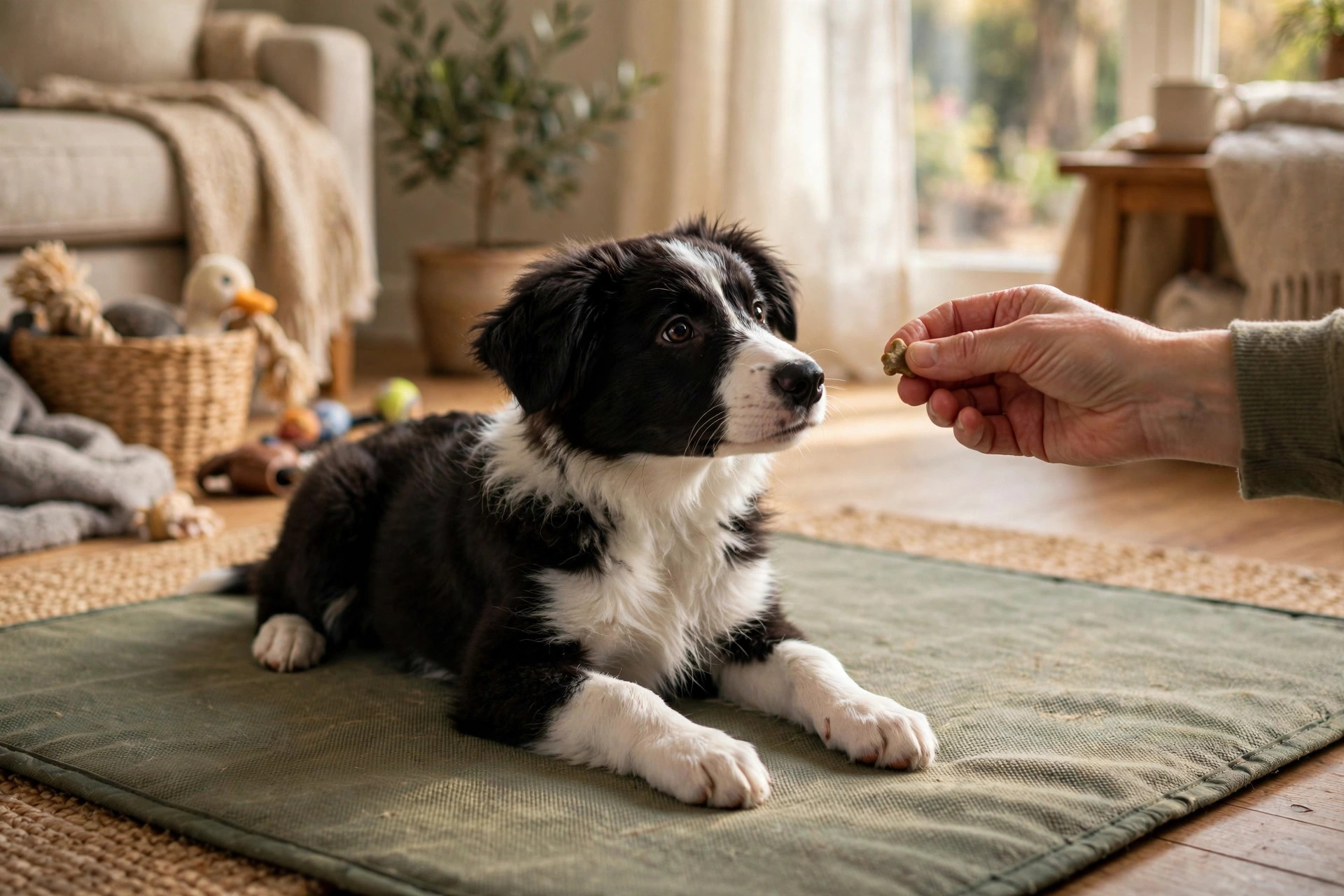
Here’s a pro tip most owners miss: reward calmness, not just position. When your puppy sighs, rests their chin on the mat, or relaxes their body — that’s gold. Mark and reward those moments extra. You’re not just training “lie here”; you’re training the feeling of settling. Over time, your puppy will offer deeper and deeper relaxation on the mat, which is exactly what you want when guests arrive or the doorbell rings.
Step 6: Add Distance and Distractions
Now make it real-world proof. Take one step away from the mat, then return and reward. Then two steps. Then walk to the other side of the room. Add mild distractions: bounce a ball gently, open and close a door, have a family member walk past. This is the same gradual-proofing principle behind good socialization — new challenges introduced one at a time, always at a level your puppy can handle.
The golden rule of this step: only ever increase one difficulty at a time. More distance or more distraction or longer duration — never two at once. If you walk across the room (distance) while someone rings the doorbell (distraction), you’ve doubled the difficulty and set your puppy up to fail. Trainers call this “splitting criteria,” and it’s the difference between steady progress and frustrating setbacks. When your puppy nails distance alone and distractions alone, then start combining them in small doses.
Step 7: Use It in Real Life
Time for the payoff. Ask for “place” before meals (puppy settles while you prepare food), when guests arrive (mat near the door, not in the chaos), during TV time, at outdoor cafés. Start with easy real-life reps and keep rewarding generously — real life is harder than training sessions, so pay like it is. Within a month of consistent practice, most puppies will start going to their mat unprompted when things get exciting. That’s the dream, and it’s absolutely achievable.
How Long Does Mat Training Take?
Honest timeline for a typical puppy with short daily sessions:
- Days 1–3: Puppy learns mat = treats, offers paws on mat eagerly.
- Days 4–7: Reliable down on the mat; cue word added.
- Weeks 2–3: Duration builds to 1–2 minutes; mild distractions handled.
- Month 2: Works in real-life situations with decreasing treat frequency.
Some quick learners do it in a week; some distracted teenagers take six. Both are normal. The only way to fail is to quit.
One thing that surprises owners: the first week feels slow, then progress suddenly accelerates. That’s because the early days are building the foundation association (mat = wonderful), and once that clicks, everything else stacks quickly. If days 1–3 feel like nothing is happening, you’re exactly where you should be — keep going.
5 Mistakes That Ruin Mat Training
- 1. Luring forever. If you always hold a treat over the mat to guide your puppy on, they learn to follow the treat — not to choose the mat. Fade the lure within the first few sessions; let them think.
- 2. Asking for too much too soon. Ten minutes of duration on day two, guests arriving on day three — that’s how you get a puppy who hates the mat. Build duration, distance, and distraction separately, one at a time.
- 3. Only using the mat for hard moments. If the mat only appears when the scary vacuum comes out or guests storm in, your puppy will dread it. Use the mat for easy, happy reps 90% of the time.
- 4. Repeating the cue. “Place, place, place, PLACE!” teaches your puppy that the first three don’t count. Say it once. Then make it easy enough to succeed.
- 5. Forgetting to reward. The mat habit is maintained by reinforcement. In the first month, reward every successful settle generously. You can thin out treats later — but never to zero in exciting situations.
Troubleshooting: Common Problems
“My puppy won’t even look at the mat.” Make it easier: toss treats onto the mat, smear a little peanut butter on it, or train right before a meal when motivation is highest. Some puppies need the mat to “pay” a few times before they believe it.
“He lies down but pops right back up.” You’re building duration too fast. Go back to rewarding 2–3 second downs, and deliver the treat while your puppy is still lying down (not after they stand). Reward the position, not the release.
“She only does it when she sees treats.” Normal early on. Start hiding treats in your pocket instead of your hand, and reward from a treat pouch after the behavior. Then begin intermittent rewards — but keep the value high when you do reward.
“My puppy gets the zoomies instead of settling.” An overtired or under-exercised puppy can’t settle — it’s biology, not disobedience. Make sure your puppy has had appropriate exercise and, crucially, enough sleep (puppies need 18–20 hours a day) before mat sessions. Pairing mat work with impulse-control exercises like “leave it” also helps enormously.
“It works at home but not at the park.” Every new location is a fresh start. Bring the mat to new places, drop your criteria back to step 2–3 level, and rebuild. This is normal — proofing takes time.
Frequently Asked Questions
What age can I start mat training?
As early as 8 weeks! Young puppies learn the mat game incredibly fast because it’s all rewards and no pressure. There’s no minimum age for this one.
Can I use their dog bed instead of a mat?
You can, but a separate portable mat is better — it becomes a clear, movable “calm station” you can take anywhere. Many owners eventually teach both.
Should I use “place” or “mat” as the cue?
Either works. “Place” is the traditional trainer term; “mat” is simpler for families. Pick one and have everyone use the same word — consistency matters more than the word itself.
My puppy chews the mat instead of settling. Help?
Totally normal puppy behavior. Redirect with a treat the moment teeth touch the mat, reward four-paws-on-mat heavily, and make sure your puppy isn’t overtired. A frozen Kong on the mat can also teach them that the mat is for settling, not shredding.
How do I get my puppy OFF the mat?
Teach a release cue like “free!” or “okay!” — say it cheerfully, toss a treat away from the mat. Always release before your puppy breaks on their own, so you stay in charge of the game.
Can mat training help with barking at guests?
Yes — it’s one of the best tools for it. A puppy holding a down-stay on a mat can’t simultaneously rush the door barking. For the full approach to guest-related barking, see our guide on stopping puppy barking at strangers.
The Bottom Line
Mat training is one of those rare skills that’s easy to teach, delightful to watch develop, and genuinely life-changing day to day. A puppy who can settle on cue is a puppy who can go anywhere with you — restaurants, friends’ houses, family gatherings — without stress for anyone.
Start today: put a mat on the floor, reward your puppy for looking at it, and you’re already on step one. In a few weeks, you’ll wonder how you ever lived without it.
Related Reads
- Easy Tricks to Teach Your Puppy
- How to Teach a Puppy “Leave It” (Step-by-Step Guide)
- How to Socialize a Puppy Properly

