
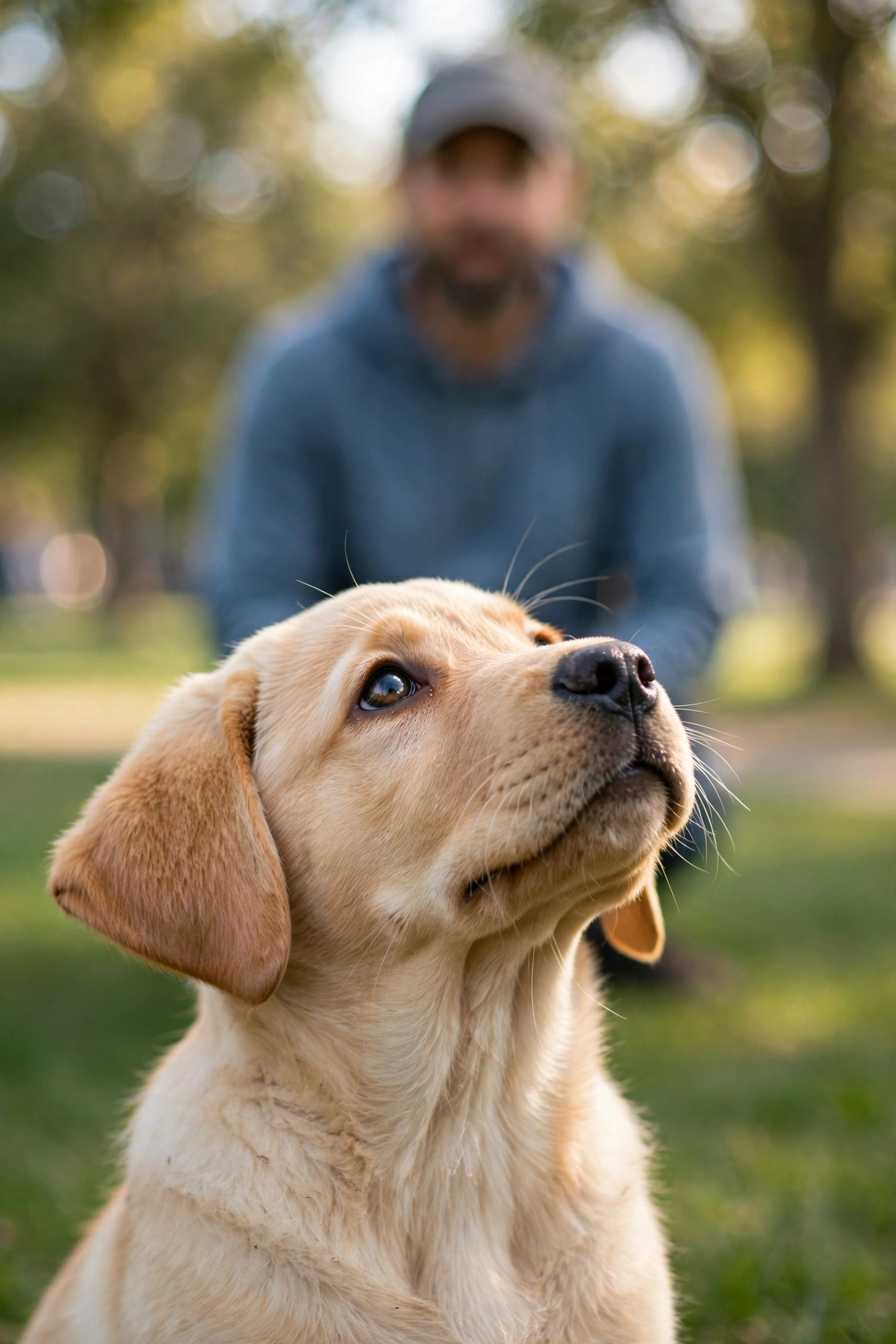
You know the stare. You are sitting on the couch, minding your own business, and you look up to find your puppy locked onto you with unblinking, laser-focused eyes — as if you are the most fascinating thing that has ever existed. If you have ever wondered why does my puppy stare at me like that, you are far from alone. It is one of the most common things new puppy owners ask about, and the answer is more interesting than you might think.
The good news first: most of the time, staring is completely normal. Puppies stare for love, for communication, and sometimes just because they are trying to figure out what on earth you are doing. This guide walks through the 7 real reasons behind that intense gaze — plus the rare situations where staring is worth a vet visit, and what to do about it day to day.
And here is something worth knowing upfront: the stare is one of the oldest parts of the dog-human relationship. Long before puppies learned to sit or shake, they learned to watch us — and we learned to love being watched. Understanding the stare does not just satisfy curiosity; it makes you a better reader of your dog, which makes everything else about training and living together easier.
Why Does My Puppy Stare at Me? 7 Reasons Behind That Intense Gaze
Not all stares are the same. A soft, relaxed gaze means something very different from a fixed, tense one. As you read through these seven reasons, think about your puppy’s body language too — loose body and soft eyes usually mean affection or curiosity, while stiffness or a hard stare deserves a closer look.
Reason #1: He Loves You (The Oxytocin Gaze)
The sweetest explanation is also the most scientifically supported one: your puppy stares at you because he loves you, and gazing at you literally feels good for both of you. In a well-known 2015 study published in the journal Science by Nagasawa and colleagues, researchers found that when dogs and their owners gazed into each other’s eyes, oxytocin — often called the “love hormone” or bonding hormone — rose in both the dogs and the humans.
Oxytocin is the same hormone involved in the bond between human parents and their babies. The researchers suggested that dogs may have developed this mutual-gaze bonding loop during domestication, essentially hijacking the same pathway that connects human families. So when your puppy melts you with that long, soft stare, something real is happening in both of your brains. You are not imagining the connection — you are both feeling it.
This is also why the loving stare looks the way it does: soft eyes, relaxed face, maybe a slow tail wag or a little sigh. If this is your puppy’s default stare, congratulations — you are his favorite person, and he is telling you so the way dogs do.
Reason #2: He Wants Something
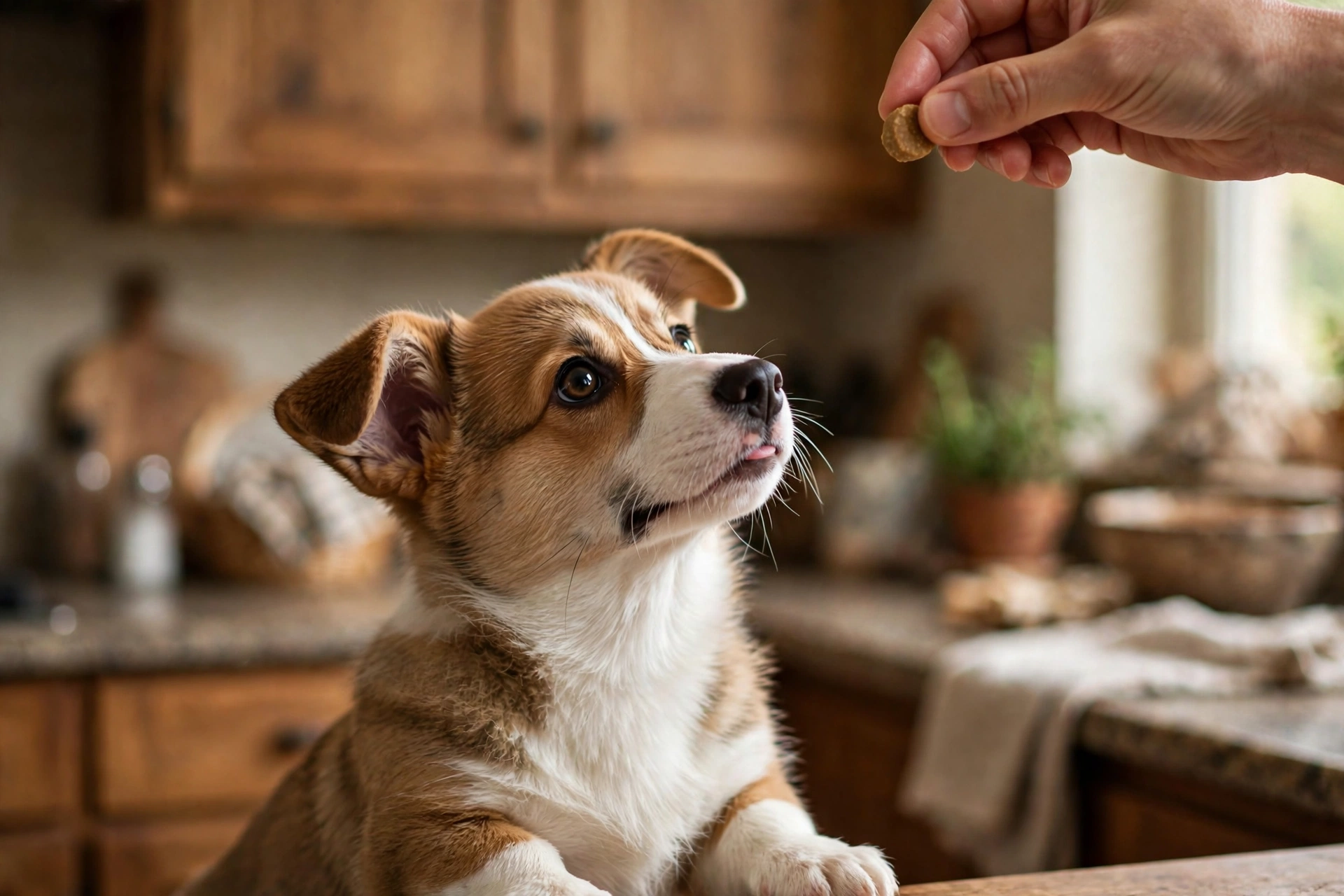
Sometimes the stare is not romantic at all — it is a request. Dogs are brilliant at learning what works, and staring at humans works remarkably well. Your puppy has figured out that locking eyes with you often produces results: a treat appears, the door opens, the leash comes out, the toy gets thrown. From his point of view, staring is simply effective communication.
Watch for the context clues. Staring at you while you eat? He wants a bite. Staring at the door, then at you, then at the door? He needs to go out. Intense gaze followed by a glance at the toy basket? Playtime, please. Puppies are constantly running little experiments on us, and the stare is one of their most reliable tools.
This is not manipulation in any negative sense — it is just how dogs talk. They cannot point with words, so they point with their eyes. Once you start reading the stare as a sentence, you will be amazed at how clearly your puppy is speaking to you.
Pay attention to where the stare is aimed, too. A puppy staring at you and then flicking his eyes toward something — the door, the treat shelf, his leash hanging by the stairs — is doing something researchers call “referential gazing.” He is not just looking at you; he is trying to direct your attention. Dogs do this with their favorite humans the way toddlers point at things they want. If you follow his gaze, you will often find the answer to what he is asking for.
Reason #3: He Is Trying to Read You
Dogs are among the best readers of human body language in the animal kingdom — better than wolves, better than chimpanzees at following human cues. Your puppy stares at you partly because he is studying you: your face, your posture, your hands, the direction of your gaze. He is gathering information about what you might do next.
Think about it from his perspective. You are the source of everything good and interesting in his world — food, walks, play, affection. Watching you closely is simply smart. Is your hand moving toward the treat jar? Are you putting on shoes (walk signal)? Did your expression just change? That intense focus is your puppy doing his homework on the most important subject in his life: you.
This is also why puppies often stare hardest when you are doing something new or unusual. A strange sound, an unfamiliar object in your hands, a different tone in your voice — all of it gets the full investigative stare while he decides what it means.
Reason #4: He Is Confused and Waiting for Direction
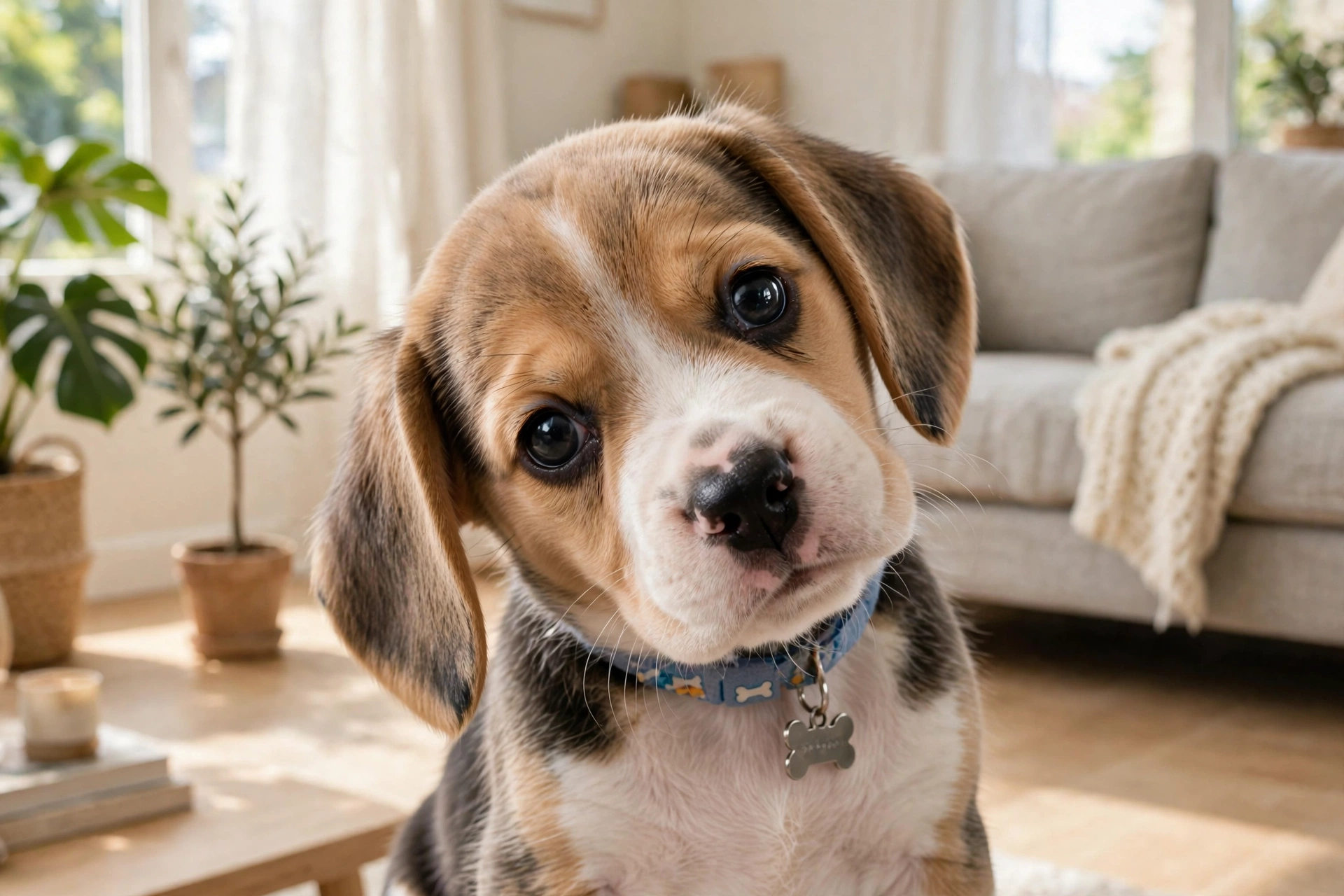
“What do you want from me?” That is the question behind many a puppy stare, especially during training. You asked for a “down,” he sat instead, and now he is staring at you waiting for feedback — did I get it right? What happens now? Puppies in training stare a lot because training is essentially a long conversation made of cues, and staring is how they hold up their end.
This kind of stare often comes with a slightly furrowed brow or a head tilt, and it is actually a great sign. A puppy who stares at you in confusion is a puppy who is engaged and trying — he cares about getting it right. If you see this stare, help him out: make the cue clearer, lure him into the right position, or simplify the task. The moment he understands, reward him, and watch how quickly that confused stare turns into an eager one.
Reason #5: He Is Seeking Attention or Reassurance
Some puppies stare because they need you — emotionally, not just practically. Young puppies, newly adopted puppies, and naturally anxious or “velcro” puppies often fix their eyes on their person as a source of comfort. In an unfamiliar or slightly scary situation, your face becomes their anchor: as long as they can see you and you look calm, the world feels safe.
You will recognize this stare by the body language around it: the puppy may press against you, tuck close, or stare with slightly worried eyes rather than bright curious ones. There is nothing wrong with being your puppy’s safe place — that is exactly what a good owner is. Just be mindful that constant reassurance-staring can grow into over-dependence if the puppy never learns to self-settle, so balance comfort with gentle confidence-building as he grows.
A practical balance looks like this: comfort him when he is genuinely frightened (a loud noise, a strange place), but in ordinary calm moments, reward him for settling on his own — a chew toy on his bed, praise for lying quietly nearby rather than plastered against your leg. Over weeks, you will see the anxious stare soften into a relaxed presence. He still loves you just as much; he is simply learning that the world is safe even when he is not staring at you.
Reason #6: It Has Become a Reinforced Habit
Here is an honest one: your puppy might stare at you simply because you have taught him to — without realizing it. Every time he stares and you respond by talking to him in a funny voice, laughing, petting him, or handing over a treat “because he is so cute,” you have just paid him for staring. Dogs repeat what gets rewarded, so the behavior grows.
There is nothing harmful about this in most cases. A puppy who stares because staring has always been delightful is just living his best life. But if the staring has tipped into demand behavior — barking when you look away, pawing at you constantly, unable to settle — it is worth noticing your own role in the loop. The fix is simple: reward calm, independent behavior just as warmly as you reward the stare, and the balance will shift.
Reason #7: Something Might Be Wrong (Rare, But Worth Knowing)
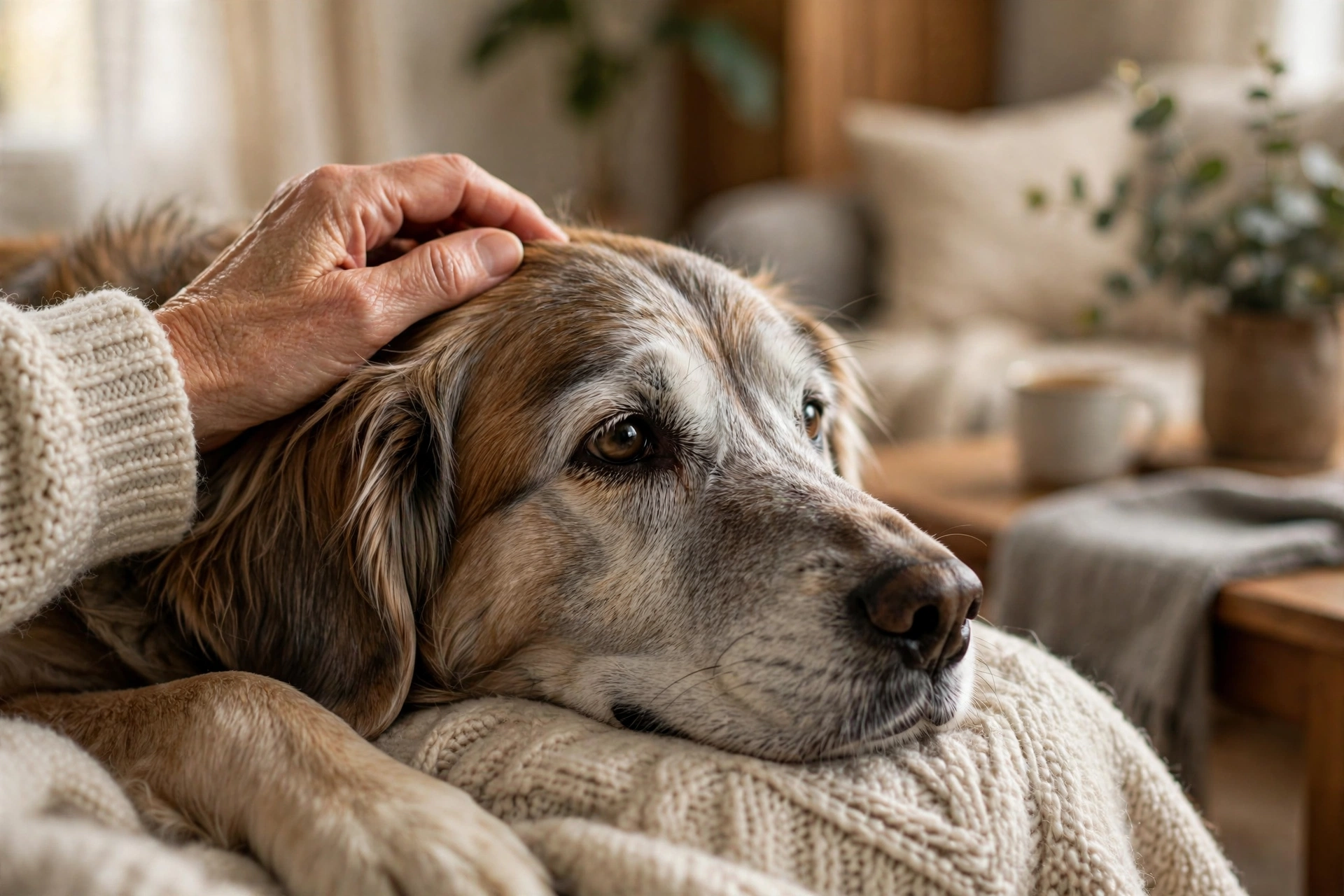
Let us be clear: the vast majority of puppy staring is normal, healthy communication. But there is a rare category worth knowing about, because sudden changes in behavior always deserve attention. If a puppy or dog who never used to stare suddenly begins staring blankly — unfocused, at walls or into space, seeming not to fully “see” you — and especially if it comes with other changes like disorientation, appetite shifts, or altered sleep, that is worth a vet visit.
In senior dogs, this kind of vacant staring can be associated with canine cognitive dysfunction (the dog equivalent of dementia). Neurological issues can occasionally present this way too. The key word is sudden change: a puppy who has always stared at you lovingly is fine; a dog whose staring pattern changes abruptly, especially alongside other symptoms, should be checked. When in doubt, a vet visit for a behavior change is never wasted — that is what vets are for.
When Staring Means a Vet Visit
To put reason #7 in practical terms, here is a calm checklist. Consider calling your vet if you notice:
- A sudden change in staring behavior — a dog who never stared now stares constantly, or the quality of the stare changes from engaged to blank.
- Blank, unfocused staring at walls, corners, or into space, where the dog seems not to register you even when you call or move.
- Disorientation alongside the staring — getting stuck in corners, seeming lost in familiar rooms, or not recognizing familiar people (most relevant in senior dogs).
- Other simultaneous changes — appetite, thirst, energy, sleep patterns, house training, or personality shifts happening at the same time as the new staring.
None of these automatically mean something serious — many have simple explanations — but together they are exactly the kind of pattern a vet wants to hear about. You are not overreacting by asking; describing a behavior change clearly (“he started doing X two weeks ago, and also Y”) gives your vet the best possible starting point. Early checks catch treatable things early, and peace of mind is valuable on its own.
A reassuring rule of thumb: engaged staring (at you, with bright eyes and responsive body language) is communication. Vacant staring (through you or at nothing, unresponsive) is the version worth mentioning to your vet. Almost everything you see day to day is the first kind.
What to Do About the Stare (Mostly: Enjoy It)
For the vast majority of puppies, the answer to “what should I do about the staring?” is: nothing much — soak it in. That intense gaze is one of the great joys of puppy ownership, and it will not last forever in quite this form. But a few practical notes will help you handle the different flavors of stare well.
If it is affection, enjoy it fully. The oxytocin loop is real — mutual gazing genuinely deepens your bond. There is no need to train away a loving stare. Talk to him softly, pet him, gaze back with soft eyes. These are the moments people remember years later.
If it is demand-staring, set gentle boundaries. You do not need to punish staring — just avoid paying for the pushy version every time. If he stares at you while you eat and you always share, he will always stare while you eat. Instead, teach and reward an alternative: a “place” or “settle” cue with a chew toy during meals gives him a job that earns the same calm praise. Reward the behavior you want to see more of, and the demanding stare fades on its own.
Use the stare as a training superpower. Here is the part trainers love: a puppy who naturally offers eye contact is giving you the foundation of all attention work. His name, “watch me,” check-ins on walks, recall — every one of these is easier with a puppy who already looks at you. Capture it: when he looks at you on his own, mark it (“yes!”) and reward. You are not just enjoying the stare; you are building the single most useful behavior in dog training.
Do not stare back hard. A soft, blinky gaze is bonding. A prolonged, hard, direct stare — especially while leaning over the dog — can feel confrontational to some dogs. If you catch yourself locked in an intense staring contest, soften your eyes, blink slowly, and smile. Your puppy reads all of that, and he will relax.
Teach children the same rules. Kids love staring contests with puppies, and puppies often love them back — but small children tend to stare hard, lean in close, and squeal, which can overwhelm a young puppy. Show kids the “soft eyes” game instead: who can blink the slowest while looking at the puppy? It turns the stare into a calm bonding ritual the whole family can share, and it teaches children to read the dog’s comfort level early.
Frequently Asked Questions
Why does my puppy stare at me all the time?
Because you are the center of his universe. Most constant staring is a mix of affection (the oxytocin bonding loop), communication (he wants something or is reading your body language), and habit (staring has been rewarded before). If the stare is soft-eyed and his body is relaxed, it is simply how he relates to you.
Is it bad if my puppy stares at me?
No — staring is normal dog communication, not a behavior problem. The only versions worth a second thought are demand-staring that has become pushy (barking, pawing when ignored) and sudden blank, unfocused staring with other behavior changes, which deserves a vet check. Everyday affectionate staring needs no fixing.
Why does my puppy stare at me and tilt his head?
The head tilt is your puppy concentrating — he is trying to understand a sound, a word, or your expression. Researchers believe dogs tilt their heads to better locate sounds and to see your face more clearly around their muzzle. Some studies even suggest that dogs who tilt their heads more tend to be better at remembering the names of their toys — the tilt may be a sign of a puppy actively matching what he hears to what he knows. Combined with the stare, it means he is working hard to figure out what you mean. It is one of the clearest signs of an engaged, thinking puppy.
Why does my puppy stare at me while I eat?
Because it has worked before — or he is hoping this is the time it starts working. Food is the highest-value thing in his world, and you are holding it. If you do not want mealtime staring to become a permanent fixture, avoid feeding from the table and reward him for settling on his bed during meals instead.
Should I stare back at my puppy?
Soft gazing back is wonderful — it is part of the bonding loop that releases oxytocin in both of you. Just keep it soft: relaxed eyes, occasional slow blinks. Avoid hard, unblinking, direct staring, especially while looming over him, as some dogs find that confrontational. Think warm eye contact, not a staring contest.
When should I worry about my puppy staring at walls or nothing?
Occasional brief staring at a wall is usually nothing — puppies notice sounds, shadows, and insects you cannot perceive. Worry only if it is new, persistent, and blank (he seems not to see or respond to you), especially combined with disorientation, appetite or behavior changes. That pattern — sudden change plus other symptoms — is worth a vet visit.
Related Reads
- Why Does My Puppy Follow Me Everywhere? — if the staring comes with shadowing your every step, this explains the velcro-puppy side of the same devotion.
- Puppy Training Schedule: What to Teach by Age — turn all that eye contact into training gold with an age-by-age roadmap of what to teach and when.
- 10 Puppy Training Mistakes New Owners Make (And How to Fix Them) — make sure accidental reward habits (like paying for demand-staring) are not quietly undermining your training.

