
Here is a secret nobody tells you when you bring a puppy home: every new owner makes puppy training mistakes. Every single one. The problem is not that you will make them — it is that a few common ones quietly sabotage your training for weeks or months before you even realize what went wrong. The good news? These mistakes are all fixable, most of them in a single afternoon, once you know what to look for.
This guide walks through the 10 biggest puppy training mistakes new owners make — the ones trainers see over and over — with a plain explanation of why each one backfires and a simple, positive fix for each. No judgment here. If you recognize yourself in a few of these, that just means you are a normal new puppy owner. Let’s fix them together.
One more reassurance before we start: fixing these mistakes does not require starting over. You do not need to throw out everything you have done so far. Each fix below is a small adjustment — shorter sessions, one consistent word, better timing — and small adjustments, applied from today onward, change the whole trajectory of your puppy’s training. Your puppy is not keeping score of your past mistakes. He is only responding to what you do next.
The 10 Puppy Training Mistakes (And How to Fix Them)
Each mistake below follows the same simple format: what is going wrong and why it backfires, then the fix. Read through the whole list first — you will probably spot two or three that explain a frustration you have been having — and then start with the easiest fix. Small corrections, applied consistently, compound fast.
Mistake #1: Training Sessions That Are Way Too Long
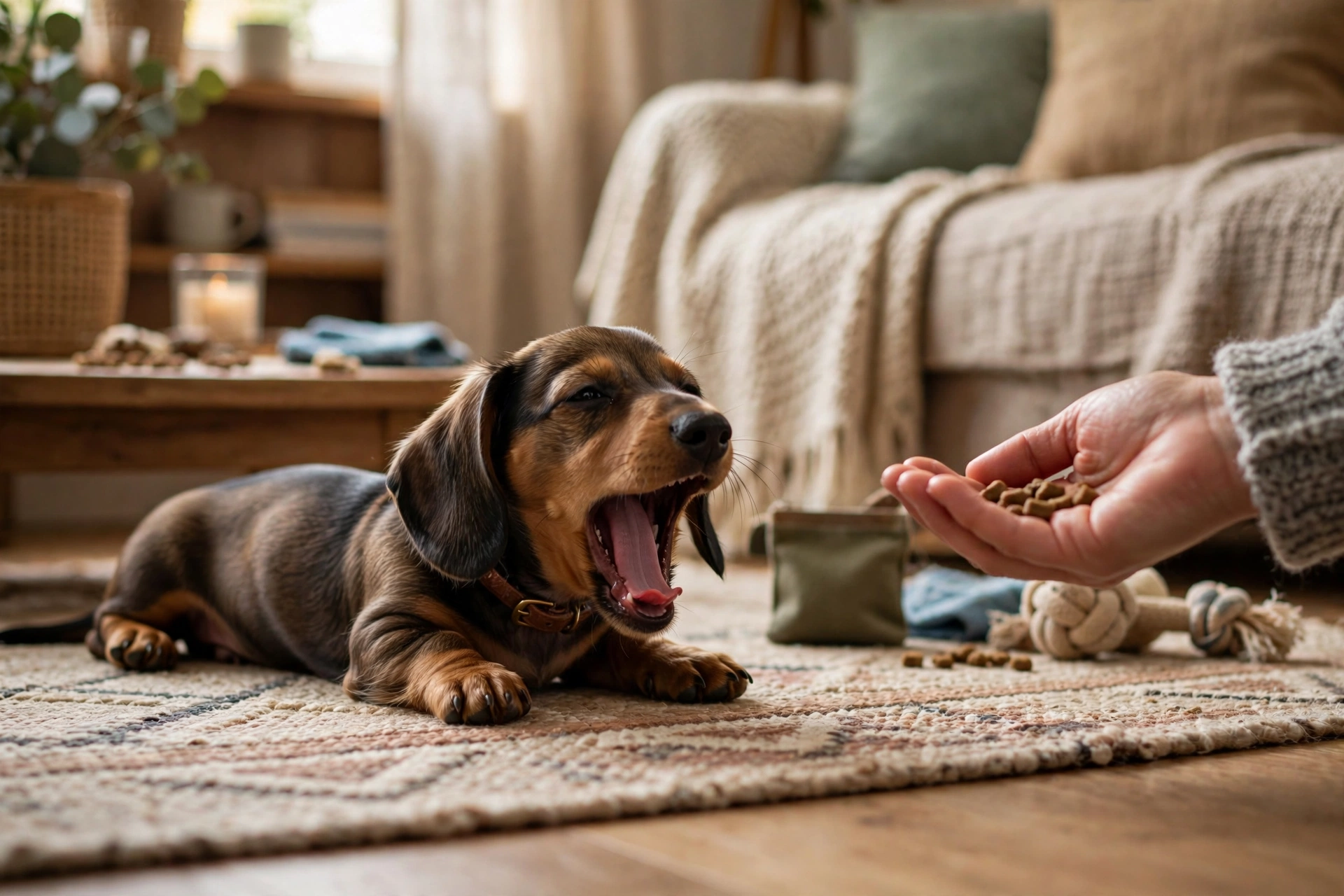
Why it backfires: A puppy’s attention span is genuinely tiny — most puppies mentally check out after 5 to 10 minutes. When you push past that, your puppy is not learning anymore; he is just getting tired, frustrated, and sloppy. Worse, those final sloppy repetitions are the ones he remembers, so long sessions can actually train worse behavior.
The fix: Keep sessions to 5 minutes (3 minutes for very young puppies), and always end on a win — finish with a rep you know he can do, reward big, and stop while he still wants more. Three short sessions a day beats one exhausted 20-minute grind every time.
Mistake #2: Being Inconsistent With Rules and Cues
Why it backfires: Puppies cannot read the fine print. If the couch is allowed on Saturday but forbidden on Monday, or if you say “down” while your partner says “off” for the same behavior, your puppy is not being stubborn — he is genuinely confused. Inconsistency is one of the top puppy training mistakes because it punishes the puppy for a human communication failure.
The fix: Pick one cue word per behavior and get the whole household on the same page — literally write the list on the fridge. Same rules, same words, every person, every time. Consistency is the fastest shortcut in dog training. If you have kids, teach them the exact words too; a five-year-old saying “sit” while dad says “sit down” is enough to confuse a puppy for weeks.
Mistake #3: Punishing Instead of Teaching
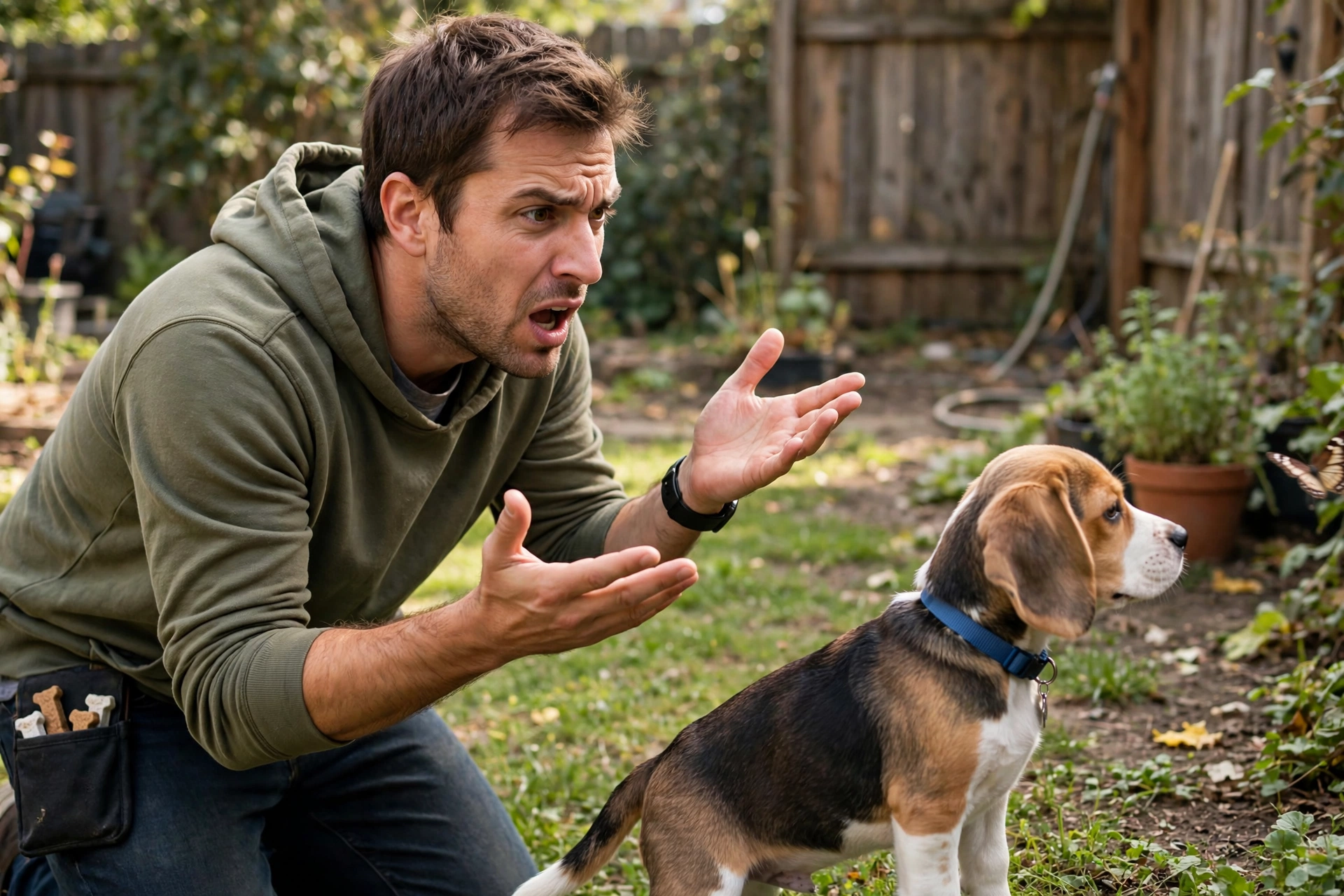
Why it backfires: Yelling, scolding minutes after the fact, or rubbing his nose in a mess does not teach your puppy what to do — it only teaches him that you are scary and unpredictable. Puppies punished after the fact cannot connect the punishment to the behavior; they connect it to you. That damages trust, and a puppy who does not trust you is much harder to train.
The fix: Every time you catch yourself about to scold, ask instead: “What do I want him to do instead?” Then teach and reward that. Chewing your shoe? Redirect to his chew toy and throw a party when he takes it. Jumping on guests? Teach and reward four-on-the-floor greetings before anyone arrives. You cannot punish a puppy into good behavior, but you can absolutely reward him into it — and the rewarded behavior is the one that sticks.
Mistake #4: Repeating the Cue Over and Over
Why it backfires: “Sit… sit… sit… SIT!” Sound familiar? Every repetition teaches your puppy that the first three “sits” are just background noise and only the shouted fourth one counts. You are accidentally training him to ignore you until you escalate — which is the exact opposite of a reliable cue.
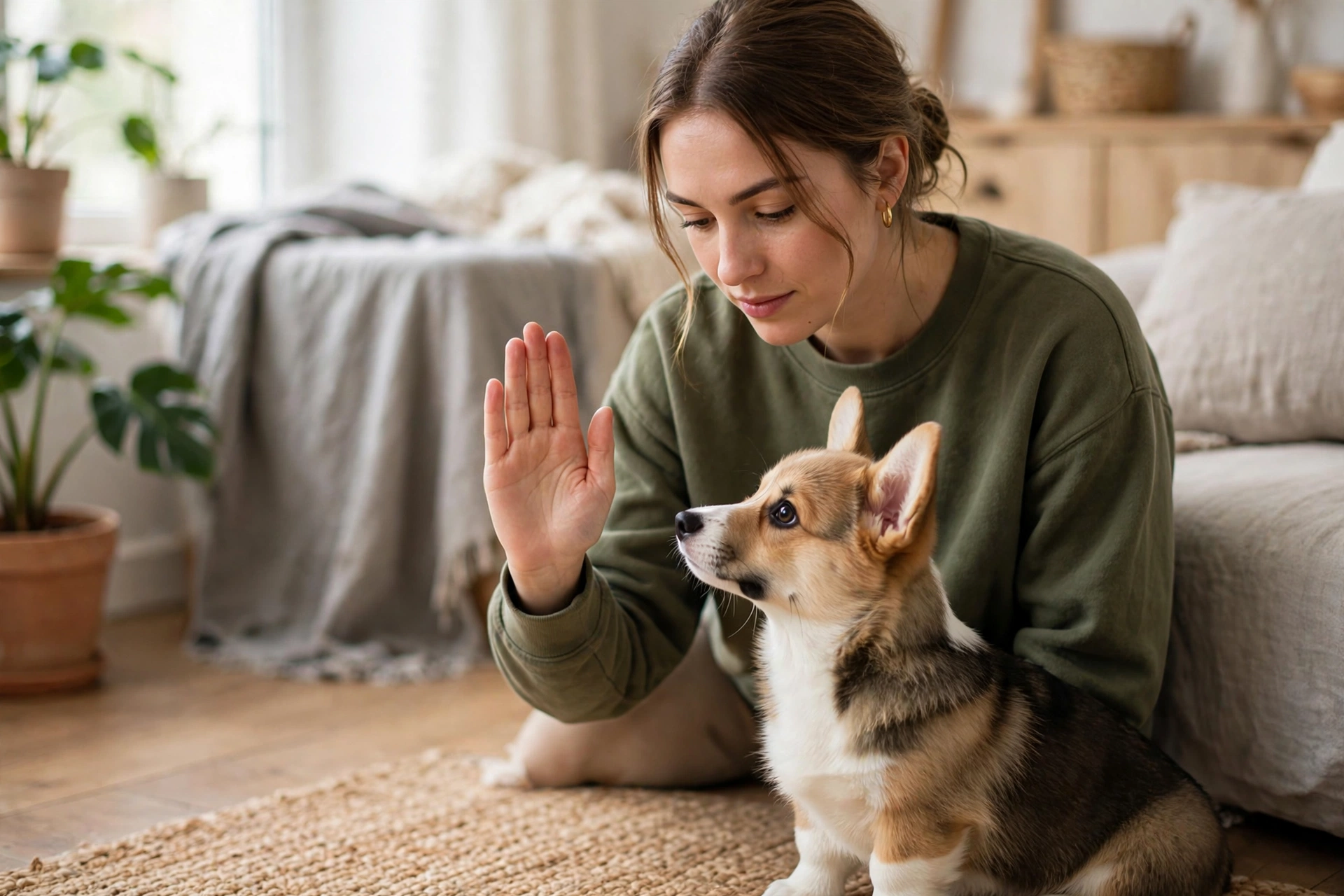
The fix: Say the cue exactly once, in a normal voice. If he does not respond within a couple of seconds, do not repeat it — help him instead: lure him into position, wait him out, or reset and try again. The instant he gets it right, mark and reward. One cue, one chance, one big reward builds a puppy who listens the first time.
Mistake #5: Training Only When the Puppy Is Already Over-Excited
Why it backfires: Trying to teach a brand-new cue to a puppy who just woke up from a nap, or right in the middle of a wild play session, is like teaching math to a kid on a sugar rush. An over-aroused puppy literally cannot think — his emotional brain has hijacked the controls. You will both end up frustrated, and you will conclude “he just won’t listen,” when the real problem was timing.
The fix: Train when your puppy is calm but awake — after a potty break and a little sniff-around, not at peak zoomie o’clock. Manage arousal first (a short sniffy walk works wonders), then ask for thinking. Set him up to succeed by choosing the right moment. If a session starts going sideways, do not push through it — take a play break or try again later. Quitting a bad session early is smarter than finishing it badly.
Mistake #6: Skipping Socialization — or Flooding Instead
Why it backfires: This mistake comes in two opposite flavors, and both hurt. Skipping socialization leaves your puppy with no frame of reference for the world — strange sights, sounds, and dogs become scary by default. Flooding (dragging a nervous puppy into a chaotic dog park to “get used to it”) is just as bad: a puppy over threshold cannot learn, he can only panic, and panic cements fear.
The fix: Go for gradual, positive exposure at your puppy’s pace. New experiences should be short, low-intensity, and paired with treats and praise. Let him watch the world from a comfortable distance before asking him to join it. Curiosity at his own speed builds a confident adult dog; pressure builds a fearful one. A useful test: if your puppy can take treats and play, he is coping fine; if he will not eat and cannot disengage, you are too close or it is too much — add distance and try again another day.
Mistake #7: Expecting Too Much Too Soon
Why it backfires: Social media is full of 12-week-old puppies doing perfect heeling routines, and it sets a brutal standard. Comparing your normal, wiggly, distractible puppy to a highlight reel — or to a calm adult dog — breeds impatience. Impatience leaks into your tone, your timing, and your body language, and your puppy feels every bit of it. Nothing kills learning faster than a frustrated teacher.
The fix: Set age-appropriate expectations: a 10-week-old puppy holding a 3-second sit is a huge win. Celebrate the small stuff out loud — your enthusiasm is fuel for him. Train the puppy in front of you, not the Instagram puppy in your head. And remember that those polished videos usually show the fiftieth take, edited down to the one perfect rep; nobody posts the forty-nine messy ones.
Mistake #8: Inconsistent or Low-Value Rewards
Why it backfires: Offering dry kibble for a recall away from a squirrel, or treating three seconds after the behavior (by which point your puppy is doing something else entirely), tells your puppy that listening is barely worth it. Dogs do what pays. If the paycheck is random, late, or boring, do not be surprised when he stops showing up for work.
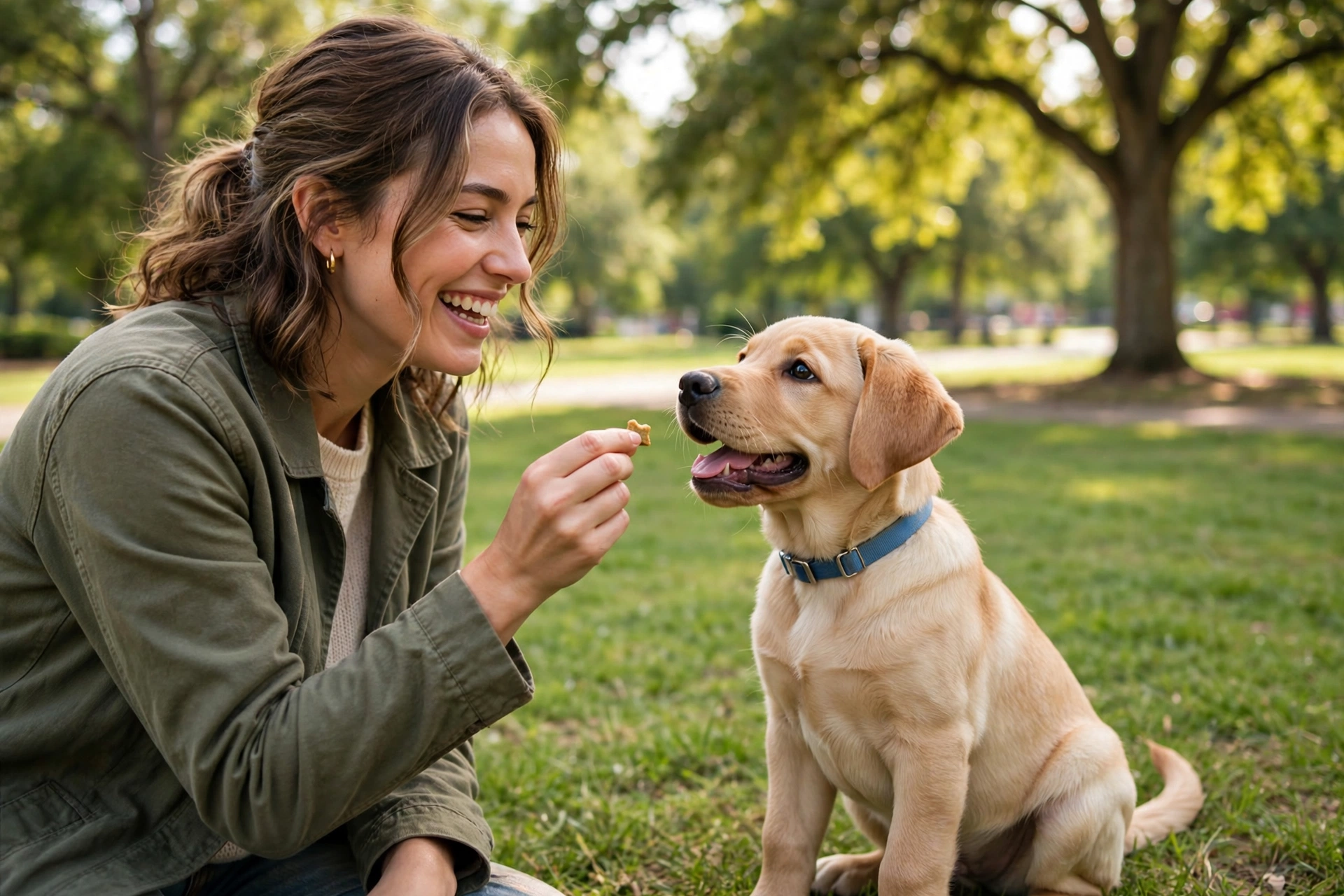
The fix: Match the reward to the difficulty — kibble for easy indoor reps, the good stuff (chicken, cheese) for hard outdoor ones. And mark the exact moment he gets it right with a crisp “yes!” or a clicker, then deliver the treat within a second or two. Precise marking plus great pay builds lightning-fast learning.
Mistake #9: Skipping the Boring Basics for Fancy Tricks
Why it backfires: Teaching “spin” and “shake” is fun, but if your puppy cannot reliably come when called, settle on a mat, or leave a dropped chicken bone alone, those tricks are decoration on a shaky foundation. The unglamorous basics are the behaviors that keep your puppy safe and make daily life livable — and they take the longest to become reliable, which is exactly why people skip them.
The fix: Foundations first, in this order: his name (attention), recall, “leave it,” “drop it,” loose-leash basics, and settle/mat work. Get these boring behaviors rock-solid in easy settings before adding distractions. Tricks are the dessert — do not serve dessert before dinner. The irony is that puppies with solid foundations actually learn tricks faster later, because they already know how to learn.
Mistake #10: Giving Up Too Early — Training in Streaks
Why it backfires: Two perfect weeks of training followed by a month of nothing is one of the most common puppy training mistakes, and it is completely human. But dogs learn through repetition over time. Streaky training teaches your puppy that cues are optional suggestions that only sometimes matter — so he treats them that way.
The fix: Think tiny daily habits, not weekend marathons. Two minutes of recall practice before dinner, rewarding calm settling every evening, one “leave it” rep on every walk. Consistency compounds: small daily deposits grow into a reliably trained dog far faster than occasional heroic efforts.
Worth remembering: if you recognized yourself in five or more of these, congratulations — you are officially a normal puppy owner. Every mistake on this list is fixable starting today, and your puppy has no idea you ever made them. He only knows what you do next.
The One Mindset Shift That Fixes Half of These
If you take only one thing from this article, make it this: your puppy is not giving you a hard time — he is having a hard time.
Almost every mistake on the list above comes from the same root: treating the puppy like a small adult who should know better. He does not know better. He is a baby animal with a developing brain, big feelings, no impulse control, and about three weeks of life experience. When he ignores your cue, he is not defying you — he is distracted, confused, tired, or over threshold. When he chews your shoes, he is not being spiteful — he is teething and bored.
This reframe changes everything about how you train. Instead of “why won’t he listen?!” you start asking “what is making this hard for him right now?” — and that question leads straight to better training: shorter sessions, clearer cues, better rewards, more patience. Train the dog in front of you, not the dog you wish you had, and half of these mistakes fix themselves.
Try it as a concrete habit: the next time your puppy “fails” a rep, pause and narrate what happened like a kind coach instead of a frustrated judge. “He didn’t sit because the neighbor’s dog just walked past — that was too hard. Let me add distance and try again.” That thirty-second reset turns a failed rep into useful information, and it keeps training fun for both of you. Puppies learn fastest from owners who stay curious instead of getting irritated.
Frequently Asked Questions
How long should puppy training sessions be?
Five minutes is the sweet spot for most puppies (three minutes for very young ones). Always end while your puppy still wants more — finish on a successful rep, reward big, and stop. Several short sessions a day will get you further than one long one.
Is it too late to fix training mistakes with an older puppy?
No — it is almost never too late. Puppies stay highly trainable well into adolescence and beyond. An older puppy may need a little more patience if a bad habit is well rehearsed, but the same fixes apply: short sessions, consistency, great rewards. Start today and you will see change.
Should I punish my puppy when he misbehaves?
No. Punishment does not teach your puppy what to do instead — it only teaches him to fear you, hide the behavior, or shut down. Every unwanted behavior has a wanted alternative: teach and reward the alternative. Redirection plus rewards beats punishment every time.
Why does my puppy listen indoors but ignore me outside?
Because outside is a hundred times harder — new smells, sounds, dogs, and distractions competing for his attention. This is not disobedience; it is a difficulty spike. The fix is to rebuild each cue outdoors from scratch: shorter distance, lower distraction, higher-value rewards, and patience. Train for the environment you are in. A good rule of thumb: when you change the environment, temporarily lower your criteria as if you were teaching the behavior for the first time — because to your puppy’s brain, you basically are.
How many treats is too many during training?
For training purposes, do not stress about it — use tiny pea-sized pieces so you can do many reps without overfeeding, and you can subtract a little from his meals on heavy training days. A single soft treat torn into four tiny bits gives you four rewards for the calories of one. Treats are a training tool, not a diet plan. As behaviors become reliable, you can gradually shift to intermittent rewards and real-life payoffs like play, praise, and getting to go sniff something interesting.
When should I get professional help with training?
Sooner than most people think. Get help if you see any aggression (growling, snapping, biting), if a problem is getting worse after two to three weeks of consistent work, or if you simply feel stuck and frustrated. There is no shame in it — even experienced owners hire trainers. Look for a certified, reward-based trainer (CPDT-KA or IAABC credentials) — and ask directly whether they use aversive tools; if the answer is anything but no, keep looking.
Related Reads
- Puppy Training Schedule: What to Teach by Age — the full age-by-age roadmap so you always know what to train (and what to expect) at every stage.
- Puppy Resource Guarding: Why Does My Puppy Growl Over Food & Toys? — if “punishing the growl” sounded familiar, read this before your next mealtime.
- Why Does My Puppy Bark at Other Dogs? Leash Reactivity Explained — big reactions on walks often trace back to mistakes #5 and #6 on this list.

